


Demystifying Solar Power Plant Investment Cost: A Data-Driven Guide for Smart Investors
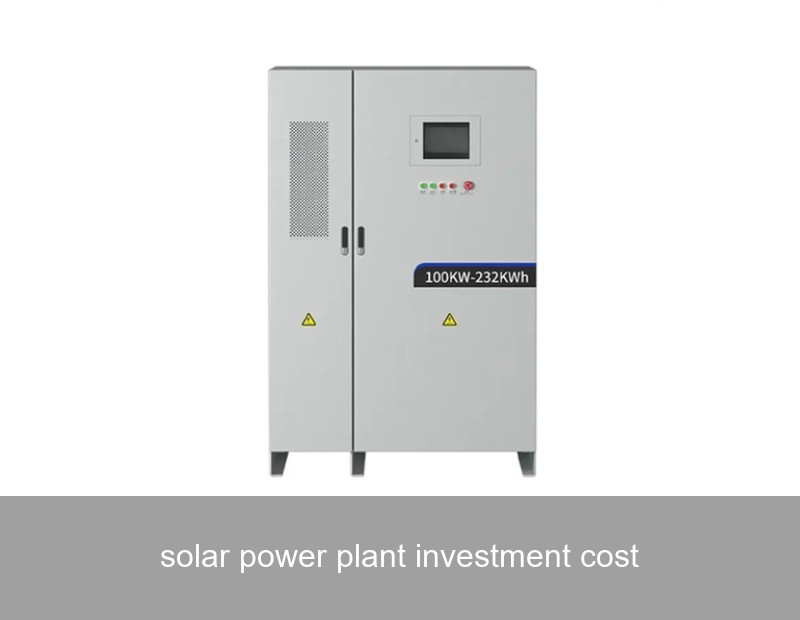
When you hear "solar power plant investment cost," what's the first figure that comes to mind? For many, it's the price per watt of the photovoltaic modules. But here's a truth seasoned developers know: the modules are just the opening chapter. The total investment is a complex equation where hardware meets software, initial capex battles long-term opex, and where an often-overlooked component—the battery energy storage system (BESS)—is becoming the most critical variable for profitability, especially in markets like Europe and the US. Let's peel back the layers.
The Solar Power Plant Investment Cost Breakdown: It's a Symphony, Not a Solo
Thinking of cost purely in terms of panels is like budgeting for a car by only considering the engine. A utility-scale solar plant is an ecosystem. The National Renewable Energy Laboratory (NREL) breaks down costs into several key categories, which we can simplify into two main buckets: the hard costs you see and the soft costs you manage.
| Cost Category | Typical Share of Total Cost | What It Includes |
|---|---|---|
| Hardware & Equipment (Hard Costs) | ~50-60% | PV modules, inverters, mounting structures, and the battery storage system. |
| Balance of System (BOS) & Installation | ~20-30% | Wiring, combiner boxes, transformers, site preparation, and labor. |
| Soft Costs | ~15-25% | Permitting, interconnection fees, engineering, legal, financing, and project management. |
While module prices have fallen dramatically, the soft costs and BOS have proven stickier. Furthermore, grid connection challenges are adding new layers of cost and complexity. This is where the investment narrative is shifting from just "building capacity" to "building intelligent, dispatchable assets."
The Hidden Cost of Curtailment: When Your Asset Can't Earn
Imagine your solar plant producing at peak capacity on a sunny afternoon, but the local grid is saturated. The grid operator asks you to reduce output—this is curtailment. You're losing potential revenue. In high-penetration areas like California or parts of Germany, curtailment is a growing reality, directly impacting the return on your solar power plant investment cost. The solution isn't just more panels; it's smarter energy management.
The Game Changer: How Battery Storage Reduces Lifetime Costs and Boosts ROI
This is the pivotal insight for modern investors. Integrating a battery energy storage system (BESS) transforms the economic model. Yes, it adds to the initial capital expenditure (capex). However, it drastically reduces the lifetime cost of energy and creates multiple, stacked revenue streams that a solar-only plant simply cannot access.
- Arbitrage: Store cheap solar energy at noon and sell it at high-price evening peaks.
- Curtailment Mitigation: Store excess energy that would have been turned away, monetizing every kilowatt-hour.
- Grid Services: Provide frequency regulation or capacity reserves, creating stable, contracted income.
- Increased Self-Consumption: For commercial/industrial plants, maximize on-site use, slashing demand charges.
This is precisely where Highjoule's expertise becomes critical. As a global leader since 2005, we don't just supply batteries; we provide intelligent, integrated storage solutions. Our H-Stack Commercial & Industrial (C&I) and Utility-Scale BESS are engineered with advanced energy management systems that autonomously optimize for these revenue streams. Think of it as adding a financial brain to your solar asset. By seamlessly coupling with your solar plant, our systems ensure you're not just saving costs but actively maximizing the financial return on every component of your investment.

Image Source: Unsplash. A modern utility-scale solar plant. The true investment cost now must account for how to maximize the value of all this generated power.
Real-World Insight: A 10MW Plant in Southern Spain
Let's move from theory to practice. Consider a 10MWp solar plant developed in Andalusia, Spain, in 2023. The region boasts excellent insolation but faces grid congestion during peak solar hours.
- Solar-Only Base Case: Initial investment cost: ~€7.2 million. Estimated annual revenue from a fixed feed-in tariff: ~€950,000. Projected curtailment losses: ~8% of generation.
- Solar + 2.5MW/5MWh BESS Integrated Case: Initial investment cost increased to ~€8.5 million (adding the Highjoule H-Stack system). However, by enabling energy arbitrage and virtually eliminating curtailment, the plant could increase its annual revenue by approximately 25%. More importantly, it secured a grid service contract for frequency response, adding a stable, non-weather-dependent income stream.
The analysis, using tools like NREL's System Advisor Model (SAM), showed the payback period for the added storage capex was under 5 years. Over the plant's 25-year lifespan, the Levelized Cost of Energy (LCOE) for the solar+storage configuration was lower, and the net present value (NPV) was significantly higher. The battery didn't just add cost; it fundamentally upgraded the asset's financial class.
Highjoule's Role in Such Projects
For a project like this, Highjoule's team provides end-to-end support. From the initial feasibility study and system sizing using our proprietary modeling tools, to supplying our containerized, UL-certified H-Stack BESS, and finally, commissioning and ongoing performance monitoring via our Highjoule Energy Cloud platform. This holistic service ensures the storage asset performs to its financial model, safeguarding the overall investment.
Future-Proofing Your Solar Investment Cost Strategy
The energy market is dynamic. Regulations change, electricity price volatility increases, and grid demands evolve. A solar plant built today must be resilient to these shifts.
Key Considerations for Your Financial Model:
- Degradation & Lifetime: Factor in panel degradation (~0.5%/year) and, crucially, battery cycle life and warranty. Highjoule's lithium iron phosphate (LFP) batteries are designed for 6,000+ cycles with minimal degradation.
- Software & Intelligence: The "brain" of your plant is a soft cost that delivers hard returns. An advanced energy management system (EMS) is non-negotiable.
- Scalability: Can you easily add more storage capacity later? Modular design, like that of our H-Stack series, allows for cost-effective future expansion.

Image Source: Unsplash. A technician inspecting a battery storage system. The quality and intelligence of the BESS are critical to long-term ROI.
Is Your Solar Investment Strategy Accounting for the Full Value Chain?
The conversation around solar power plant investment cost has matured. It's no longer a simple race to the lowest dollar-per-watt capex. It's a strategic exercise in designing an asset that delivers the lowest lifetime cost of energy and the highest possible value in an evolving market. By integrating intelligent storage from the outset, you're not just buying equipment; you're investing in revenue flexibility, grid relevance, and long-term resilience.
What single grid challenge or market opportunity in your target region could an integrated solar-plus-storage solution turn from a risk into your most compelling financial advantage?
 Inquiry
 Online Chat