


Understanding the Deye Grid Tie Energy Storage Cabinet: A Complete Guide
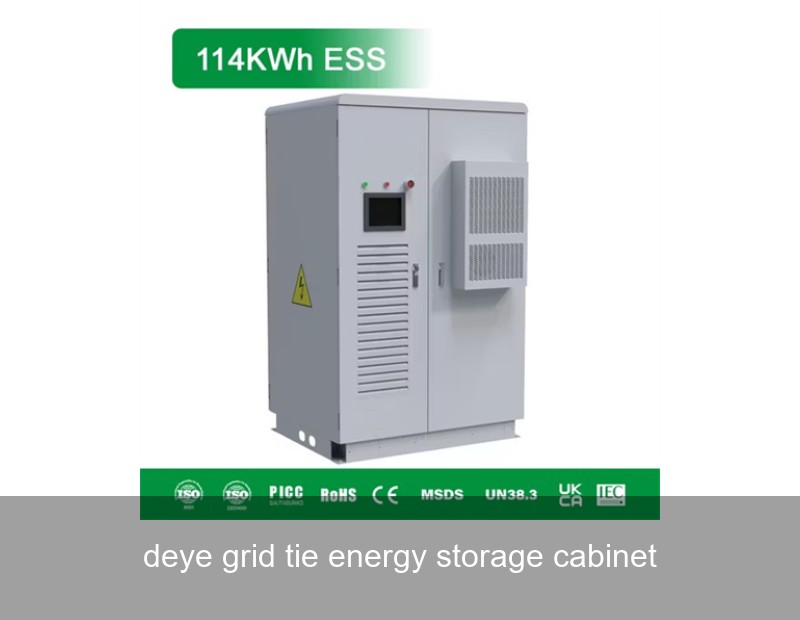
Have you ever wondered how businesses and large homeowners are not just surviving but thriving during grid instability and peak rate hours? The answer increasingly lies in a sophisticated piece of technology: the grid-tie energy storage cabinet. These systems are revolutionizing how we interact with the grid, turning passive consumers into proactive energy managers. For commercial and industrial entities, this isn't just about backup power; it's a strategic financial tool. In this deep dive, we'll explore the Deye grid tie energy storage cabinet, its benefits, and how integrating such advanced technology with a holistic energy strategy can unlock unprecedented value and resilience.
Table of Contents
- What is a Deye Grid Tie Energy Storage Cabinet?
- The Problem: Grid Instability and Soaring Energy Costs
- Case Study: A European Manufacturing Plant's Success
- Key Components and How It Works
- Highjoule's Expertise: Beyond the Cabinet
- The Future of Grid-Tied Storage
What is a Deye Grid Tie Energy Storage Cabinet?
Let's demystify the term. A Deye grid tie energy storage cabinet is a pre-assembled, large-scale battery energy storage system (BESS) designed to seamlessly integrate with the electrical grid and on-site generation, like solar PV arrays. Unlike an off-grid system, it works in concert with the utility grid. The "cabinet" refers to its all-in-one, containerized design, housing lithium-ion battery modules, a built-in inverter/charger, a battery management system (BMS), thermal controls, and safety mechanisms. Deye, as a leading inverter and BESS manufacturer, provides the core hardware. However, the true potential of a Deye energy storage cabinet is unlocked through expert system design, integration, and intelligent energy management software—this is where a provider like Highjoule becomes critical.

Image: A modern industrial energy storage system installation. Source: Unsplash (Representative image)
The Problem: Grid Instability and Soaring Energy Costs
Across Europe and the United States, two parallel phenomena are pushing energy to the top of the operational risk register. First, aging grid infrastructure is struggling with the dual demands of extreme weather events and the influx of intermittent renewable energy, leading to more frequent brownouts and voltage fluctuations. Second, energy pricing structures have evolved. Time-of-Use (TOU) rates and demand charges—fees based on your highest 15-minute power draw in a billing cycle—can constitute up to 50% of a commercial electricity bill.
The traditional response, diesel generators, only addresses backup. They don't help with daily cost savings and come with emissions, noise, and maintenance burdens. There's a clear need for a smarter, cleaner, and more profitable solution.
The Data: Why Storage is Now a Financial Imperative
The business case for grid-tie energy storage is backed by compelling data. According to the U.S. Energy Information Administration, commercial electricity prices have seen consistent volatility and upward trends (EIA, 2023). In Europe, the 2022 energy crisis dramatically highlighted dependency and cost issues.
Here’s how a system like a Deye cabinet directly tackles costs:
- Demand Charge Management: The system discharges battery power during short periods of peak facility demand, "shaving" the peak draw from the grid, potentially reducing demand charges by 20-40%.
- Arbitrage: It stores cheap electricity from the grid or solar panels during off-peak hours (or when solar production is high) and uses it during expensive peak hours.
- Grid Services: In some markets, systems can provide frequency regulation or capacity services to the grid operator, generating new revenue streams.
| Financial Benefit | Mechanism | Potential Impact |
|---|---|---|
| Reduced Demand Charges | Peak Shaving | 20-40% savings on that portion of the bill |
| Reduced Energy Costs | Time-of-Use Arbitrage | Shift 80%+ of load from peak to off-peak rates |
| Increased Solar Self-Consumption | Store excess daytime solar | Increase on-site use of solar from ~30% to 70%+ |
| Backup Power | Island mode operation | Critical load support during outages |
Case Study: A German Automotive Parts Manufacturer
Let's look at a real-world application. A mid-sized automotive supplier in Bavaria, Germany, faced steep demand charges and wanted to optimize its 500 kW rooftop solar array. Their goal was to improve energy resilience against grid fluctuations and reduce operational costs.
The Solution: Highjoule designed and deployed a turnkey system centered around a Deye grid tie energy storage cabinet with 400 kWh of usable capacity and a 250 kW inverter. The system was integrated with the existing solar PV and the facility's energy management system. Highjoule's proprietary AI-driven software platform, Highjoule Neuron, was implemented to autonomously control the charge/discharge cycles based on real-time electricity prices, solar forecast, and production schedules.
The Results (12-month period):
- Demand Charge Reduction: 28% average reduction, saving over €18,000 annually.
- Solar Self-Consumption: Increased from 35% to 82%, drastically reducing grid import.
- ROI: The project achieved a simple payback period of under 5 years, factoring in German subsidy programs for commercial storage.
- Resilience: The system provided seamless backup for critical manufacturing lines during two brief grid disturbances, preventing an estimated €50,000 in production downtime.
This case illustrates that a Deye energy storage cabinet is not just hardware; it's the heart of an intelligent energy ecosystem.
Key Components and How It Works
Understanding the internal architecture clarifies its robustness. The cabinet is a marvel of integration:
- Lithium-Ion Battery Modules (Typically LFP): Lithium Iron Phosphate chemistry is preferred for its safety, long cycle life (6,000+ cycles), and stability. These are the workhorses storing the energy.
- Hybrid Inverter/Charger (Deye): This bidirectional device is the brain. It converts DC from the batteries or solar to AC for the building, and AC from the grid to DC to charge the batteries, all while maintaining perfect grid synchronization.
- Battery Management System (BMS): The guardian. It monitors every cell for voltage, temperature, and state of charge, ensuring safety, longevity, and performance.
- Power Conversion System (PCS) & Controls: Manages the overall power flow and includes the critical grid-tie protection that automatically disconnects during a blackout (anti-islanding) before switching to backup mode.
The operational logic is smart yet elegant. On a typical day, the Highjoule control software charges the cabinet with mid-day solar surplus. As the evening peak period approaches and grid prices spike, the system dispatches the stored energy to power the facility, avoiding expensive grid imports and high demand peaks.

Image: Technical monitoring of an energy storage system's performance. Source: Unsplash (Representative image)
Highjoule's Expertise: Beyond the Cabinet
As a global leader since 2005, Highjoule's role transcends supplying equipment. We provide intelligent, efficient, and sustainable power solutions. Selecting a Deye grid tie energy storage cabinet is a great first step, but its configuration, integration, and long-term optimization are where the real value is created—or lost.
Our service offering includes:
- Feasibility & Financial Modeling: We analyze your load profiles, utility bills, and solar data to precisely size the system for maximum ROI, not just maximum capacity.
- Turnkey Design & Integration: Our engineers handle the entire process—electrical design, permitting, grid interconnection agreements, and seamless integration with existing infrastructure.
- Highjoule Neuron AI Software: This is our differentiator. Our platform uses machine learning to predict energy usage and market prices, making real-time, profit-optimizing decisions for your storage system.
- Ongoing Performance Management & Warranty: We offer remote monitoring, proactive maintenance, and comprehensive warranties to ensure your system performs optimally for its entire 15+ year lifespan.
Think of Highjoule as the conductor, ensuring the Deye energy storage cabinet performs in perfect harmony with your solar, your grid connection, and your financial goals.
The Future of Grid-Tied Storage and Your Next Step
The trajectory is clear. As noted by the International Energy Agency, energy storage is a cornerstone of the net-zero transition, with global grid-scale capacity set to multiply 35-fold by 2030 (IEA, 2023). Technologies like virtual power plants (VPPs), where thousands of distributed systems like yours are aggregated to act as a single power plant, are emerging. A Deye grid tie energy storage cabinet installed today is a future-proof asset that can participate in these new market opportunities, especially when paired with an advanced software platform like Highjoule Neuron.
The question is no longer if commercial and industrial energy users should consider storage, but how to implement it most effectively. With volatile energy markets becoming the new normal, how will you transform your energy profile from a fixed cost into a strategic, controllable, and revenue-generating asset?
What would a detailed analysis of your facility's last 12 months of utility bills reveal about your potential for savings and resilience with a tailored energy storage solution?
 Inquiry
 Online Chat