


Practical Solutions to Renewable Energy Problems: A Guide for a Stable Clean Future
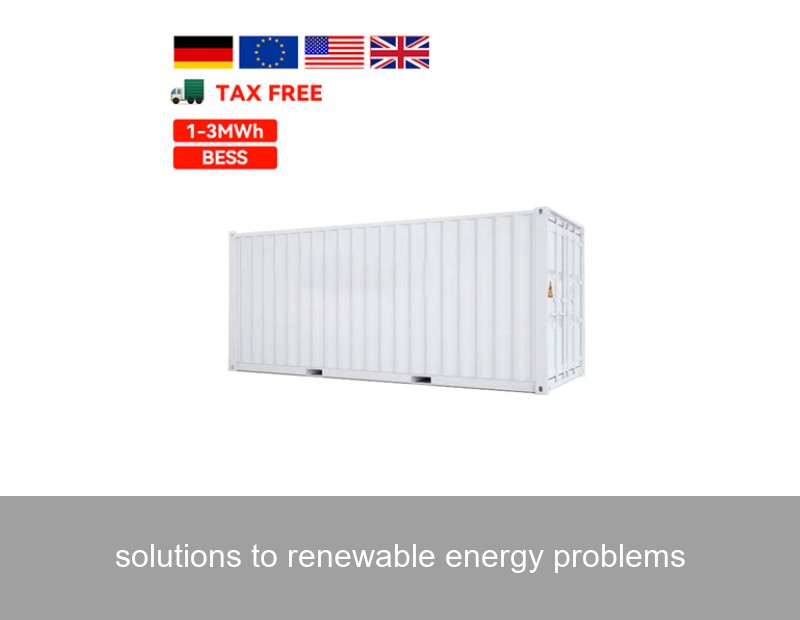
You've likely seen the headlines: solar and wind power are breaking records, driving down costs, and leading the charge toward a decarbonized grid. But as a homeowner, business manager, or community leader, you might also have heard about the challenges—what happens when the sun doesn't shine or the wind doesn't blow? This intermittent nature is one of the most cited solutions to renewable energy problems we must address. The good news is, the technology to solve these issues isn't a distant dream; it's available today. The key lies in intelligent energy storage and management, transforming problems into opportunities for resilience and savings. Companies like Highjoule, a global leader in advanced energy storage systems since 2005, are at the forefront of delivering these critical solutions to renewable energy problems for commercial, industrial, residential, and microgrid applications.
Table of Contents
- The Core Problem: Intermittency and Grid Strain
- The Data: Why Storage is No Longer Optional
- Case Study: A German Manufacturing Plant's Journey to Resilience
- Technology Solutions: From Batteries to Brainpower
- Highjoule's Integrated Approach to Renewable Challenges
- The Future Grid: Decentralized and Intelligent
The Core Problem: Intermittency and Grid Strain
Let's face it, renewable sources like solar PV and wind are weather-dependent. This creates a fundamental mismatch: energy generation peaks often don't align with energy demand peaks. A sunny afternoon might produce a solar surplus, while evening demand is met by fossil fuels. This intermittency poses a dual challenge: it can lead to curtailment (wasting clean energy) and forces reliance on carbon-intensive "peaker" plants during gaps. Furthermore, as more renewables connect to the grid, they can cause voltage and frequency instability, creating headaches for grid operators. The question, therefore, shifts from simply generating clean energy to managing it intelligently.

Image Source: Unsplash - Visual representation of renewable energy sources subject to weather conditions.
The Data: Why Storage is No Longer Optional
The numbers paint a clear picture of both the challenge and the opportunity. According to the International Renewable Energy Agency (IRENA), to meet global climate goals, the world needs up to 14 times more energy storage capacity by 2030. In the U.S., the Department of Energy's "Long-Duration Storage Shot" aims to reduce the cost of grid-scale storage by 90% within a decade. Why this urgency? Because storage is the linchpin. Consider this: in 2023, California, a renewable leader, had to curtail over 2.4 million megawatt-hours of primarily solar and wind energy—enough to power around 250,000 homes for a year—due to insufficient transmission and storage. This isn't just a technical problem; it's an economic and environmental one.
Case Study: A German Manufacturing Plant's Journey to Resilience
Let's make this concrete with a real-world example. A mid-sized automotive parts manufacturer in Bavaria, Germany, faced a classic dilemma. They had invested in a 1.5 MW rooftop solar array, significantly reducing daytime energy costs. However, their highest energy consumption occurred in the early morning and late afternoon, outside peak solar production. They relied heavily on the grid, exposing them to volatile European energy prices and carbon taxes.
The Solution & Implementation: In 2022, they partnered with Highjoule to deploy a turnkey Highjoule Industrial Battery Energy Storage System (BESS). The system included:
- A 2 MWh lithium-ion battery bank.
- Highjoule's proprietary Adaptive Power Management (APM) software.
- Advanced grid-interactive inverters for seamless bi-directional flow.
The APM software intelligently schedules energy flow: storing excess solar generation midday, discharging during high-price evening peaks, and even providing frequency regulation services to the grid for additional revenue.
The Results (Data after 18 months):
| Metric | Before Highjoule BESS | After Highjoule BESS |
|---|---|---|
| Grid Energy Dependency | 65% | 28% |
| Energy Cost Savings | Baseline | 41% reduction |
| On-Site Renewable Utilization | ~72% | ~98% |
| Carbon Footprint Reduction | From Solar Alone | Additional 34% reduction |
This case demonstrates that the right storage solution doesn't just "store energy"; it optimizes an entire energy ecosystem, delivering financial and operational resilience.
Technology Solutions: From Batteries to Brainpower
So, what are the core technological solutions to renewable energy problems? They fall into a few key categories:
1. Advanced Battery Energy Storage Systems (BESS)
Modern lithium-ion batteries, particularly Lithium Iron Phosphate (LFP), offer high efficiency, long cycle life, and declining costs. They are the workhorses for short- to medium-duration storage (hours to a full day), perfect for daily solar shifting and peak shaving.
2. Intelligent Energy Management Software
This is the "brain." Hardware alone is inert. Software like Highjoule's APM platform uses AI and real-time data (energy prices, weather forecasts, consumption patterns) to make autonomous decisions on when to charge, discharge, or hold. It's the difference between having a battery and having a smart energy partner.
3. Hybrid and Multi-Technology Systems
Sometimes, one technology isn't enough. Combining solar PV with wind, and coupling them with both battery storage (for immediate response) and perhaps a backup generator (for long-term resilience), creates a robust microgrid. These systems can operate connected to or independently from the main grid ("island mode").

Image Source: Unsplash - A technician performing checks on a large-scale battery storage installation.
Highjoule's Integrated Approach to Renewable Challenges
At Highjoule, we don't just sell components; we deliver integrated solutions to renewable energy problems. Our expertise, honed since 2005, lies in designing systems that address the specific pain points of each client segment.
- For Homes: Our Residential Energy Hub seamlessly integrates with rooftop solar, allowing homeowners to maximize self-consumption, secure backup power during outages, and reduce reliance on the grid. Its user-friendly app puts energy control in the palm of your hand.
- For Business & Industry: Our scalable Commercial & Industrial BESS solutions, like the one deployed in Germany, are engineered for demanding applications. They provide peak shaving, demand charge reduction, power quality improvement, and can even create new revenue streams through grid services.
- For Utilities and Microgrids: We provide large-scale, grid-connected storage systems that enhance stability, defer costly infrastructure upgrades, and enable higher penetration of renewables. Our microgrid controllers can orchestrate diverse distributed energy resources (DERs) into a single, reliable network.
Our systems are built with safety, longevity, and total cost of ownership as primary design criteria, ensuring they are not just effective but also a sound long-term investment.
The Future Grid: Decentralized and Intelligent
The ultimate solutions to renewable energy problems point toward a fundamental shift: from a centralized, one-way grid to a decentralized, interactive network of "prosumers" (producer-consumers). In this future, millions of assets—home batteries, EV chargers, industrial systems—will be aggregated into virtual power plants (VPPs). These VPPs can provide grid services more efficiently than traditional power plants. Highjoule's technology is inherently designed for this future, with communication protocols and software intelligence that allow our distributed systems to contribute to grid health while prioritizing the owner's needs.
As the National Renewable Energy Laboratory (NREL) emphasizes, storage is the critical enabler of this transition. The journey involves not just technology adoption, but also supportive policy frameworks and market designs that recognize the value of flexibility.
 Inquiry
 Online Chat