


Solar Urja Plant: How Much Energy Can It Really Generate for You?
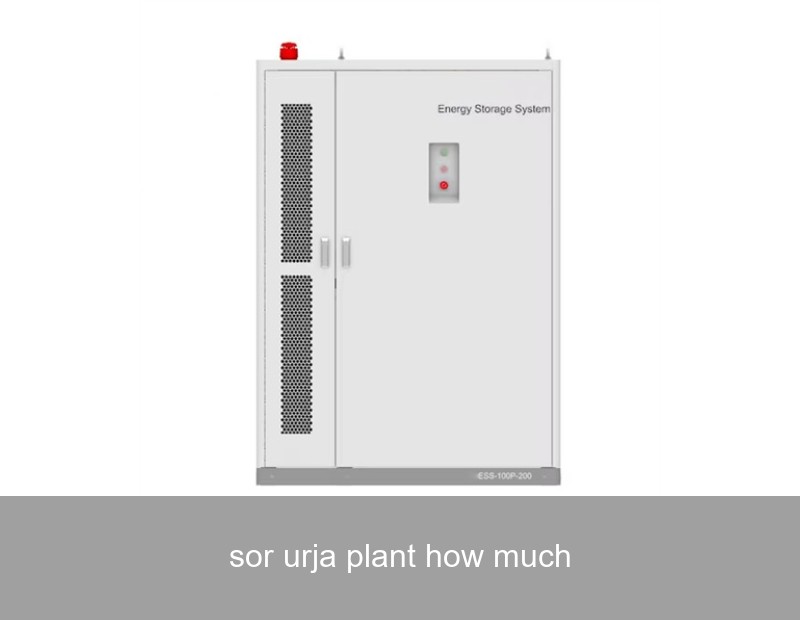
If you're considering investing in a solar power system, whether for your home, business, or community, one question inevitably rises to the top: "Solar urja plant how much?" How much power will it produce? How much will it save me? How much space does it need? The answer, as with many things in energy, is "it depends," but not in an unhelpful way. Understanding the factors behind solar output empowers you to make a smart, data-driven decision. As a global leader in advanced energy storage since 2005, Highjoule has partnered on countless solar projects, and we know that maximizing the return on your solar investment hinges on asking the right "how much" questions from the start.
Key Factors Influencing "How Much" Energy You Get
Think of your solar plant as a sophisticated crop. Its yield (energy) depends on the quality of the seeds, the fertility of the soil, and the local climate. Let's break down the key variables:
- Solar Irradiance & Location: This is your "sunlight fuel." A rooftop in Arizona will naturally harvest more energy than one in Scotland. Tools like the Global Solar Atlas provide excellent preliminary data for specific regions.
- System Size & Panel Efficiency: Measured in kilowatts-peak (kWp), this is your plant's potential capacity. Higher-efficiency panels (like monocrystalline) generate more power per square meter, crucial for space-constrained sites.
- Orientation and Tilt: In the Northern Hemisphere, south-facing arrays at an angle matching the latitude typically capture the most annual energy.
- Shading and Soiling: Even partial shading from a chimney or tree can disproportionately reduce output. Regular cleaning is also essential, especially in arid, dusty environments.
- System Losses & Inverter Efficiency: Energy is lost in cables, due to heat, and during the DC-to-AC conversion by the inverter. A high-quality system minimizes these losses.

Image Source: Unsplash - A utility-scale solar plant, where precise calculations of 'how much' energy are critical for grid contracts.
Putting It Into Numbers: A Simple Estimation Table
| System Size (kWp) | Good Sun Region (Yearly kWh/kWp)* | Moderate Sun Region (Yearly kWh/kWp)* | Estimated Annual Production (Good Sun) |
|---|---|---|---|
| 5 kWp (Residential) | 1,400 - 1,600 kWh | 900 - 1,100 kWh | 7,000 - 8,000 kWh |
| 100 kWp (Commercial) | 1,400 - 1,600 kWh | 900 - 1,100 kWh | 140,000 - 160,000 kWh |
| 10 MWp (Industrial) | 1,400 - 1,600 kWh | 900 - 1,100 kWh | 14 - 16 Million kWh |
*Example values based on generalized conditions. A professional site assessment is essential for accurate figures.
A Real-World Case Study: From Theory to Practice
Let's move beyond theory. Consider a mid-sized dairy processing facility in Bavaria, Germany—a region with moderate solar potential. They installed a 850 kWp rooftop and ground-mounted solar plant. Based on initial modeling, they expected an annual yield of approximately 850,000 kWh.
The Challenge: Their production was highly variable. On bright summer days, the plant would generate a surplus, often exporting it to the grid at low feed-in tariffs. On cloudy days and at night, they were forced to buy expensive peak electricity from the utility. They weren't fully optimizing their self-consumption or protecting against volatile energy prices. The question became: "How much of our self-generated energy can we actually use, and how much do we need to store?"
The Data-Driven Solution: The facility partnered with Highjoule to integrate a 500 kWh battery energy storage system (BESS). This system was powered by Highjoule's IntelliGrid software platform, which uses AI to forecast solar production and facility load.
The Result: The BESS stores midday solar excess and discharges it during evening operational peaks. Their self-consumption rate jumped from 35% to over 80%. They now avoid the highest grid tariffs, shield themselves from price spikes, and have gained backup power for critical cooling processes. The combined solar + storage system is projected to pay for itself in under 7 years, a figure that improved significantly with rising grid electricity costs. You can explore more on the importance of storage for grid stability from the International Renewable Energy Agency (IRENA).
Beyond Generation: The Critical Role of Energy Storage
This case highlights the paradigm shift in solar energy. The most valuable question is no longer just "solar urja plant how much generation?" but rather "solar urja plant how much usable, reliable, and cost-effective energy?" This is where energy storage becomes non-negotiable.
- Maximizing Self-Consumption: Store your cheap solar power for use when you need it most.
- Providing Resilience: Keep critical operations running during grid outages, a growing concern for businesses and communities alike.
- Enabling Energy Independence: Reduce your reliance on the public grid and its fluctuating prices.

Image Source: Unsplash - A battery storage system, the key to unlocking the full value of solar generation.
How Highjoule Transforms Solar Potential into Reliable Power
For nearly two decades, Highjoule has been answering the complex "how much" questions for our commercial, industrial, and microgrid clients. We don't just provide components; we deliver integrated, intelligent power solutions.
Our H-Series Commercial & Industrial Battery Systems are engineered for high-cyclability and safety, seamlessly coupling with new or existing solar installations. Paired with our IntelliGrid Energy Management System (EMS), the system becomes predictive, not just reactive. It learns your consumption patterns, uses weather forecasts, and can even respond to grid signals (where available) to optimize every kilowatt-hour for maximum financial return.
For larger-scale or off-grid applications, our Microgrid Controllers can orchestrate a mix of solar, storage, and even backup generators as a single, resilient virtual power plant. This is how we ensure that the theoretical output of your solar urja plant translates into tangible, controllable, and sustainable power for your specific needs. Learn about technological advancements from trusted sources like the U.S. Department of Energy's Solar Energy Technologies Office.
Making the Right Choice for Your Energy Needs
So, how do you start answering "solar urja plant how much" for your own situation? Begin with a professional energy audit. Look at your past utility bills to understand your load profile. Then, partner with a provider who thinks beyond the panels to the entire energy ecosystem.
The future of energy is not just about generation; it's about intelligent control and storage. As you contemplate your solar journey, what specific energy challenge—be it rising costs, reliability concerns, or sustainability goals—is driving you to seek an answer today?
 Inquiry
 Online Chat