


Demystifying Standard Solar ESS Sizes: Your Guide to a Perfect Fit
So, you're considering a solar energy storage system (ESS). It's a brilliant move for energy independence and sustainability. But if you've started your research, you've likely encountered a bewildering array of battery sizes, capacities, and configurations. Terms like 5kW/10kWh or 10kW/20kWh are thrown around, but what do these standard solar ESS sizes actually mean for your home or business? More importantly, how do you choose the right one? Let's cut through the confusion. This guide will explain the common standards, why they exist, and how to match them to your real-world energy needs, ensuring your investment delivers maximum value.
Table of Contents
Why Standard Solar ESS Sizes Exist: The Backbone of an Industry
Imagine if every car manufacturer used completely unique, incompatible tires. Chaos, right? The evolution of standard solar ESS sizes follows a similar logic. In the early days, systems were highly custom, complex, and costly. As the market matured, manufacturers like Highjoule identified common customer needs—backup power for essential circuits, whole-home coverage, or maximum self-consumption of solar. Packaging proven battery chemistry and inverter technology into standardized units brings several key benefits: it streamlines installation, improves reliability through mass testing, reduces costs via economies of scale, and makes system comparisons easier for consumers.

Image Source: Unsplash - A standardized ESS allows for a clean, modular installation.
Decoding the Specs: Understanding kW vs. kWh
This is the most critical concept. Confusing power (kW) and energy (kWh) is like mixing up the top speed of a hose (how fast water comes out) with the size of its tank (how much water it holds).
- Power (kW, kilowatts): This is the rate at which your system can deliver electricity at any single moment. It determines how many appliances you can run simultaneously from the battery. A 5kW inverter can power more than a 3kW one.
- Energy (kWh, kilowatt-hours): This is the total capacity or "fuel in the tank." It determines how long you can run those appliances. A 10kWh battery will power a 1kW load for 10 hours, or a 2kW load for 5 hours.
A standard size is always expressed as a pair: Inverter Power (kW) / Battery Energy (kWh). For example, a common standard solar ESS size is "5kW / 10kWh." This means the system can deliver up to 5kW of instantaneous power and has 10kWh of total stored energy available.
Common Residential Standard Sizes and Their Best Uses
Based on typical household energy profiles, several standard sizes have emerged as market favorites. Here’s a breakdown:
| System Size (Power/Energy) | Typical Daily Backup | Best For | Key Considerations |
|---|---|---|---|
| 3kW / 5-6kWh | Critical loads (fridge, lights, modem) for 8-12 hours. | Small homes, essential backup, budget-conscious buyers. | May not run large HVAC systems. Ideal for time-of-use bill shifting in smaller homes. |
| 5kW / 10-13.5kWh | Most household circuits for 12-24 hours. | The "sweet spot" for average 3-4 bedroom homes. Balances cost and capability. | Can often handle a well pump or central AC for limited periods. Excellent for maximizing solar self-consumption. |
| 8-10kW / 15-20+kWh | Whole-home backup for 1+ days, depending on usage. | Larger homes, electric vehicle owners, areas with frequent/long outages. | Higher upfront cost but provides greater energy security and independence. |
It's important to remember that these are modular building blocks. At Highjoule, our H-Joule HomePower series, for instance, is designed around a scalable 5kWh battery module and intelligent inverters. This means you can start with a standard 5kW/10kWh system and seamlessly add more battery modules later as your needs evolve—a flexibility that rigid, non-standard systems simply cannot offer.
From Theory to Practice: A California Case Study
Let's look at real data. The National Renewable Energy Lab (NREL) has extensively studied residential storage. In a 2023 report, they analyzed a typical Northern California home with a 7kW solar array and an average daily consumption of 20kWh.
Phenomenon: The homeowner faced steep time-of-use rates and wanted backup for occasional grid outages.
Data: NREL modeling showed that a standard solar ESS size of 5kW/13.5kWh increased the home's solar self-consumption from ~40% to over 80%. It could shift nearly all peak evening load to stored solar energy.
Case: The homeowner installed such a system. During a planned safety power shutoff (PSPS) event lasting 18 hours, the system maintained all critical loads, including refrigeration, lighting, and internet, with 35% capacity remaining at grid restoration.
Insight: The data-driven choice of a mid-sized standard system provided optimal economic payback (through bill savings) and met resilience goals, proving that bigger isn't always better—smarter is.
Beyond the Home: Commercial & Industrial Standard Sizes
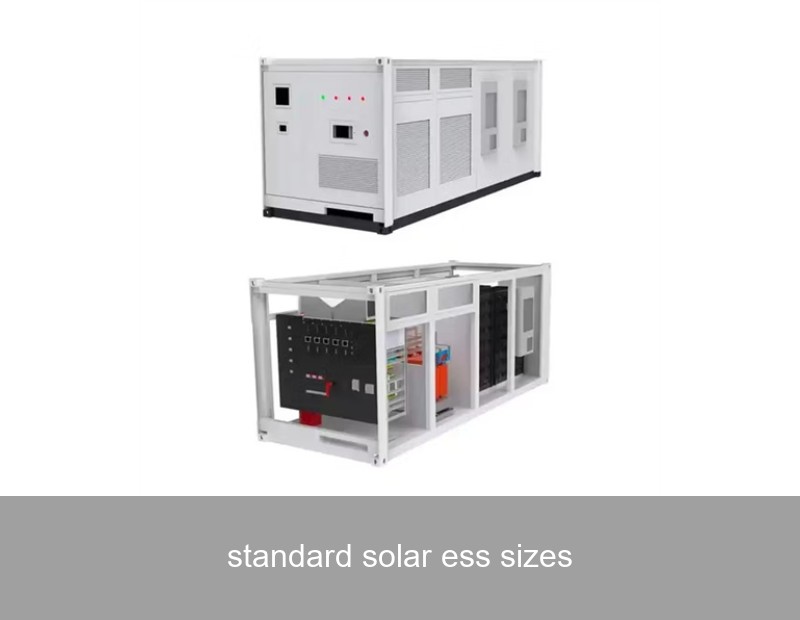
The concept of standardization scales up. For commercial and industrial (C&I) applications, standard solar ESS sizes are often built from larger, containerized or skid-mounted units. Common C&I blocks might start at 50kW/100kWh and scale to multiple megawatts (MW). These systems address different needs: demand charge reduction, power quality management, and renewable integration for microgrids. Highjoule's H-Joule GridMax series exemplifies this, offering pre-engineered, containerized solutions from 250kWh to multi-MWh. These standardized yet configurable platforms drastically reduce project complexity and deployment time for businesses and utilities, while ensuring robust performance and safety.

Image Source: Unsplash - Containerized ESS units represent standardization at the utility/commercial scale.
The Highjoule Approach: Intelligence Within the Standard
At Highjoule, we believe a standard size should be the starting point for intelligence, not a limitation. While we offer products aligned with common market sizes, what truly differentiates our systems is the software that manages them. Our Adaptive Energy Operating System (AEOS) turns a standard hardware configuration into a dynamic energy asset. It doesn't just store and release energy; it learns your patterns, forecasts weather and solar production, and automatically chooses the optimal strategy—whether it's maximizing self-consumption, navigating time-of-use rates, or providing backup—without you lifting a finger. This means you get more value out of every kilowatt-hour stored in your battery, regardless of its standard size.
How to Choose the Right Standard Solar ESS Size For You
Forget the "one-size-fits-all" myth. Follow this logical ladder to find your fit:
- Audit Your Energy Goals: Is your primary driver bill savings, backup power, or environmental impact? Quantify it. How many kWh do you use on a typical day and during peak times? (Your utility bill is key here.)
- List Your Critical Loads: For backup, what must stay on? Sump pump, medical equipment, refrigerator? Calculate their total wattage and expected runtime.
- Analyze Your Solar: A large solar array can recharge a larger battery more effectively. Your ESS size should be in harmony with your PV generation.
- Consider Future Needs: Planning an EV, a heat pump, or a home addition? Opt for a modular, scalable system like Highjoule's that can grow with you.
- Consult a Professional: A certified installer can perform a detailed load analysis and model different standard solar ESS sizes against your historical usage data. This is the most reliable path to a perfect match.
The journey to energy independence is exciting. With the clarity on standard solar ESS sizes you now have, what's the first question you'll ask when discussing your project with an installer?
 Inquiry
 Online Chat