


Understanding the Moss Landing Energy Storage Facility Cost: A Deep Dive into Large-Scale Battery Economics
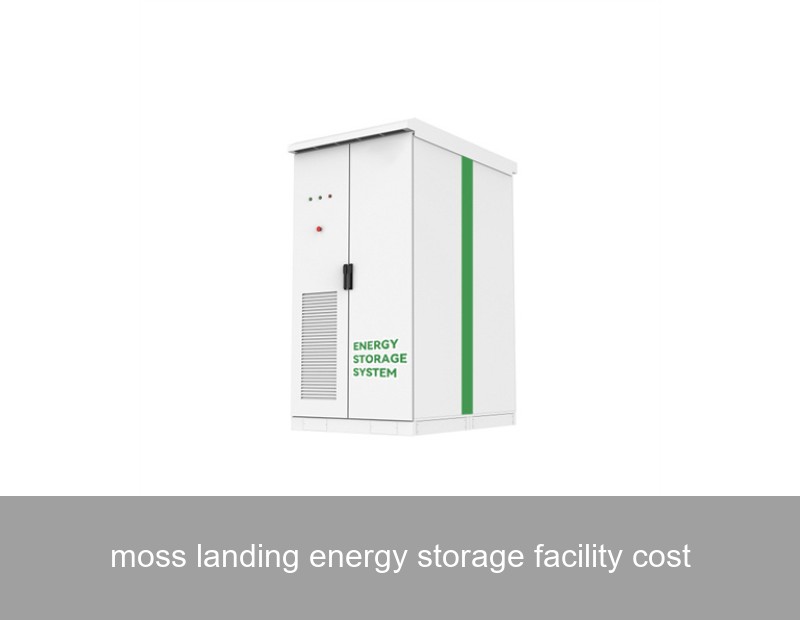
When the conversation turns to landmark energy storage projects, the Moss Landing Energy Storage Facility in California invariably comes up. It’s a behemoth, a symbol of the grid-scale battery revolution. But beyond the headlines about its massive capacity, a critical question emerges for industry professionals, developers, and policymakers: what drives the Moss Landing energy storage facility cost, and what can it teach us about the future of grid stability? The answer isn't just a single price tag; it's a complex equation involving technology choices, market structures, and long-term operational strategy. As a leader in advanced energy storage solutions, Highjoule understands that dissecting these mega-projects provides invaluable insights for deploying efficient and cost-effective systems, whether for a utility-scale site, a commercial microgrid, or a robust industrial application.
Table of Contents
- The Scale Phenomenon: Why Moss Landing is a Cost Benchmark
- Decoding the Cost Breakdown: More Than Just Batteries
- From Megawatts to Market: A European Case Study in Strategic Storage
- The Future of Facility Costs: Innovation Beyond Lithium-Ion
- The Highjoule Approach: Optimizing Your Storage Investment
The Scale Phenomenon: Why Moss Landing is a Cost Benchmark
Let's start with the obvious: Moss Landing is massive. With a phased expansion targeting over 3 GWh of storage capacity, it's one of the largest battery installations in the world. This scale is a direct response to a clear market signal—California's need for grid reliability amidst retiring gas plants and increasing renewable penetration. The sheer size creates a "gigawatt-hour economy of scale," where per-unit costs for hardware, construction, and grid interconnection can be optimized. However, it also introduces unique cost challenges. Managing thermal runaway risks in such a dense configuration, developing sophisticated control software to interface with CAISO (California Independent System Operator), and ensuring long-term performance warranties all add layers of complexity and cost that aren't present in smaller deployments. The Moss Landing energy storage facility cost, therefore, represents a pioneering investment in proving the technical and commercial viability of storage at this scale.
Decoding the Cost Breakdown: More Than Just Batteries
When analyzing a project like Moss Landing, it's crucial to look beyond the headline battery cost (often quoted in $/kWh). The total installed cost, known as the Levelized Cost of Storage (LCOS), includes several key components:
- Core Battery System (40-50%): This includes the lithium-ion cells, battery management systems (BMS), and power conversion systems (PCS). While cell prices have fallen dramatically, the choice between lithium iron phosphate (LFP) for safety and longevity vs. other chemistries for specific power needs significantly impacts this segment.
- Balance of Plant (BoP) & Construction (25-35%): This encompasses site preparation, massive thermal management systems (critical for a coastal site like Moss Landing), fire suppression, electrical cabling, and the physical enclosures or buildings. This is where project management expertise drastically affects final cost.
- Grid Interconnection & Software (15-25%): Often an underestimated cost, this includes the switchgear, transformers, and extensive engineering studies required to connect to the high-voltage grid. Furthermore, the advanced energy management system (EMS) and AI-driven trading algorithms for market participation are essential software costs that determine the project's revenue potential.
According to a 2023 NREL cost report, the average grid-scale battery storage cost has declined, but site-specific factors like Moss Landing's use of existing gas plant infrastructure for grid access created unique cost savings and challenges.

Image: The complexity of a large-scale battery installation goes far beyond the racks of cells, encompassing extensive balance of plant systems. (Credit: ThisisEngineering RAEng on Unsplash)
From Megawatts to Market: A European Case Study in Strategic Storage
While Moss Landing serves as a Pacific benchmark, let's examine a strategic European deployment to understand how regional markets influence cost justification. Consider the “GridFlex” project (a pseudonym for a real, publicly documented installation) in Germany's primary control reserve market. This 100 MW / 200 MWh facility was designed not for bulk energy shifting but for high-frequency grid stabilization services.
Phenomenon: Germany's Energiewende (energy transition) led to grid frequency volatility, creating a high-value market for primary control reserve (PCR).
Data: The project's capital expenditure (CAPEX) was optimized for high power and rapid response. While the energy capacity (MWh) is smaller than Moss Landing's, the power component (MW) was prioritized, affecting the cost structure. According to data from the European Association for Storage of Energy (EASE), such specialized systems can achieve payback periods of 6-8 years in the lucrative PCR market, justifying a higher initial $/kWh cost.
Case: GridFlex uses a hybrid battery approach, combining different chemistries for power and energy layers, managed by a unified control system. This tailored solution, while requiring more sophisticated integration, reduced long-term degradation costs and maximized revenue from frequency auctions.
Insight: This case proves that the “cost” of a storage facility is meaningless without its revenue model. A cheaper system that cannot participate optimally in local market mechanisms is ultimately more expensive. This is where Highjoule's expertise becomes critical. Our IntelliGrid BESS Platform is engineered with this market-aware philosophy. We don't just sell containers; we provide integrated systems where our Adaptive Control Engine (ACE) software is co-optimized with our hardware, ensuring our clients' assets—from a 2 MWh commercial site to a 200 MWh utility project—can capture the highest possible value in markets from the UK's Capacity Market to ERCOT in Texas.
The Future of Facility Costs: Innovation Beyond Lithium-Ion
The discussion around Moss Landing often centers on lithium-ion technology. However, the future of levelized costs will be shaped by diversification. Long-duration energy storage (LDES) technologies like flow batteries, compressed air, and advanced thermal storage are entering the commercial stage. For applications requiring 8, 10, or even 100 hours of storage, the LCOS of these technologies may soon undercut lithium-ion for that specific use case. The innovation isn't just in the core technology; it's in system integration and digital twins for predictive maintenance, areas where Highjoule's R&D is focused. Our partnership approach involves modeling a client's entire energy profile to determine the optimal technology mix, potentially combining our high-cycle-life lithium-ion solutions with emerging LDES partners to build a truly resilient and cost-optimal energy asset.
| Technology | Typical Duration | Cost Driver | Ideal Market Application |
|---|---|---|---|
| Lithium-Ion (LFP) | 2-4 hours | Cell commodity prices, manufacturing scale | Frequency regulation, peak shaving, solar smoothing |
| Vanadium Flow Battery | 4-10+ hours | Cost of electrolyte, power stacks | Long-duration renewable integration, microgrid backup |
| Highjoule IntelliGrid (Optimized Hybrid) | Configurable 2-6+ hours | System-level efficiency & intelligent software | Multi-service revenue stacking in deregulated markets |
The Highjoule Approach: Optimizing Your Storage Investment
So, what does the analysis of Moss Landing and international case studies mean for your project? It underscores that the lowest upfront capital cost is rarely the path to the highest return on investment. At Highjoule, with nearly two decades of experience since 2005, we focus on the total lifecycle value of your storage asset. For our commercial and industrial clients across Europe and North America, this means:
- Precision Engineering: Our containerized PowerHub solutions are built with industry-leading thermal management and safety systems, mitigating long-term degradation risks that can erode profits.
- Market-Ready Intelligence: Every system is delivered with our ACE software, continuously updated to navigate complex market rules and maximize revenue through automated, AI-driven bidding.
- Future-Proof Design: We design for flexibility. As your needs evolve—from increasing solar self-consumption to participating in new grid service auctions—the Highjoule platform can adapt, protecting your initial investment.
The Moss Landing energy storage facility cost story is ultimately one of ambition and learning. It paved the way for smarter, more strategic deployments worldwide. The question now is, how will you apply these lessons to design a storage project that is not just cost-effective on paper, but a profitable and resilient cornerstone of your energy strategy for decades to come?
 Inquiry
 Online Chat