


Sun Grow Solar Energy Storage Cabinet: The Key to Unlocking True Energy Independence
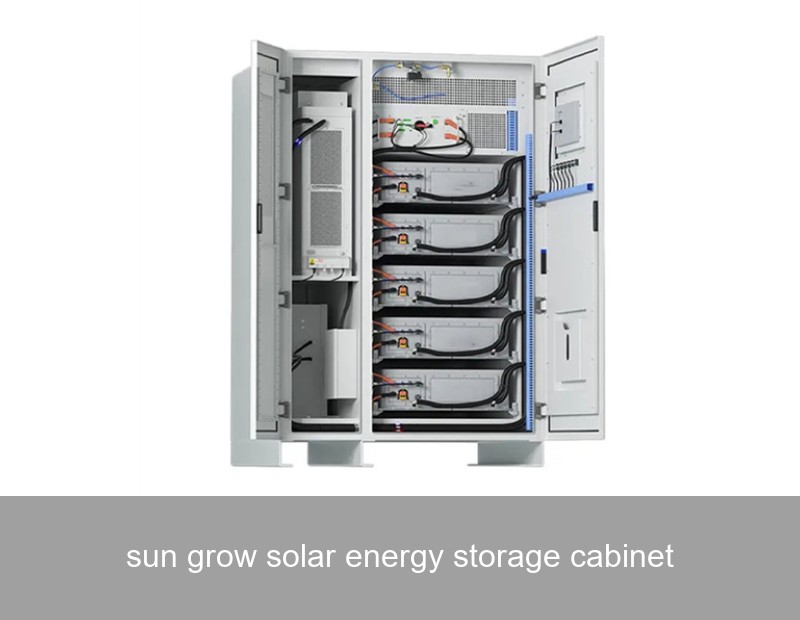
Have you ever looked at your solar panels on a bright, sunny day and wondered, "Where is all this extra power going?" If you're like many solar adopters in Europe and the US, you're generating a surplus of clean energy that often flows back to the grid for minimal compensation, only to buy it back at full price in the evening. This is the solar conundrum. The solution? A sophisticated solar energy storage cabinet. This isn't just a battery in a box; it's the intelligent brain of your energy ecosystem, and for systems like the Sun Grow solar energy storage cabinet, it's the cornerstone of modern energy resilience. Let's explore how this technology transforms sunlight from a momentary gift into a 24/7 power source.
Table of Contents
- The Duck Curve Problem: A Grid Under Stress
- Beyond Batteries: What Makes a Storage Cabinet Smart?
- Case Study: A German Bakery's Recipe for Resilience
- The Highjoule Approach: Integrated Intelligence for Demanding Applications
- Choosing the Right System for Your Home or Business
- Your Role in the Future Grid
The Duck Curve Problem: A Grid Under Stress
The phenomenon is most visible in sunny regions like California or Southern Europe. As solar production soars midday, net grid demand plummets. Then, as the sun sets and people return home, demand spikes rapidly while solar generation falls off a cliff. This creates a sharp, duck-shaped curve in demand graphs that is incredibly challenging for grid operators to manage with traditional power plants.
The data is telling. The California Independent System Operator (CAISO) has documented the deepening "duck curve" year after year, highlighting the urgent need for energy storage to absorb excess solar and release it during the ramp-up period. This isn't just a utility-scale issue; it trickles down to every prosumer. Without storage, your solar system's contribution to grid stability is limited, and your personal energy independence is incomplete.

Image Source: U.S. Department of Energy, illustrating the evolving duck curve.
Beyond Batteries: What Makes a Storage Cabinet Smart?
A Sun Grow solar energy storage cabinet represents the evolution from simple battery packs to an all-in-one power management hub. Think of it as the difference between a basic cell phone and a modern smartphone.
Here’s what a true energy storage cabinet integrates:
- Advanced Battery Modules: Typically using Lithium Iron Phosphate (LFP) chemistry for safety, longevity (often 6,000+ cycles), and stable performance.
- Hybrid Inverter/Charger: The core component that intelligently manages DC power from panels, converts it to AC for home use, and handles bidirectional charging/discharging of the battery.
- Energy Management System (EMS): The software brain. It learns your consumption patterns, considers weather forecasts, and can be programmed to optimize for self-consumption, time-of-use bill savings, or backup priority.
- Safety & Thermal Management: An integrated cabinet provides a controlled environment with proper ventilation, fire suppression systems, and safety disconnects—a critical factor for commercial and industrial installations.
- Grid Interaction Interface: Enables safe, grid-compliant functions like peak shaving and, where permitted, participation in virtual power plant (VPP) programs.
This integrated approach is where companies like Highjoule excel. Since 2005, Highjoule has focused on designing such intelligent, cabinetized systems. Our HPS Series Commercial & Industrial Storage Solutions are not just products; they are engineered ecosystems. They combine UL9540A-certified battery racks, high-efficiency inverters, and our proprietary JouleBrain™ EMS platform into a single, pre-integrated cabinet. This reduces installation complexity by up to 40% and provides a seamless, scalable solution for businesses looking to take control of their energy costs and carbon footprint.
Case Study: A German Bakery's Recipe for Resilience
Let's ground this in reality. Consider Bäckerei Schmidt, a mid-sized bakery chain in Bavaria with high, consistent energy demands for ovens, refrigeration, and lighting. Their existing 100 kW rooftop solar system was covering only about 30% of their total consumption due to misalignment between production and usage peaks.
The Challenge: Reduce peak demand charges (which can constitute up to 50% of a commercial electricity bill), increase solar self-consumption, and ensure backup power for critical cold storage.
The Solution: Installation of a 120 kWh Highjoule HPS cabinet system alongside their solar array. The JouleBrain™ EMS was configured for peak shaving and maximum self-consumption.
The Data-Driven Outcome (12-month period):
| Metric | Before Installation | After Installation | Improvement |
|---|---|---|---|
| Solar Self-Consumption Rate | 35% | 82% | +134% |
| Peak Demand from Grid | 150 kW | 95 kW | -37% |
| Overall Electricity Costs | €48,000/year | €31,200/year | €16,800 saved (35%) |
| CO2 Emissions Offset | 42 tonnes/year | 58 tonnes/year | +16 tonnes |
The system paid for itself in under 5 years and now provides a critical 8-hour backup for their walk-in freezers. This is the tangible power of a well-integrated solar energy storage cabinet.
The Highjoule Approach: Integrated Intelligence for Demanding Applications
Highjoule's philosophy is that storage should be simple, safe, and scalable. For residential clients, our HomePower Wall series offers the same cabinet-level intelligence in a sleek, compact design, easily managed via a smartphone app. But our core expertise shines in larger-scale applications.
For commercial, industrial, and microgrid projects, our cabinet systems are designed for the real world:
- Modular Design: Start with a 50 kWh cabinet and scale to multi-megawatt hours by linking additional units. This future-proofs your investment.
- Unmatched Safety: Our cell-to-cabinet safety architecture includes passive and active protection, continuous gas and thermal monitoring, and industry-leading certifications.
- Grid-Supportive: Our systems are designed to provide grid services like frequency regulation, helping to stabilize the very network we all depend on.

Image Source: Highjoule product installation gallery.
This holistic approach ensures that whether you're a homeowner with a Sun Grow solar energy storage cabinet or a factory manager with a 1 MWh Highjoule system, you're getting more than storage—you're getting a strategic energy asset.
Choosing the Right System for Your Home or Business
Navigating the storage market can be complex. Here are key questions to ask any provider:
- Is it a pre-integrated cabinet or a site-assembled kit? Pre-integrated units from experienced providers like Highjoule offer faster commissioning and proven interoperability.
- What is the depth of the Energy Management System? Can it integrate weather data, utility rate schedules, and future EV charging?
- What is the true cycle life at the stated Depth of Discharge (DoD)? A battery rated for 6,000 cycles at 90% DoD offers far more lifetime value than one rated for 6,000 cycles at 60% DoD.
- What are the safety certifications? Look for UL 9540 (system level) and UL 9540A (fire safety) for complete peace of mind.
- What is the warranty and service model? A 10-year performance warranty with remote monitoring support is now the industry benchmark.
Your Role in the Future Grid
The energy transition is not just about large wind farms and utility-scale solar plants. It's a distributed movement, powered by millions of homes and businesses generating, storing, and sharing clean energy intelligently. By investing in a robust solar energy storage cabinet, you're not just slashing your own bills; you're becoming an active participant in a more resilient and sustainable grid. You're turning your property into a personal power plant with the intelligence to operate optimally.
So, the next time you see your solar panels humming in the sun, ask yourself: Is it time to capture that potential fully? What would complete energy security and independence look like for your home or business today?
 Inquiry
 Online Chat