


Finding the Right Supplier of AI-Enabled Energy Storage Systems (ESS): Your Guide to Smarter Power
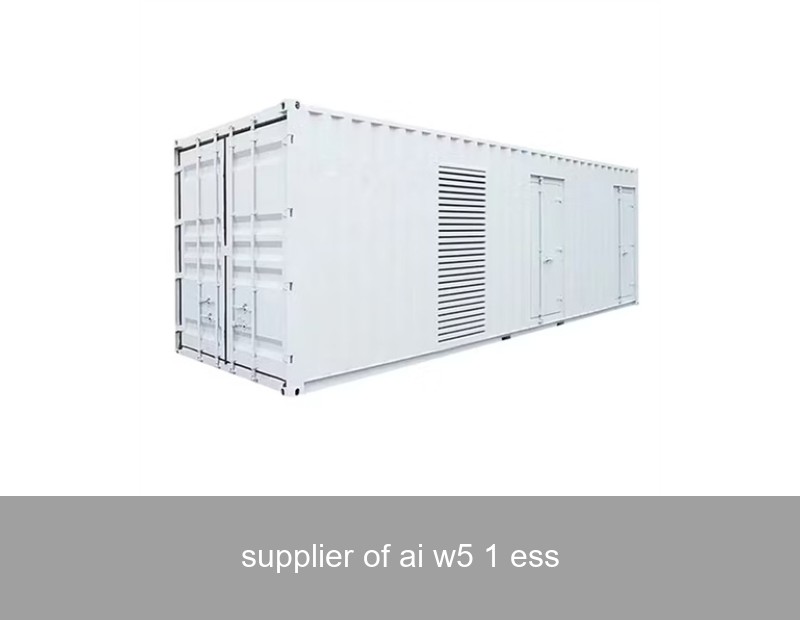
Have you noticed how the conversation around renewable energy is shifting? It's no longer just about installing solar panels or wind turbines. The real buzz is about what happens after the sun sets or the wind calms—how we store that energy and, more importantly, how we make it work intelligently. This is where the search for a capable supplier of AI-enabled energy storage systems (ESS) becomes critical. It's not just about buying a battery; it's about investing in a dynamic brain for your energy ecosystem. For businesses and communities, choosing the right partner in this space is the difference between having a passive power bank and an active, profit-generating asset.
Table of Contents
- The Silent Revolution: From Dumb Batteries to AI Power Plants
- The "W5" Framework: What an AI ESS Must Do for You
- Case Study: A European Industrial Park's AI-Driven Success
- Beyond the Box: What to Look for in Your AI ESS Supplier
- Highjoule: Integrating Intelligence into Every Kilowatt-Hour
- The Future Is Adaptive: What Will Your Energy System Learn Next?
The Silent Revolution: From Dumb Batteries to AI Power Plants
Traditional energy storage is reactive. It charges when there's excess power and discharges when there's demand. But in a world of volatile energy prices, complex tariff structures, and intermittent renewables, this simple logic leaves massive value on the table. The phenomenon? Businesses with solar and storage are still facing surprisingly high energy bills and grid dependency.
The data reveals the gap. According to the U.S. Department of Energy, achieving high solar penetration requires advanced, "smart" storage that can provide grid services. A study in the Journal of Energy Storage notes that using AI for forecasting and optimization can improve storage profitability by 20-40% by aligning operations with real-time market signals and physical constraints. This isn't incremental improvement; it's a complete overhaul of the storage value proposition.

This is the core of the AI ESS. It’s a system that uses machine learning algorithms to continuously analyze a flood of data—from weather forecasts and historical consumption patterns to real-time electricity prices and grid frequency. It doesn't just store energy; it predicts, strategizes, and autonomously makes decisions to optimize for your specific goals, be it cost savings, carbon reduction, or energy resilience.
The "W5" Framework: What an AI ESS Must Do for You
When evaluating a supplier of AI-enabled energy storage systems, their technology should answer five key adaptive questions—the "W5":
- Weather & Generation: What will my solar/wind output be in the next 48 hours?
- Workload: What will my facility's energy consumption profile look like?
- Wallet (Market): What are the real-time energy prices and grid service opportunities?
- Wear (Battery Health): What is the optimal charging cycle to maximize lifespan and performance?
- What-If (Resilience): What is the best action during a grid outage or extreme event?
A true AI ESS synthesizes these data streams. For instance, if the AI forecasts a sunny afternoon (high solar generation) followed by a period of high grid prices in the evening, it will plan to store excess solar energy rather than exporting it at low midday prices, then discharge it during the expensive peak, maximizing savings. All without human intervention.
Case Study: A European Industrial Park's AI-Driven Success
Let's ground this in reality. A manufacturing industrial park in Northern Germany, with a 2 MW solar canopy, partnered with Highjoule to move beyond basic self-consumption. Their challenge was to reduce high demand charges and participate in Germany's lucrative primary control reserve (PCR) market, a task too complex for manual or rule-based systems.
Highjoule deployed its Neuron AI Platform integrated with a 3 MWh containerized battery storage system. The AI was tasked with a multi-objective optimization: minimize overall energy costs, reduce peak grid draw, and bid capacity into the PCR market.
| Metric | Before AI ESS | After AI ESS (12 Months) |
|---|---|---|
| Annual Energy Cost Savings | Baseline | €182,000 |
| Peak Demand Reduction | 0% | 22% |
| Revenue from Grid Services | €0 | €41,000 |
| Effective System Payback Period | N/A | ~4.5 Years |
The AI's predictive capabilities allowed it to precisely hold battery reserves for potential PCR activations while simultaneously ensuring enough charge remained to shave the facility's own power peaks. This dual-income stream transformed the storage system from a cost center into a revenue-generating asset. As the park's manager noted, "The system doesn't just save us money; it earns its keep. The AI handles complexities we couldn't possibly manage in-house."
Beyond the Box: What to Look for in Your AI ESS Supplier
Choosing a supplier isn't just about hardware specs. The AI software, its integration, and ongoing support are paramount. Key considerations include:
- Proprietary vs. Generic AI: Does the supplier develop its own algorithms tailored for energy markets, or are they using off-the-shelf solutions?
- Cybersecurity & Data Governance: With great data comes great responsibility. Ensure the supplier adheres to stringent standards like IEC 62443 for industrial security.
- Openness & Integration: Can the platform integrate with your existing building management system, SCADA, or renewable assets? Avoid vendor lock-in.
- Proven Track Record: Ask for case studies with verifiable data in your region (e.g., FERC markets in the U.S. or ancillary service markets in Europe).
A true partner will act as an extension of your team, ensuring the AI model continuously learns and adapts to changing regulations and market conditions.

Highjoule: Integrating Intelligence into Every Kilowatt-Hour
At Highjoule, our mission since 2005 has been to deliver not just storage, but intelligent, sustainable power solutions. We understand that being a leading supplier of AI-enabled energy storage systems means bridging the physical and digital worlds seamlessly.
Our flagship offering, the Highjoule Aegis ESS, is a hardware-software ecosystem built from the ground up for intelligence. The containerized, UL9540-certified battery systems are designed for safety and scalability. The true differentiator is the Neuron AI Platform, which serves as the central nervous system. Neuron employs reinforcement learning—a type of AI where the system learns optimal strategies through continuous interaction with market and site data—to master the "W5" framework. It's like having a 24/7 trading desk and operations manager dedicated solely to your energy assets.
Our services extend beyond installation. We provide comprehensive Grid Service Market Integration support, helping clients in the U.S. and Europe navigate the paperwork and technical requirements to monetize their storage. Our Performance Guarantee packages, backed by the AI's predictive maintenance alerts, ensure your system delivers the financial and operational returns promised, year after year. For microgrids, our AI becomes the master controller, dynamically balancing diesel generators, renewables, and storage to achieve the lowest cost and highest reliability.
The Future Is Adaptive: What Will Your Energy System Learn Next?
The journey towards a fully adaptive, self-optimizing energy infrastructure is just beginning. With the rise of electric vehicles and heat pumps, demand profiles will become even more complex. The AI ESS of tomorrow will need to orchestrate these new assets seamlessly.
This leads us to a pivotal question for any business leader or energy manager: Is your organization ready to treat energy not as a static utility bill, but as a dynamic, AI-optimized portfolio? What is the first data point you would want an intelligent system to analyze for your operations?
 Inquiry
 Online Chat