


Choosing the Right Supplier of ICS Inverter for Your Energy Storage System
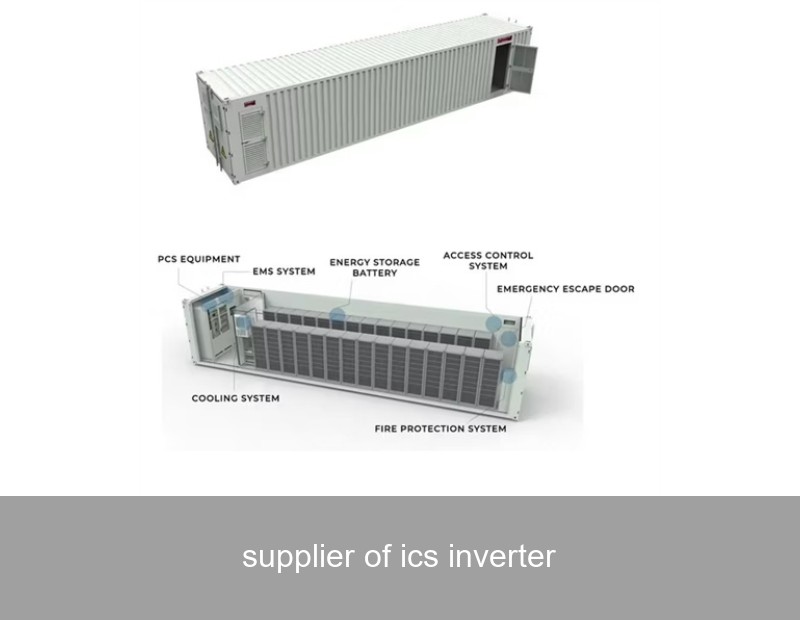
If you're exploring energy storage, you've likely encountered the term "ICS" or Integrated Converter System. The supplier of ICS inverter you choose becomes the vital partner for your system's brain and heart. This decision impacts everything from efficiency and safety to long-term return on investment. As grid demands shift and renewable adoption grows, understanding the value of a premium ICS is more crucial than ever.
Table of Contents
What is an ICS Inverter and Why Does Its Supplier Matter?
An Integrated Converter System (ICS) inverter is the multi-talented core of a modern Battery Energy Storage System (BESS). Unlike a simple DC-to-AC inverter, an ICS seamlessly integrates multiple functions: bi-directional conversion, advanced grid management, and system control. Think of it as the command center that not only converts power but also intelligently decides when to store, when to discharge, and how to keep the entire system stable and efficient.
Why is the supplier of ICS inverter so critical? Because this component's reliability dictates your project's success. A top-tier supplier doesn't just sell hardware; they provide the embedded intelligence, ongoing firmware support, and grid compliance expertise that ensures your storage asset performs optimally for its entire 15-20 year lifespan. Choosing based on price alone can lead to hidden costs in downtime, inefficient cycling, or failed grid interconnection tests.
The Hidden Costs of a "Basic" Inverter
- Lower Round-Trip Efficiency: Even a 2% lower efficiency can mean thousands in lost energy revenue annually.
- Compliance Risks: Grid codes (like UL 1741 SB in the US or VDE-AR-N 4105 in Germany) evolve. A supplier without active update services can leave your system non-compliant.
- Integration Headaches: Poorly designed communication protocols can make system monitoring and control a constant challenge.
Key Criteria for Selecting Your ICS Inverter Supplier
Navigating the market requires a checklist. Here are the non-negotiables when evaluating a supplier of ICS inverter.
| Criteria | Why It Matters | Questions to Ask |
|---|---|---|
| Proven Grid Compliance | Ensures safe, legal interconnection and future-proofing against regulatory changes. | Can you provide certification documents for my target market (e.g., CE, UL)? How do you manage firmware updates for new grid codes? |
| System Efficiency & Durability | Directly impacts financial returns and system longevity. Look for peak efficiency over 98%. | What is the guaranteed round-trip efficiency at different C-rates? What is the expected lifespan and what are the derating factors? |
| Advanced Software & Control | Unlocks value stacking: arbitrage, peak shaving, frequency response. | Is your software platform open for third-party integration? What energy management algorithms do you offer? |
| Technical Support & Service | Minimizes downtime and ensures optimal performance through remote diagnostics and local service. | What is your mean time to repair (MTTR)? Do you offer performance monitoring and proactive alerts? |
For example, at Highjoule, our NeoGrid ICS Series is engineered with these criteria at its core. We build our inverters with a focus on robust grid-forming capabilities, which are becoming essential for microgrid and weak-grid applications. Our proprietary Adaptive Cycle Management software actively optimizes battery usage to maximize lifetime value, not just daily profit—a crucial distinction for asset owners.
Case Study: A European Industrial Park's Transformation
Let's make this real with data. A major automotive manufacturing park in Bavaria, Germany, faced two problems: volatile energy costs and a corporate mandate to reduce its carbon footprint. Their onsite 2.5 MW solar farm was underutilized, often facing curtailment during peak production.
The Goal: Increase solar self-consumption from 35% to over 70% and provide backup power for critical assembly lines.
The Solution: After a rigorous tender, they selected Highjoule as their supplier of ICS inverter for a 4 MWh / 2.5 MW battery storage system. The key deciding factors were our ICS's proven compliance with the strict German VDE grid codes and its ability to seamlessly switch between grid-following and grid-forming modes.
The Results (18 Months Post-Installation):
- Solar Self-Consumption: Increased to 78%, reducing grid purchases by approximately €145,000 annually.
- Peak Shaving: By automatically discharging during high-price periods, the system saves an additional €52,000 per year on demand charges.
- Grid Services: The system participates in the German primary control reserve market, generating ancillary service revenue.

Image: A modern industrial energy storage installation. Source: Unsplash (Representative image)
"The Highjoule ICS platform's intelligence was the differentiator," noted the park's energy manager. "It doesn't just store and release; it constantly calculates the most economically beneficial mode for us, whether that's self-consumption, arbitrage, or grid services. The single-point responsibility from Highjoule for both the inverter and system integration simplified the entire project."
The Future of ICS Technology and Smart Grid Integration
The role of the supplier of ICS inverter is rapidly evolving from component provider to grid ally. Two key trends are shaping the next generation of ICS technology:
1. Grid-Forming Inverters: As thermal power plants retire, the grid loses its traditional rotational inertia. Advanced ICS inverters can now digitally simulate this inertia, providing critical stability to grids with high renewable penetration. This isn't future tech—it's being deployed today in island grids and is fast becoming a requirement in markets like California and Hawaii.
2. AI-Driven Energy Management: The next layer of value lies in predictive analytics. Imagine an ICS that cross-references local weather forecasts, real-time electricity prices, and the facility's production schedule to pre-charge the battery optimally. This level of foresight maximizes ROI and will soon be standard for leading suppliers.
Highjoule's Approach as Your Trusted ICS Partner
Since 2005, Highjoule has built its reputation as a global supplier of ICS inverter and complete storage solutions by focusing on intelligence and resilience. We understand that our technology is a long-term investment for your business, home, or community.
Our product philosophy centers on three pillars:
- Interoperability: Our NeoGrid ICS is designed to work with a wide range of battery chemistries (from Li-ion NMC to LFP), future-proofing your investment.
- Cybersecurity by Design: In an era of smart grids, security is paramount. Our systems are built with hardened communication protocols and regular OTA security patches.
- Scalable Architecture: Whether it's a 10 kWh residential system or a 100 MWh utility-scale project, our modular ICS design allows for seamless power stacking and centralized control.
For commercial and industrial clients, our Highjoule Horizon energy management platform turns the ICS into a true asset commander, enabling sophisticated strategies like demand charge reduction, tariff optimization, and participation in virtual power plants (VPPs).

Image: Technician monitoring a modern battery energy storage system. Source: Unsplash (Representative image)
Choosing the right partner is more than a technical specification check. It's about aligning with a company that will be there to navigate the energy transition with you. As a leading supplier of ICS inverter solutions, we at Highjoule are committed to providing not just superior hardware, but the ongoing intelligence and support that transforms a capital expense into a resilient, revenue-generating asset.
What specific energy challenge—be it unpredictable costs, renewable integration, or backup power needs—is driving you to evaluate energy storage and its critical component, the ICS inverter, today?
 Inquiry
 Online Chat