


Top Lithium Battery Companies: Powering a Sustainable Future
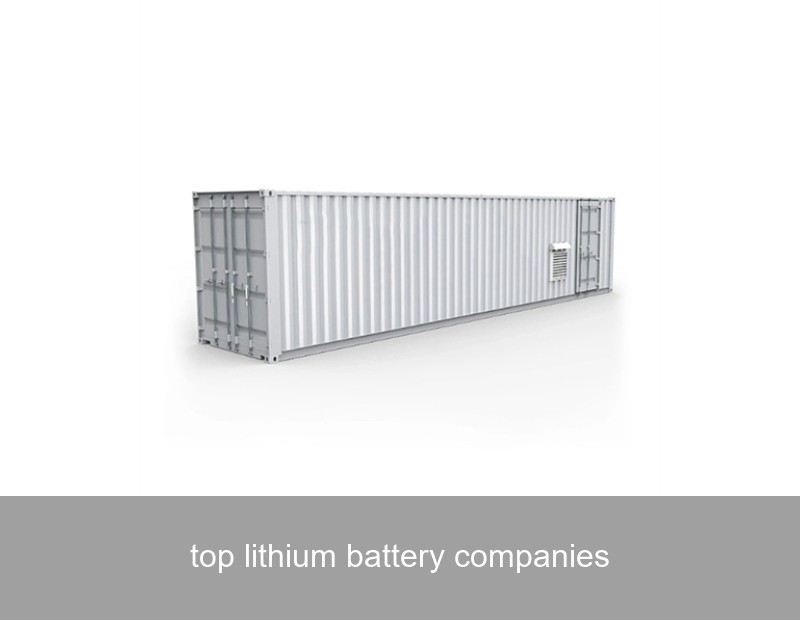
Have you ever wondered what truly powers the global shift towards renewable energy? While solar panels and wind turbines capture the spotlight, there's a silent, intelligent force working behind the scenes: advanced energy storage. As Europe and the U.S. aggressively pursue decarbonization goals, the demand for reliable, high-performance lithium-ion battery systems has skyrocketed. This surge has propelled a competitive landscape of top lithium battery companies, each vying to provide the cornerstone of our clean energy infrastructure. But in a market flooded with options, what differentiates the true leaders from the rest? It goes far beyond just supplying battery cells.
The real challenge for businesses and communities isn't simply acquiring batteries; it's about integrating intelligent, safe, and durable storage systems that deliver predictable financial and operational returns. It's about finding a partner who understands the intricate dance between energy generation, consumption, storage, and grid interaction. This is where the definition of a top company expands from being a cell manufacturer to becoming a full-solution technology provider.
What Makes a Leader? Key Metrics for Top Lithium Battery Companies
When evaluating the landscape of top lithium battery companies, industry experts look beyond marketing claims. Several concrete metrics separate the front-runners:
- Cycle Life & Degradation Rate: A premium battery system should deliver thousands of deep cycles with minimal capacity loss. Leading systems today offer 6,000+ cycles while retaining 70-80% of original capacity, ensuring a lifespan often exceeding 15 years.
- Safety & System Architecture: Top-tier providers invest heavily in proprietary Battery Management Systems (BMS) and robust thermal management. Safety isn't an add-on; it's engineered into every module and cabinet, with certifications like UL 9540A being a non-negotiable benchmark.
- Energy Density & Footprint: For commercial and industrial applications where space is revenue, achieving more storage capacity in a smaller footprint is critical. Advanced cell chemistry and compact system design are hallmarks of innovation.
- Grid Services Capability: Can the system do more than just backup power? Leading solutions are grid-interactive, capable of providing frequency regulation, peak shaving, and virtual power plant (VPP) participation, unlocking additional revenue streams.
According to a 2023 IEA report on energy storage, global grid-scale battery storage capacity is set to multiply exponentially, with lithium-ion dominating the market. This growth is directly tied to the proven performance and rapidly declining costs engineered by these leading companies.
The Highjoule Difference: Engineered for Performance and Longevity
At Highjoule, our position among the top lithium battery companies is built on nearly two decades of system-level innovation. Since 2005, we have focused not just on cells, but on creating fully integrated, smart storage solutions. Our H-Joule Cube commercial & industrial (C&I) series exemplifies this. It leverages lithium iron phosphate (LFP) chemistry for superior safety and longevity, coupled with our patented adaptive BMS that continuously optimizes performance and lifespan. We understand that for a business in Munich or Michigan, storage is a capital investment. Our design philosophy prioritizes total cost of ownership, ensuring our systems deliver energy savings and resilience year after year.
Beyond the Cell: The System Integration Imperative
Think of a battery cell as a brilliant musician. An orchestra, however, requires a conductor, harmonized sections, and a shared score to create a symphony. Similarly, the true value of a storage solution lies in its system integration. This is a crucial differentiator often overlooked when simply comparing cell specifications.
| Component | Basic Provider Approach | Integrated System Approach (e.g., Highjoule) |
|---|---|---|
| Power Conversion (PCS) | Off-the-shelf, generic inverter | Fully compatible, co-engineered bi-directional inverter for optimal communication and efficiency. |
| Energy Management (EMS) | Basic control software | AI-driven platform that learns load patterns, forecasts weather, and autonomously maximizes economic value. |
| Installation & Service | Delegated to third-party contractors | End-to-end project management from site audit to commissioning, backed by global service networks. |
For a hospital, data center, or manufacturing plant, this integrated approach means one point of responsibility, guaranteed performance, and seamless operation. It transforms a complex engineering project into a turnkey energy asset.
Case Study: A German Industrial Park's Journey to Resilience and Savings
Let's ground this discussion in reality. A mid-sized industrial park in Bavaria, Germany, faced two pressing issues: skyrocketing peak-demand charges from the grid and an increasing need for backup power to ensure continuous production. Their solar PV system was helping, but much of its midday generation was being exported at low rates, while they bought expensive power in the early evening.
They partnered with Highjoule to deploy a 1.2 MWh H-Joule Cube system integrated with their existing solar infrastructure. The goals were clear: reduce peak demand, increase solar self-consumption, and provide backup power for critical loads.
Image: A modern industrial facility with solar and battery storage. Credit: Unsplash (Representative image)

The results, monitored over 12 months, were significant:
- Peak Demand Reduction: The system shaved peak loads by 40%, leading to a direct reduction of over €45,000 annually in grid demand charges.
- Self-Consumption Boost: On-site consumption of solar power increased from 35% to over 80%, drastically reducing purchased energy.
- ROI & Backup: The project achieved a simple payback period of under 5 years. Furthermore, the system automatically provided seamless backup power during two unplanned grid outages, preventing production stoppages.
This case, documented in part with data from the Fraunhofer Institute for Solar Energy Systems, highlights how choosing a top lithium battery company that provides intelligent system integration turns storage from a cost into a strategic asset.
Choosing Your Partner: More Than Just a Battery Supplier
So, how should you approach selecting a partner for your energy storage project? The checklist should extend well beyond a datasheet.
Essential Questions to Ask:
- Does the provider have a proven track record in my specific application (C&I, microgrid, residential community)?
- What is the depth of their software intelligence? Can it adapt to changing tariffs and usage patterns?
- What is the warranty structure, and what long-term service and performance guarantees are offered?
- Can they provide references from projects with similar scope and geography?
Highjoule's approach is partnership-centric. Our H-Joule Nexus energy management platform is the brain of our systems, offering real-time monitoring, remote diagnostics, and actionable insights via a user-friendly dashboard. For our utility and microgrid clients, our H-Joule GridSync solutions enable large-scale storage deployments that stabilize grids and integrate renewables at the distribution level. This comprehensive portfolio, backed by nearly 20 years of global experience, is what defines our role as a leader.
Future Horizons: What's Next for Energy Storage?
The innovation curve in energy storage is steep. While LFP chemistry is currently the safety and longevity leader for stationary storage, research into solid-state batteries, sodium-ion, and advanced recycling methods is relentless. The next frontier for top lithium battery companies will involve deeper grid-forming capabilities, enabling storage systems to "black start" sections of the grid and operate completely independently. Furthermore, the integration of artificial intelligence for predictive maintenance and market bidding will become standard.
Image: A technical specialist monitoring a modern battery energy storage system. Credit: Unsplash (Representative image)

The journey towards a decarbonized, resilient energy system is undeniable. The choice of your storage partner will fundamentally shape the reliability, economics, and sustainability of your power for decades to come. As you evaluate the landscape of top lithium battery companies, are you looking for a component vendor, or a strategic partner to engineer your energy independence?
 Inquiry
 Online Chat