


Unlocking Energy Independence: Your Guide to the Modern Total Solar Energy Solution
Have you ever looked at your rising electricity bill and wondered if there's a better way? Or perhaps you're driven by a genuine desire to reduce your carbon footprint. You've likely heard that solar panels are a great start. But here's the reality many discover: panels alone only work when the sun shines. This is where the concept of a total solar energy solution becomes not just beneficial, but essential. It's the integrated system that captures, stores, manages, and optimizes solar power, turning sunlight into a reliable, 24/7 energy source for your home or business. Let's explore how this complete approach is redefining energy self-sufficiency.
Table of Contents
The Phenomenon: Solar Panels Are Just the Beginning
Across Europe and the U.S., rooftop solar adoption has soared. The initial promise is clear: free energy from the sun. However, many early adopters hit a common wall. Their systems export massive amounts of cheap, solar-generated electricity back to the grid in the middle of the day, only to buy back expensive power from the utility in the evening when the sun sets and demand peaks. This mismatch creates an economic and practical gap. A true total solar energy solution closes this loop. It's a symphony of components working together—solar generation, battery storage, smart inverters, and energy management software—to maximize self-consumption and provide unwavering backup power.

Image Source: Unsplash - A modern home equipped with a complete solar and storage system.
The Data: Why Storage is the Missing Link
The numbers paint a compelling picture. According to the U.S. Department of Energy's Solar Futures Study, solar could provide up to 40% of the nation's electricity by 2035, but notes that "energy storage is a key enabler of this transition." Let's break down a typical household energy profile with and without storage:
| Scenario | Solar Self-Consumption | Grid Dependence at Night | Bill Savings Potential |
|---|---|---|---|
| Solar Panels Only | 30-50% | ~100% | 40-60% |
| Total Solar + Storage Solution | 70-90%+ | 10-30% | 80-95%+ |
This dramatic shift is driven by the battery storage system, which captures midday surplus for use during peak hours. For businesses, this is even more critical, as it allows them to avoid punitive demand charges imposed by utilities for short periods of high power draw.
The Core Components of a Total Solar Energy Solution
Think of it as an ecosystem. Each part has a distinct role:
- Solar Photovoltaic (PV) Array: The primary energy harvesters, converting sunlight into direct current (DC) electricity.
- Hybrid Inverter/Charger: The brain of the power system. It converts DC from the panels or batteries to usable AC for your home, manages the flow of energy, and charges the batteries intelligently.
- Battery Energy Storage System (BESS): The heart of resilience. Modern lithium-ion phosphate (LFP) batteries, like those used by Highjoule, offer safety, longevity, and high cycling capability.
- Energy Management System (EMS): The nervous system. This software uses weather forecasts, usage patterns, and tariff schedules to autonomously decide when to store, use, or export energy, optimizing for cost and carbon.
Case Study: A German Bakery's Recipe for Resilience
Let's ground this in reality. "Bäckerei Schmidt," a mid-sized artisan bakery in Bavaria, faced two challenges: volatile energy costs and the critical need for uninterrupted refrigeration. Their old diesel generator was costly and dirty. In 2022, they implemented a total solar energy solution.
- System: A 120 kWp solar roof array paired with a 240 kWh Highjoule Cobalt-Iron commercial battery system.
- Results (First Year):
- Energy self-sufficiency increased from 35% to 92%.
- Eliminated €18,000 in annual demand charges.
- Provided seamless backup during two grid outages, preventing €15,000 in spoiled inventory.
- Achieved a return on investment (ROI) in under 5 years, factoring in German subsidy programs.
The bakery owner noted, "The system doesn't just save money; it secures our operation. We can now proof dough overnight using stored solar energy, which is both economical and a great sustainability story for our customers."

Image Source: Unsplash - A commercial-scale battery energy storage system installation.
Highjoule's Role in Advanced Energy Solutions
As a global leader in advanced energy storage since 2005, Highjouselives at the integration point of these components. We don't just supply batteries; we provide the intelligence that makes a total solar energy solution greater than the sum of its parts. Our products are designed for the specific demands of the European and North American markets.
For residential clients, our HomePower Stack series is a modular, wall-mounted LFP battery system that integrates seamlessly with leading solar inverters. Its scalable design lets you start with 5 kWh and expand to 25 kWh, adapting to your growing needs, whether it's adding an electric vehicle or a heat pump.
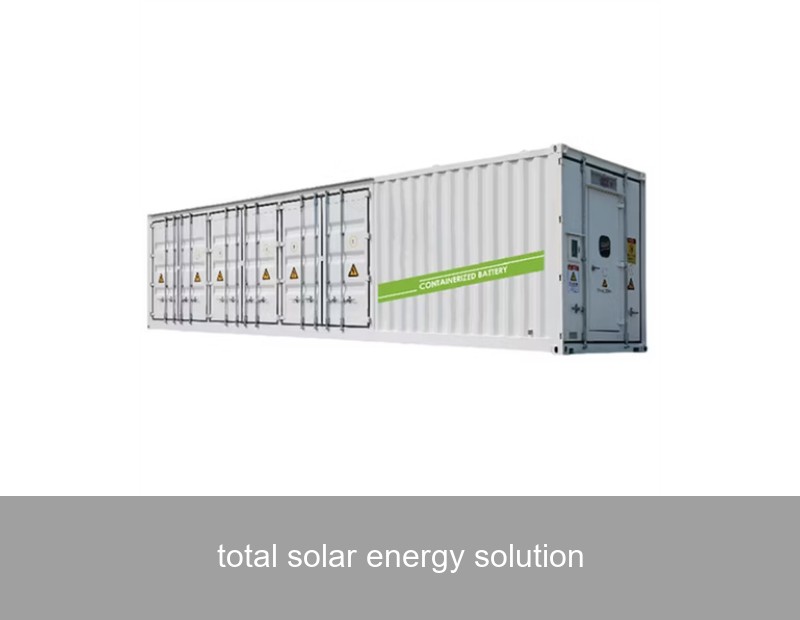
For commercial and industrial (C&I) applications, our GridShield Industrial platform is a game-changer. These containerized or skid-mounted systems offer from 100 kWh to multi-megawatt-hour capacity. They feature advanced thermal management for safety and are built with a robust cycle life, ensuring performance over a 15+ year lifespan. Crucially, they come with Highjoule's OptiMax AI EMS, which continuously learns your site's energy profile to execute the most cost-effective dispatch strategy.
The Future: Intelligent Energy Management
The next evolution of the total solar energy solution is virtual power plants (VPPs) and peer-to-peer energy trading. Imagine your home or business battery not just serving you, but also providing stability to the local grid during times of stress—and getting paid for it. Highjoule's systems are already VPP-ready. By aggregating thousands of distributed storage systems, we can help balance the grid, integrate more renewables, and create new revenue streams for our customers. This transforms a passive asset into an active grid participant.

Image Source: Unsplash - Conceptual visualization of a smart grid and distributed energy network.
The journey to energy independence is no longer a distant dream. It's a tangible, technology-driven reality. With a properly designed total solar energy solution, you move from being a consumer at the mercy of utility rates to a proactive manager of your own clean energy microgrid. The question is no longer *if* you should make the switch, but *how* to design the system that perfectly aligns with your financial goals and resilience needs. What would complete energy security enable you to do or build next?
 Inquiry
 Online Chat