


Maximizing Solar Energy Utilization: From Sunlight to Sustainable Power 24/7
You've seen the sleek panels glinting on rooftops and in fields, symbols of a cleaner future. The global surge in solar photovoltaic (PV) installations is undeniable, driven by falling costs and rising environmental consciousness. But here's a question we at Highjoule often encounter: "I have solar panels, but am I truly using all that free energy?" This brings us to the heart of the matter: true utilizacion de la energia solar—or solar energy utilization. It's not just about generation; it's about intelligently harnessing, storing, and using every possible kilowatt-hour your system produces. Let's explore how moving beyond simple generation to optimized utilization is the key to unlocking full energy independence and economic return.
What is Solar Energy Utilization?
Solar energy utilization refers to the effective capture, management, and consumption of the electricity generated by a PV system. Think of it as the difference between having a well and having a well plus a water tower and an intelligent irrigation system. The well (solar panels) collects water (sunlight), but without storage and smart management, you can only use water when the sun is shining. True utilization means having power available—and using it strategically—day and night, rain or shine.
The Core Challenge: Intermittency and the Duck Curve
The phenomenon is simple: the sun doesn't always shine when we need energy most. Solar production peaks in the middle of the day, often when residential demand is low (people are at work or school) and commercial demand may be variable. In the evening, as the sun sets and families return home, demand spikes just as solar generation plummets. This mismatch creates the famous "Duck Curve" observed by grid operators in California and increasingly in Europe.

Source: U.S. Department of Energy - The "Duck Curve" illustrates the timing imbalance between peak solar production and peak electricity demand.
This curve visually represents the grid management challenge. Without a solution, valuable solar energy is wasted during overproduction periods, and fossil-fuel-powered "peaker" plants must ramp up quickly to meet the evening demand, undermining the environmental benefits of solar.
Beyond the Meter: Maximizing Self-Consumption
The economic model for solar is also shifting. Feed-in tariffs, which paid a premium for sending solar back to the grid, are being phased out in many regions like Germany, Spain, and parts of the US. The new paradigm is self-consumption. The goal is to consume as much of your self-generated solar power as possible on-site. Why? Because the price you pay for grid electricity (e.g., €0.30/kWh) is often much higher than the compensation you receive for exporting surplus (e.g., €0.08/kWh). Maximizing self-consumption directly slashes your energy bills.
- Direct Use: Running appliances during peak solar hours.
- Intelligent Load Shifting: Using smart controllers to schedule energy-intensive tasks (like EV charging or pool pumping) for sunny periods.
- Energy Storage: The game-changer. Storing midday surplus for use in the evening and night.
Case Study: A German Bakery's Recipe for Energy Independence
Let's look at a real-world example from Bavaria, Germany. A mid-sized artisan bakery with a 100 kW rooftop solar system faced a classic problem: high production during the day, but its most energy-intensive processes—oven pre-heating and refrigeration—ran heavily during early morning and night hours. They were exporting over 60% of their solar yield at low rates and drawing expensive power from the grid during peak times.
The Solution: The bakery integrated a Highjoule HI-Cube 120 commercial battery energy storage system (BESS) with a capacity of 120 kWh and a smart energy management system (EMS).
The Data-Driven Outcome (12-month post-installation):
| Metric | Before Highjoule BESS | After Highjoule BESS |
|---|---|---|
| Solar Self-Consumption Rate | 38% | 92% |
| Grid Energy Import (Peak Hours) | 85% of total import | 15% of total import |
| Annual Energy Cost Savings | Baseline | €18,500 |
| ROI Period | N/A | Estimated 5.2 years |
The Highjoule EMS intelligently manages the energy flow, prioritizing charging the batteries with excess solar, then discharging to cover the bakery's early morning power ramp-up and evening cooling loads. This not only saved money but also provided backup power for critical refrigeration, reducing food spoilage risk.
The Solar+Storage System as a Grid Partner
Advanced utilization turns a solar system from a passive generator into an active grid asset. Through programs like virtual power plants (VPPs) or frequency regulation services, aggregated home and commercial battery systems can provide stability to the wider grid. By discharging during times of high grid stress, they can prevent blackouts and defer the need for costly grid infrastructure upgrades. A report by IRENA highlights how solar and storage are becoming the cornerstone of cost-effective, resilient power systems.
Highjoule's Intelligent Solutions for Optimal Solar Utilization
At Highjoule, we design our systems with the principle of maximum utilization at their core. Our products are not just hardware; they are integrated, intelligent energy platforms.
For Homes and Small Businesses: The Highjoule HEM Series
Our Home Energy Manager (HEM) series integrates seamlessly with new or existing solar arrays. Its AI-driven software learns your consumption patterns and automatically optimizes energy flow between your solar panels, battery (like our HI-Powerwall equivalent), home loads, and the grid. You can monitor and control everything via a user-friendly app, ensuring you use your solar energy when it's most valuable to you.
For Commercial & Industrial (C&I) and Microgrids: The HI-Cube Platform
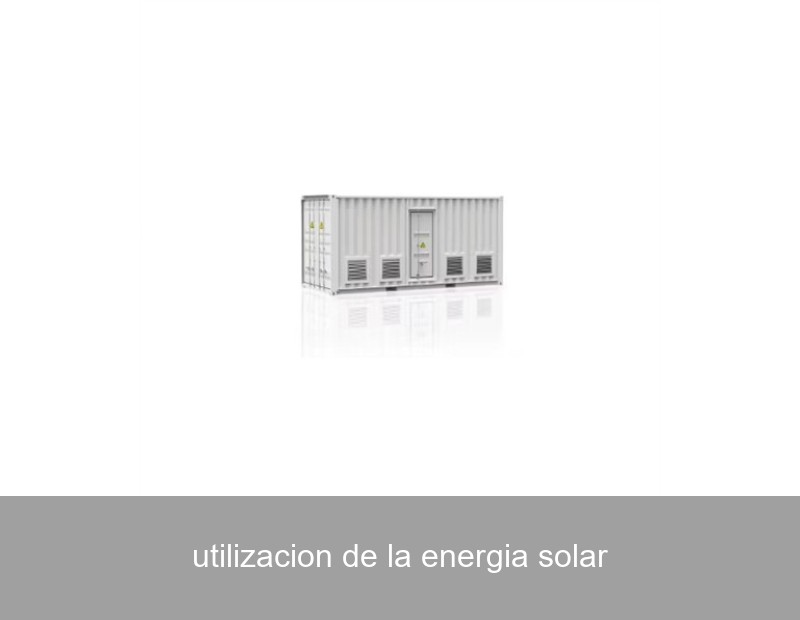
Our flagship HI-Cube containerized BESS is a powerhouse for larger-scale solar utilization. It features:
- Modular Design: Scalable from 100 kWh to multiple MWh to match your solar capacity and load profile.
- Advanced Battery Chemistry: Utilizing LFP (Lithium Iron Phosphate) cells for superior safety, longevity (over 6000 cycles), and stable performance.
- Grid-Interactive Inverters: Enable peak shaving, demand charge reduction, and participation in grid services programs.
- Robust EMS: Provides real-time monitoring, forecasting, and automated control to maximize ROI and energy resilience.

Source: Industry example of a containerized BESS installation, similar to Highjoule's HI-Cube platform, enabling large-scale solar optimization.
Whether it's a factory in Texas aiming to cap its demand charges or a community microgrid in Spain seeking to run on 100% local renewables, Highjoule's technology provides the critical link between solar generation and reliable, usable power.
What Does the Future Hold for Solar Utilization?
The journey doesn't end with storage. The next frontier is the full integration of solar, storage, electric vehicle (EV) charging, and smart home/building systems into a single, autonomous energy ecosystem. Imagine your EV charging from your rooftop sun during the day, then powering your home at night (vehicle-to-home), or your entire neighborhood sharing energy peer-to-peer on a blockchain-secured local energy market. The foundational step for all these exciting possibilities is mastering solar energy utilization today.
As you consider your own energy journey, whether for your home or your business, ask yourself this: Is your solar system just generating power, or is it intelligently working to maximize your independence, resilience, and savings? The potential of the sun is vast, but it's through smart utilization that we truly capture its full value.
 Inquiry
 Online Chat