


Understanding the Victoria Big Battery Cost: A Milestone in Grid-Scale Storage Economics
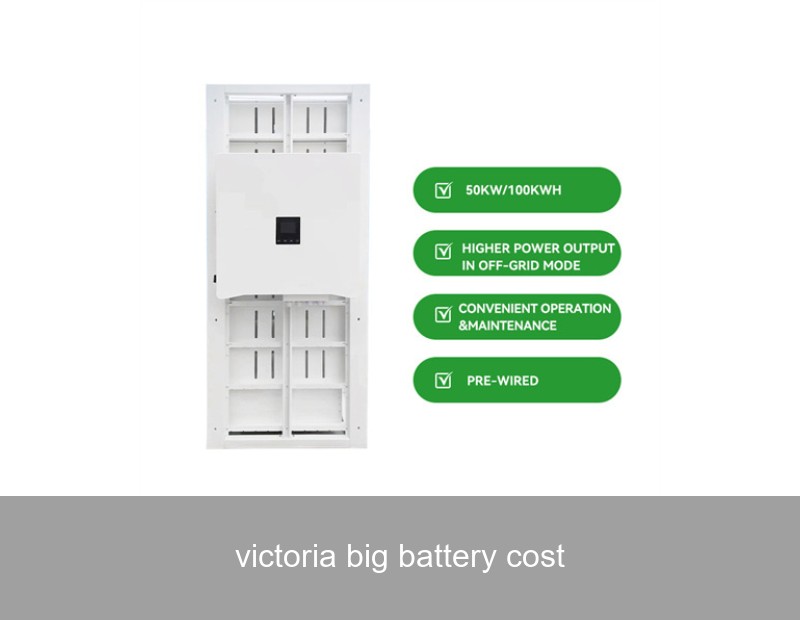
When the Victoria Big Battery (VBB) in Australia switched on, it wasn't just a technical achievement; it became a global case study in the evolving economics of large-scale energy storage. For industry observers in Europe and the United States, the "Victoria Big Battery cost" represents more than a price tag—it symbolizes the tipping point where utility-scale batteries transition from ambitious pilots to essential, cost-effective grid infrastructure. This article delves into the financial and strategic drivers behind such projects and what they mean for the future of renewable energy integration worldwide.
Table of Contents
- The Phenomenon: Why Grid Batteries Are Suddenly Everywhere
- The Data: Decoding the Victoria Big Battery Investment
- The Case Study: Victoria's Real-World Performance
- The Insight: Cost Components and Future Trends
- The Highjoule Solution: Scalable Architecture for Modern Grids
- Your Next Step: Evaluating Your Storage Potential
The Phenomenon: Why Grid Batteries Are Suddenly Everywhere
You've likely seen the headlines: "World's Largest Battery Switches On," "Mega-Battery Project Announced." From California to Germany, grids are increasingly relying on massive lithium-ion batteries. The driving force? The rapid growth of wind and solar power. These renewable sources are clean and increasingly cheap, but their output is variable. This intermittency creates a challenge for grid operators who must balance supply and demand in real-time. Enter the grid-scale battery. By storing excess renewable energy and discharging it when needed, these systems provide critical stability services, prevent blackouts, and defer costly grid upgrades. The business case, as proven by projects like the VBB, is now compelling.

Image Source: Unsplash - A modern solar farm coupled with battery storage systems.
The Data: Decoding the Victoria Big Battery Investment
Let's talk numbers. The Victoria Big Battery, a 300 MW / 450 MWh system built by Neoen using Tesla Megapacks, involved a capital cost of approximately A$84 million (around $56 million USD at the time). To understand its value, we must look beyond the upfront price. Its primary revenue streams are multifaceted:
- Frequency Control Ancillary Services (FCAS): This is its bread and butter. The battery earns revenue by providing ultra-fast response to stabilize grid frequency, a service traditionally supplied by fossil-fuel plants.
- Load Shifting & Arbitrage: Buying and storing cheap energy (often during sunny/windy periods) and selling it during expensive peak demand times.
- Network Support: Its contract with the Australian Energy Market Operator (AEMO) includes providing a "virtual transmission" service, effectively unlocking more capacity on an existing transmission line during peak periods, which avoided over A$120 million in traditional network upgrade costs.
This multi-use, stacked revenue model is key to justifying the Victoria Big Battery cost. The project is designed to pay for itself through these market services while providing immense system-wide reliability benefits. A report by the International Renewable Energy Agency (IRENA) highlights how such value stacking is crucial for battery project economics.
The Case Study: Victoria's Real-World Performance and Impact
The proof, as they say, is in the pudding. In its first year of operation, the VBB made headlines by responding to a major coal plant tripping in under 150 milliseconds, preventing potential load shedding for thousands of customers. Financially, its performance has been robust. Analysis from market watchers indicates it earned significant revenue from the FCAS market, demonstrating the viability of its model.
For a European or U.S. context, consider a similar dynamic: in the UK, the National Grid ESO procures fast-frequency response, and in Texas (ERCOT), batteries are increasingly competing in ancillary service markets. The lesson from Victoria is that a well-sited battery, with a contract for essential network services, can be a highly strategic and profitable asset. It's not merely a cost; it's an investment in grid resilience and market efficiency.
The Insight: Breaking Down Cost Components and Future Trends
So, what determines the "cost" of a Victoria-sized battery? It's a blend of hardware, software, and integration.
| Cost Component | Description | Trend |
|---|---|---|
| Battery Cells & Packs | The core lithium-ion modules. This has been the most significant cost driver. | Gradual decline, though subject to raw material price volatility. |
| Power Conversion System (PCS) | Inverters and transformers that manage AC/DC conversion. | Costs are stabilizing with increased manufacturing scale. |
| Balance of Plant (BoP) | Civil works, thermal management, fire suppression, and grid connection. | Relatively stable; smart design can optimize here. |
| Software & Integration | The "brain" of the system—energy management software (EMS) for market bidding and control. | Increasingly critical for value. Advanced AI-driven platforms command a premium but maximize ROI. |
The future points towards continued reduction in levelized cost of storage (LCOS), driven by technology improvements, supply chain scaling, and innovative system architecture. This is where companies like Highjoule lead the next wave. While the VBB utilized a centralized block of Megapacks, the future lies in more modular, intelligent systems that can be optimized for specific duty cycles and market rules, potentially improving longevity and financial returns.

Image Source: Unsplash - Technician monitoring advanced battery storage control systems.
The Highjoule Solution: Intelligent, Scalable Architecture for Modern Grids
At Highjoule, we've analyzed projects like the Victoria Big Battery to inform our own global product strategy. Our approach focuses on maximizing economic and operational value per dollar invested. For commercial, industrial, and utility clients, this means:
- Highjoule GridMax Utility-Scale Systems: Our flagship product line features a modular, containerized design that allows for flexible scaling from 2 MWh to hundreds of MWh. Unlike monolithic designs, our architecture allows individual pods to be serviced or upgraded without taking the entire system offline, enhancing availability and revenue potential.
- Athena AI Energy Management Platform: The true differentiator. This proprietary software doesn't just operate the battery; it continuously analyzes market data, weather forecasts, and grid conditions to execute optimal bidding strategies across multiple revenue streams simultaneously—be it FCAS, energy arbitrage, or peak shaving for a large industrial site.
- Focus on Safety and Longevity: With over 15 years in the industry, our systems are engineered with multi-layer safety protocols and advanced thermal management to ensure a 20+ year design life, protecting your capital investment.
For a business in Germany navigating volatile energy prices or a microgrid developer in California seeking reliability, Highjoule's technology translates the lessons from mega-projects into actionable, optimized solutions. We provide the intelligence to make the cost of a large battery a strategic investment with a clear, data-driven return.
Your Next Step: Evaluating Your Storage Potential
The story of the Victoria Big Battery cost is ultimately a story of value creation. It demonstrates that when planned and operated strategically, large-scale storage is a financial and infrastructural asset. The question for energy managers, developers, and policymakers is no longer "Can we afford a grid battery?" but rather "What is the cost of not having one?" in terms of lost renewable integration, grid congestion, and reliability risks.
What specific market opportunities or grid challenges in your region could be addressed with a tailored, intelligent battery storage system like Highjoule's?
 Inquiry
 Online Chat