


The VIMo Pro Lithium Battery: Powering a Resilient and Sustainable Energy Future
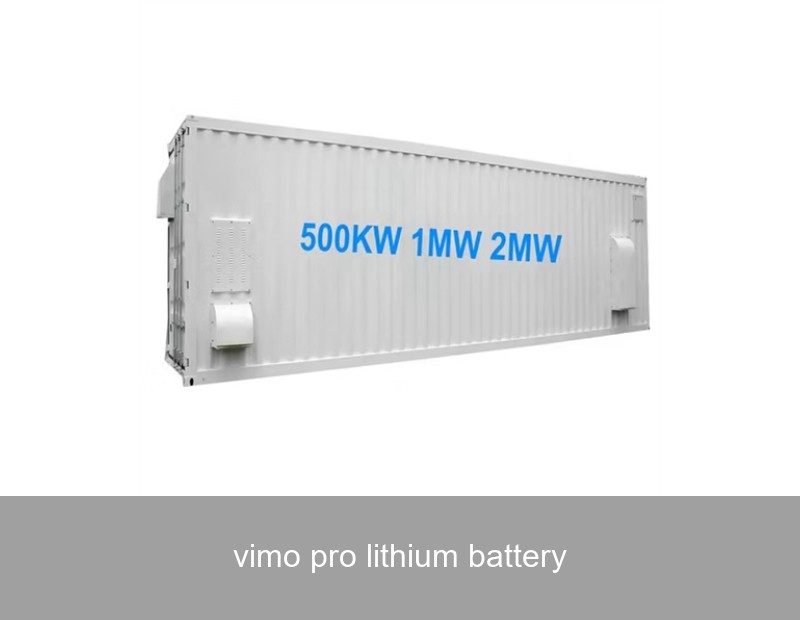
If you're exploring energy storage solutions, whether for your home, business, or community project, you've likely encountered a wave of new technologies. At the heart of this revolution is the lithium battery, but not all are created equal. The demand is shifting from simple backup power to intelligent, integrated systems that manage energy proactively. This is where advanced solutions like the VIMo Pro lithium battery come into play, representing a new standard in efficiency, intelligence, and durability for residential and commercial applications.
Table of Contents
- The Rise of Smart Storage: Beyond Basic Backup
- What Makes the VIMo Pro Lithium Battery Different?
- Real-World Impact: A Case Study from Bavaria
- The Highjoule Ecosystem: More Than Just a Battery
- Your Energy Future: Questions to Consider
The Rise of Smart Storage: Beyond Basic Backup
For years, energy storage was often an afterthought—a bulky, lead-acid battery in the basement providing limited backup during an outage. The modern energy landscape, however, tells a different story. With the dramatic increase in renewable generation, particularly solar PV, and the growing frequency of grid instability events, energy storage has become a central pillar of a resilient power strategy.
The data is compelling. According to the U.S. Department of Energy's Solar Futures Study, achieving decarbonization goals will require hundreds of gigawatts of storage to balance our grids. In Europe, the European Electricity Review 2024 highlights that renewables now generate over 40% of the EU's electricity, intensifying the need for flexible storage solutions to manage intermittency. The phenomenon is clear: we are moving from a one-way grid to a dynamic, two-way energy network where consumers are also producers—"prosumers."
What Makes the VIMo Pro Lithium Battery Different?
So, what should you look for in a modern lithium battery system? It's no longer just about kilowatt-hours (kWh). Key differentiators now include:
- Longevity & Cycle Life: How many charge/discharge cycles can it withstand before significant degradation?
- Depth of Discharge (DoD): Can you safely use 95%+ of the stored energy without harming the battery?
- Integrated Intelligence: Does it actively learn and adapt to your usage patterns and weather forecasts?
- Scalability & Safety: Can you easily expand capacity, and is the system designed with robust thermal management?
This is precisely the design philosophy behind Highjoule's VIMo Pro. Engineered with premium LiFePO4 (LFP) cells, the VIMo Pro series is built for endurance and safety. LFP chemistry is renowned for its thermal stability and long cycle life, a critical factor for daily cycling applications. But Highjoule took it further by integrating a sophisticated Battery Management System (BMS) that doesn't just protect the cells—it optimizes them.
Imagine a battery that communicates seamlessly with your solar inverters, home energy management system, and even the grid. The VIMo Pro's adaptive software can prioritize self-consumption of solar power, schedule charging during low-cost off-peak hours, and provide grid services if permitted. It's a thinking component of your energy ecosystem.

Image Source: Unsplash - A modern home energy system integrating solar and battery storage.
Real-World Impact: A Case Study from Bavaria
Let's move from theory to practice. Consider a mid-sized dairy farm in Bavaria, Germany. The farm operates energy-intensive cooling and milking systems and had installed a 50 kW rooftop solar array. Their challenge wasn't just backup; it was maximizing their solar self-consumption to reduce peak demand charges and insulate themselves from volatile energy prices.
In early 2023, they installed a Highjoule energy storage system centered around a scalable bank of VIMo Pro lithium batteries with a total capacity of 120 kWh, integrated with their existing solar and a new energy management controller.
| Metric | Before Installation (2022 Avg.) | After Installation (6-Month Avg. 2023) | Change |
|---|---|---|---|
| Solar Self-Consumption Rate | 35% | 89% | +154% |
| Grid Energy Import (Peak Hours) | 1,850 kWh/month | 320 kWh/month | -83% |
| Monthly Energy Cost | €2,400 | €950 | -60% |
The system was programmed to charge the VIMo Pro batteries with excess solar during the day, then power the evening milking and cooling cycles. During a regional grid outage in December 2023, the farm's critical operations continued uninterrupted for over 14 hours. The farm manager noted, "It's not just about saving money anymore; it's about operational resilience. The system pays for itself while guaranteeing we can care for our animals."
The Highjoule Ecosystem: More Than Just a Battery
At Highjoule, we understand that a battery is only as good as the intelligence that surrounds it. Founded in 2005, we've evolved from a component provider to a full-solution architect for commercial, industrial, residential, and microgrid applications. The VIMo Pro is a cornerstone product, but it shines brightest within our integrated Highjoule Energy Operating System (HEOS).
HEOS is the brain that coordinates solar, storage, grid interaction, and even generator backup. For our commercial clients, this means sophisticated load-shaving and demand-charge management. For homeowners, it means a simple, set-and-forget system that maximizes energy independence. Our services extend from initial consultancy and system design to remote monitoring, maintenance, and performance optimization over the system's entire lifespan, which for the VIMo Pro is engineered to exceed 6,000 cycles while maintaining 80% of its original capacity.

Image Source: Unsplash - Technician analyzing data from a large-scale battery storage system.
Your Energy Future: Questions to Consider
The transition to a smarter, more resilient energy setup is not a distant future concept—it's available today with technologies like the VIMo Pro lithium battery. As you evaluate your next steps, ask yourself:
- Is my current energy system merely reactive, or is it proactively managing costs and carbon footprint?
- How would a prolonged power outage affect my home, business, or critical community services?
- Am I fully leveraging my renewable energy investments, or is excess energy going to waste?
The choice of an energy storage partner is crucial. It requires a blend of cutting-edge hardware, proven software intelligence, and deep domain expertise. We invite you to explore what a tailored Highjoule solution, built around the reliable and intelligent VIMo Pro platform, can do for your energy resilience and sustainability goals. What will be the first load you choose to secure when the grid goes down?
 Inquiry
 Online Chat