


Which Panel is Best for Solar? A Guide to Maximizing Your Investment
So, you've decided to harness the sun's power. Congratulations! It's a smart move for your wallet and the planet. But as you start your research, one question quickly rises to the top: which panel is best for solar? The answer isn't a simple brand name. It's a balance of technology, efficiency, durability, and—crucially—how it integrates with a complete, high-performance energy system. As a leader in advanced energy storage, Highjoule has seen firsthand that the best solar panel is the one that works seamlessly with intelligent storage to deliver reliable, sustainable power day and night.
Table of Contents
Solar Panel Types: The Core Technologies
Today's market is dominated by three main technologies, each with its own profile. Let's break them down.
| Panel Type | Key Characteristics | Best For | Efficiency Range |
|---|---|---|---|
| Monocrystalline (Mono-Si) | Made from single-crystal silicon, dark black color, uniform appearance. | Premium residential and commercial projects where space is limited and high output is critical. | 20% - 23%+ |
| Polycrystalline (Poly-Si) | Made from melted silicon fragments, blueish hue, speckled look. | Budget-conscious installations with ample roof space. | 15% - 17% |
| Thin-Film (e.g., CdTe, CIGS) | Lightweight, flexible layers applied to surfaces, lower profile. | Large commercial roofs with weight constraints, unconventional surfaces, or utility-scale projects. | 10% - 13% (Commercial variants can be higher) |
While monocrystalline panels often lead in efficiency, the raw panel rating is just the opening chapter of your energy story. The real plot twist? Efficiency alone doesn't guarantee optimal energy yield or financial return over 25+ years.
Why Efficiency & Degradation Rates Are Your Long-Term Metrics
Think of panel efficiency as the engine's horsepower, but degradation is the engine's longevity. A premium monocrystalline panel might start at 22% efficiency but degrade at 0.5% per year. A cheaper option degrading at 1% per year will produce significantly less energy over its lifetime. According to the National Renewable Energy Laboratory (NREL), quality panels should have a degradation rate well below 0.7% annually.
This long-term view is where system thinking becomes essential. A high-efficiency panel paired with a mediocre inverter or no storage is like a sports car with flat tires. You need a holistic solution.
Looking Beyond the Panel: The System Integration Imperative
Asking "which panel is best for solar" is like asking which engine is best for a car. You need the whole vehicle. The true performance of your solar investment is determined by its integration with power conversion and storage.
- The Inverter Factor: Panels produce DC power; your home uses AC. The inverter's quality dictates how much of that precious DC power is successfully converted and managed. Microinverters or DC optimizers can mitigate shading issues, but they add complexity.
- The Storage Imperative: This is the game-changer. Without storage, excess solar energy produced at midday is exported to the grid, often at low rates. In the evening when you need power, you buy it back at a premium. The best solar panel system is one you can use on your own terms.
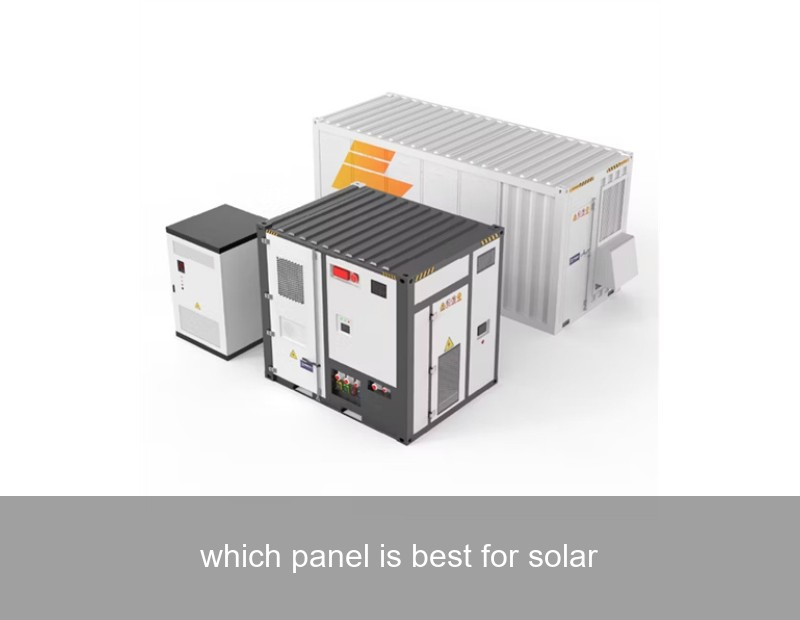
This is precisely where Highjoule's expertise transforms a simple solar installation into a resilient energy asset. Our IntelliBESS commercial and industrial battery storage systems and HomePower residential solutions are engineered to integrate seamlessly with high-efficiency solar arrays, regardless of panel brand. Our AI-driven energy management platform doesn't just store energy; it learns your consumption patterns, weather forecasts, and utility rates to autonomously dispatch stored solar energy when it provides the most value—maximizing self-consumption and ROI.

Image: A modern home solar plus storage installation. Credit: Unsplash.
Real-World Insights: A German Industrial Case Study
Let's move from theory to practice. In 2022, a mid-sized automotive parts manufacturer in Bavaria faced soaring energy costs and needed to secure predictable operational expenses. They installed a 550 kWp rooftop solar array using high-efficiency monocrystalline panels.
The Challenge: Their production peaked in the early morning and late afternoon, misaligned with solar peak generation. Over 40% of their solar yield was being fed to the grid during low-price hours.
The Highjoule Solution: They integrated a 500 kWh Highjoule IntelliBESS system. Our platform's algorithms were configured to:
- Store midday solar surplus.
- Discharge during high-price evening peaks and for early morning production ramp-up.
- Provide backup power for critical assembly lines.
The Data-Driven Outcome (12-month post-installation):
- Self-Consumption of Solar: Increased from 58% to 92%.
- Grid Energy Cost Reduction: 68% decrease.
- ROI Acceleration: The combined solar + storage system payback period was reduced by an estimated 4 years compared to solar alone.
This case, mirrored across Fraunhofer ISE's studies on sector coupling, proves that the value of a solar panel is unlocked by the intelligence of the storage system it's paired with.
Choosing the Right Partner for Your Solar Journey
So, how do you decide? Follow this actionable framework:
- Audit Your Load Profile: Look at your utility bills. When do you actually consume energy? A good installer will analyze this.
- Prioritize Total System Warranty: Seek partners who offer a single point of responsibility for panels, inverters, and storage.
- Demand a Storage-First Design: Ask for proposals that model solar + storage as a single solution, not as add-ons. Highjoule works with a global network of certified installers who specialize in this integrated approach.
- Evaluate the Software Brain: The storage system's software is its intelligence. Ensure it offers smart, forecast-based control and open protocol compatibility.
Highjoule's global experience since 2005, from sunny California homes to grid-constrained European industrial sites, has cemented one truth: energy independence isn't just about generation; it's about intelligent control and dispatch. Our products are designed to be the perfect complement to the world's best solar panels, ensuring every kilowatt-hour you produce is used strategically.

Image: A utility-scale solar farm. Credit: Unsplash.
Your Next Step
The journey to answering "which panel is best for solar" starts with a more powerful question: What specific energy independence and financial goals do you want your solar investment to achieve in the next decade, and how can intelligent storage help you get there faster?
We invite you to explore this question with one of our certified system integrators. Bring your solar quotes, and let's model how Highjoule's storage solutions can elevate their performance and your peace of mind.
 Inquiry
 Online Chat