


Which Solar Battery is the Best? A Guide to Smart Energy Storage
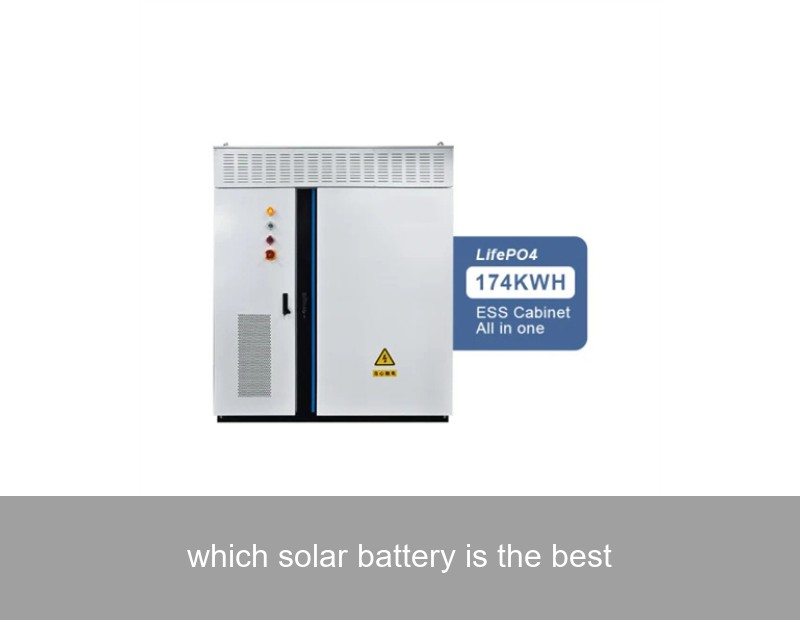
You've made the excellent decision to invest in solar panels. Now, you're watching them generate clean power during the day, but you might be wondering: how can I use that energy when the sun goes down? This is where the critical question arises: which solar battery is the best for my home or business? The answer isn't one-size-fits-all. The "best" battery is the one that optimally balances capacity, power, longevity, and intelligence for your specific energy needs. Let's demystify the key factors so you can make an informed choice for a truly resilient and efficient energy system.
Table of Contents
- The Energy Storage Phenomenon: Beyond Just Backup
- Key Metrics: Decoding Battery Specifications
- The Chemistry Showdown: Lithium-ion Variants
- Beyond the Battery: The Importance of System Intelligence
- A Real-World Case: The California Commercial Retrofit
- Making Your Choice: A Framework for Decision
- The Highjoule Approach: Engineered for Performance
The Energy Storage Phenomenon: Beyond Just Backup
For years, the primary driver for solar batteries was emergency backup power. While that remains a crucial benefit, the landscape has dramatically evolved. Today, the best solar batteries are integrated energy management systems. They help you maximize self-consumption—using more of the solar energy you produce—and provide financial benefits through mechanisms like time-of-use (TOU) rate arbitrage, where you store cheap energy to use during expensive peak hours.
Consider this data: The U.S. Energy Information Administration (EIA) notes that average electricity prices for U.S. homeowners have increased significantly over the past decade. Pair this with rising grid instability, and the value proposition of a solar battery shifts from a luxury to a strategic investment in energy independence and cost predictability.

Image: A modern home energy system combining solar panels and battery storage. Source: Unsplash
Key Metrics: Decoding "Which Solar Battery is the Best" for You
To compare batteries effectively, you need to speak the language of specs. Here are the non-negotiables:
- Usable Capacity (kWh): This is the amount of electricity the battery can actually store and you can use. It's like the size of your fuel tank. A typical home battery might range from 5 to 20 kWh.
- Power Rating (kW): This determines how much electricity the battery can deliver at one time. Think of it as the width of the hose. A higher power rating is needed to start large appliances (like air conditioners or well pumps) or to back up multiple circuits simultaneously.
- Depth of Discharge (DoD): Most batteries shouldn't be fully drained. A 95% DoD means you can safely use 95% of the battery's nominal capacity without harming it. Higher is better.
- Round-Trip Efficiency: The percentage of energy put into the battery that you can get back out. Losses occur due to heat and conversion. Top-tier systems offer over 90% efficiency.
- Warranty & Cycles: The warranty often guarantees a certain capacity (e.g., 70%) after a specified number of cycles (full charge/discharge) or years (e.g., 10 years). This is a key indicator of expected lifespan.
| Metric | What It Means | Why It Matters |
|---|---|---|
| Usable Capacity (kWh) | The "fuel tank" size of stored energy. | Determines how long your essential loads can run during an outage. |
| Power Rating (kW) | The "hose width" for delivering electricity. | Defines how many and what type of appliances you can power at once. |
| Round-Trip Efficiency | Energy out ÷ Energy in (as a %). | Higher efficiency means more of your solar energy is saved for your use, not lost as heat. |
The Chemistry Showdown: Lithium-ion Variants
While several chemistries exist, lithium-ion dominates the market. But not all lithium-ion is the same:
- Lithium Iron Phosphate (LFP): This is the rising star for stationary storage. LFP batteries are renowned for exceptional safety (thermal stability), long cycle life (often 6000+ cycles), and tolerance for full state-of-charge. Their energy density is slightly lower than NMC, but for home and business storage, safety and longevity are paramount. This chemistry has become the preferred choice for leading providers focused on reliability.
- Nickel Manganese Cobalt (NMC): Common in early EV and storage systems, NMC offers high energy density. However, it generally has a shorter cycle life than LFP and requires more careful management of its state-of-charge for optimal longevity.
When evaluating which solar battery is the best, the industry's clear trend is toward LFP chemistry for its safety profile and durability, making it a future-proof choice.
Beyond the Battery: The Importance of System Intelligence
The battery cells are just one component. The true "brain" of the system is the inverter and energy management system (EMS). A sophisticated EMS can:
- Prioritize between solar self-consumption, grid charging, and backup reserve.
- Seamlessly integrate with smart home devices and utility demand-response programs.
- Provide real-time monitoring and diagnostics via an intuitive app.
- Enable scalable expansion, allowing you to add more battery units as your needs grow.
Without smart software, you have a passive tank of energy. With it, you have an active financial and energy optimization tool.
A Real-World Case Study: The California Commercial Retrofit
Let's look at concrete data. A mid-sized winery in Napa Valley, California, faced crippling peak demand charges and frequent Public Safety Power Shutoffs (PSPS). Their existing solar system was offsetting daytime usage, but evening operations and grid outages remained a problem.
Solution: They installed a 100 kWh / 50 kW DC-coupled battery storage system. The system was programmed for peak shaving—discharging during the 4-9 pm window when utility rates were highest—and providing full backup for critical refrigeration and fermentation control systems.
- Demand Charge Reduction: 40% average monthly reduction, saving over $1,800 monthly.
- Increased Self-Consumption: Solar self-consumption rose from 30% to over 85%.
- Reliability: Seamlessly weathered 7 grid outages, protecting a vintage worth millions of dollars.
This case highlights that the best solar battery isn't just about chemistry; it's about a system configured to solve specific economic and operational challenges.

Image: A commercial-scale Battery Energy Storage System (BESS). Source: Unsplash
Making Your Choice: A Framework for Decision
So, how do you decide? Ask yourself these questions:
- What are my primary goals? (Maximize savings, ensure backup for essential loads, participate in grid services?)
- What is my critical load? (Calculate the total wattage of appliances you must run during an outage.)
- Do I need scalability? (Will my energy needs grow with an EV or home addition?)
- How important is safety and longevity? (LFP chemistry often provides greater peace of mind.)
The Highjoule Approach: Engineered for Performance and Intelligence
At Highjoule, with nearly two decades of experience since 2005, we've engineered our solutions around these core principles. We believe the best solar battery is part of a holistic, intelligent system.
Our HPS (Highjoule PowerStack) Series for residential and commercial applications utilizes advanced Lithium Iron Phosphate (LFP) cells, renowned for their safety and long cycle life. Each modular unit is designed for simple, scalable expansion. But the true differentiator is the Highjoule Energy Operating System (EOS). This proprietary platform acts as the brain of your energy ecosystem, continuously learning your usage patterns, integrating weather forecasts, and optimizing every kilowatt-hour for either maximum savings or maximum resilience based on your preferences.
For larger-scale needs, our containerized Megapack solutions provide utility-grade storage for microgrids and industrial sites, all managed by the same intelligent software layer. Whether for a home in Texas, a factory in Germany, or a community microgrid, Highjoule systems are built to deliver reliable, sustainable, and economically smart power.
Choosing the right solar battery is a significant step toward true energy independence. It's not just about picking a product off a shelf; it's about designing a system that aligns with your life and goals. So, we leave you with this: What single energy goal—whether it's never fearing a blackout again, eliminating your peak demand charges, or simply maximizing your use of clean solar power—would most transform your relationship with energy?
 Inquiry
 Online Chat