


The World Energy Summit 2025: Where Storage Takes Center Stage in the Global Transition
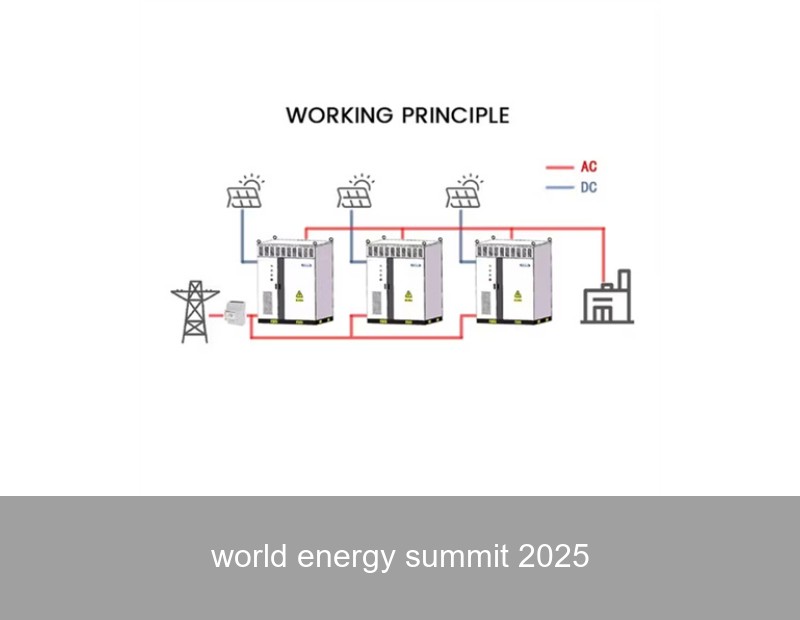
As the global energy community gears up for the World Energy Summit 2025, a pivotal shift is underway. The conversation is moving decisively from simply generating renewable power to intelligently managing it. The central question is no longer "How do we build more solar and wind?" but rather "How do we ensure this clean, abundant power is reliable, resilient, and ready when needed?" The resounding answer, and the undeniable theme you'll witness at the summit, is advanced energy storage. It’s the critical linchpin transforming our energy grids from fossil-dependent systems to flexible, clean networks.
The Storage Imperative: From Megawatts to Megawatt-Hours
Let's face a common challenge: the sun sets, and the wind calms. This intermittency of renewable sources creates a fundamental mismatch between supply and demand. We've all seen the headlines about grid strain during heatwaves or the dreaded "duck curve" that keeps grid operators up at night. This is the core phenomenon driving the storage revolution.
The data is compelling. According to the International Energy Agency (IEA), the world needs to add nearly 600 GW of energy storage capacity by 2030 to stay on track for net-zero goals. That's a massive leap from today's levels. This isn't just about backup power; it's about enabling a fundamental economic shift. Storage allows us to capture cheap, midday solar energy and dispatch it during expensive, high-demand evening peaks. This "energy time-shifting" flattens price curves, reduces reliance on peaker plants (often fossil-fueled), and directly lowers consumer costs.

Image: Utility-scale battery storage is becoming a common sight next to solar farms. Source: Unsplash.
The Hardware Evolution: More Than Just Lithium-Ion
While lithium-ion batteries dominate current discussions—and for good reason, given their rapidly falling costs and high efficiency—the World Energy Summit 2025 will showcase a broader portfolio. You'll hear about:
- Flow Batteries: Ideal for long-duration storage (4+ hours) with exceptional cycle life.
- Thermal Storage: Capturing heat or cold for industrial processes or district heating.
- Mechanical Storage: Innovations in compressed air (CAES) and gravity-based systems.
The "right" technology depends entirely on the application: is it for 2-hour frequency regulation, 4-hour solar shifting, or 8+ hours of grid resilience? This nuanced understanding is key.
Case Study: Texas Grid Resilience & The Data That Tells the Story
Let's move from theory to a real-world, data-driven example. The Electric Reliability Council of Texas (ERCOT) grid has faced significant weather-related challenges. In response, it has become one of the world's most active markets for battery storage. During a critical grid event in the summer of 2023, battery storage resources played a decisive role.
The Phenomenon: A prolonged heatwave led to record electricity demand, pushing the grid to its limits.
The Data & Case: On August 10, 2023, ERCOT reported that battery storage systems provided over 2,300 MW of instantaneous power during the evening peak—enough to power approximately 460,000 homes. Crucially, these systems didn't just discharge; they had charged earlier in the day using abundant, low-cost solar and wind power. This cycle directly prevented rolling blackouts and demonstrated storage's dual role as both a load and a generation resource.
The Insight: This Texas case proves that storage is no longer a pilot technology. It is a commercially viable, grid-critical asset that provides essential reliability services (like frequency response) and energy arbitrage. It's a blueprint for grids worldwide facing similar volatility from climate change and renewable integration.
Beyond the Box: Why BESS Hardware is Only Half the Story
Here's a crucial insight you'll hear from leading providers at the summit: a Battery Energy Storage System (BESS) is only as smart as its software. Stacking containers is one thing; making them work in perfect harmony with the grid's second-by-second needs is another. This is where the true innovation lies.
| Hardware Component | Software & Intelligence Layer | Business Value Created |
|---|---|---|
| Battery Cells & Racks | Advanced Battery Management System (BMS) | Maximizes lifespan, ensures safety, monitors health. |
| Power Conversion System (PCS) | Grid-Forming Inverter Controls | Can "hold up" the grid like a traditional power plant, enabling higher renewable penetration. |
| Enclosure & Thermal Management | AI-Powered Energy Management System (EMS) | Optimizes charge/discharge cycles for multiple revenue streams (e.g., energy trading, frequency regulation). |
An intelligent EMS can analyze weather forecasts, electricity prices, and grid signals to autonomously decide the most profitable and grid-supportive action for the battery every five minutes. Without this brain, a BESS is just a costly battery.
Highjoule's Role: Intelligent Storage for a Stable Grid
At Highjoule, with nearly two decades of experience since 2005, we've built our philosophy around this integrated hardware-software approach. As delegates at the World Energy Summit 2025 explore solutions, they'll find that our systems are designed for the complex realities of modern grids.
For our commercial and industrial (C&I) clients across Europe and the U.S., this means the Highjoule H-Series isn't just about backup power. It's a financial asset. Our AI-driven OptiCharge EMS seamlessly integrates with onsite solar, allowing a factory to maximize self-consumption, avoid peak demand charges from the utility, and even participate in demand response programs—all automatically.

Image: Intelligent energy management is key for industrial applications. Source: Unsplash.
On a larger scale, our Utility-Scale GridStack solutions are engineered for durability and grid support. Featuring our proprietary GridSync inverter technology, these systems can provide synthetic inertia and black-start capabilities, helping to stabilize grids with high renewable penetration. For microgrids in remote communities or critical infrastructure, Highjoule systems provide energy independence and security, blending solar, storage, and generator assets into a resilient, low-carbon power source.
Our services extend beyond installation. From initial feasibility studies and financial modeling to 24/7 remote monitoring and performance guarantees, we partner with clients for the entire lifecycle of the storage asset. This holistic support is essential for banks, investors, and operators who need certainty in a rapidly evolving market.
What This Means for Summit Delegates
When you walk the halls of the World Energy Summit 2025, you'll be evaluating not just products, but partners. Look for providers who can demonstrate:
- Proven Grid Interconnection: Real experience navigating complex utility interconnection processes in your target market (FERC in the U.S., ENTSO-E codes in Europe).
- Transparent Financial Modeling: Clear projections on ROI, considering all potential revenue streams (energy arbitrage, capacity markets, ancillary services).
- Cybersecurity & Safety: Stringent protocols, both in hardware design (like UL 9540 certification) and software architecture, are non-negotiable. The National Renewable Energy Laboratory (NREL) provides essential guidelines in this area.
Your Energy Future: Questions to Bring to the Summit
The discourse at the World Energy Summit 2025 will set the tone for the next decade of energy infrastructure. The transition is inevitable, but its speed, equity, and stability are not. Storage is the key determinant.
So, as you engage with experts, innovators, and policymakers, move beyond surface-level questions. Don't just ask about price per kWh. Instead, consider asking: "How does your solution's intelligence layer adapt to evolving market signals and grid codes, ensuring my investment is future-proof for the next 15 years?" or "Can you show me a case study where your system provided multiple stacked value streams simultaneously to a client with a profile similar to mine?"
The future grid is bidirectional, dynamic, and clean. Are you ready to be not just a consumer, but an active participant in its stability?
 Inquiry
 Online Chat