


"120kW Generator, How Much?" - Unpacking the True Cost of Backup Power
If you're a business owner, facility manager, or developing an off-grid project, the question "How much does a 120kW generator cost?" is likely just the tip of the iceberg. You're not just shopping for a piece of machinery; you're seeking reliability, operational continuity, and financial predictability. While a quick online search might give you a capital expenditure (CapEx) range of $25,000 to $45,000+ for a 120kW diesel generator, the true answer is far more complex. In today's landscape of volatile fuel prices, stringent emissions regulations, and a global push for sustainability, the initial purchase price is often the smallest part of the equation. This article will guide you through the total cost of ownership and introduce a smarter, cleaner alternative that forward-thinking businesses are adopting.
Beyond the Price Tag: The Real Cost of Ownership
Let's break down what "how much" really means over the lifespan of a traditional 120kW diesel genset.
The Visible Costs: Purchase and Installation
The upfront cost includes the generator unit, a sound-attenuated enclosure, a transfer switch, and professional installation. Factors like brand, fuel type (diesel, natural gas), and emission control systems (like DPF for Tier 4 Final standards in the US and EU) significantly influence this figure. Installation can add $5,000 to $15,000, depending on site complexity.
The Hidden and Ongoing Costs
This is where the financial picture becomes clear. Over 10 years, these costs can dwarf the initial investment.
- Fuel: The largest variable. A 120kW generator running at 80% load consumes roughly 10-12 gallons of diesel per hour. With fuel prices fluctuating, a prolonged outage can mean thousands in fuel costs alone.
- Maintenance: Regular oil changes, filter replacements, coolant servicing, and major overhauls are mandatory to ensure reliability. Annual maintenance can easily reach 5-10% of the initial purchase price.
- Emissions Compliance & Carbon Pricing: In many European and U.S. regions, operating diesel generators is subject to strict limits and potential carbon taxes, adding regulatory risk and cost.
- Noise & Environmental Impact: While not a direct line item, noise pollution can affect community relations and employee well-being, and diesel exhaust poses health risks.

Image Source: Unsplash (License: Free to use)
Case Study: A California Winery's Power Transformation
Let's look at a real-world example. A mid-sized winery in Sonoma County, California, was reliant on a 120kW diesel generator for backup during Public Safety Power Shutoffs (PSPS) and harvest season peaks. Their annual cost analysis was revealing:
| Cost Category | Annual Estimate (Diesel Genset) | Notes |
|---|---|---|
| Fuel for 150 hrs runtime | $9,000 - $12,000 | Based on 10 gal/hr & volatile diesel prices |
| Scheduled Maintenance | $2,500 | Oil, filters, inspections |
| Unscheduled Repairs | $1,500 (avg.) | Injection system, starter failures |
| Carbon/Emissions Fees | $500 | Local regulatory costs |
| Total Annual Operational Cost | $13,500 - $16,500 | Not including capital depreciation |
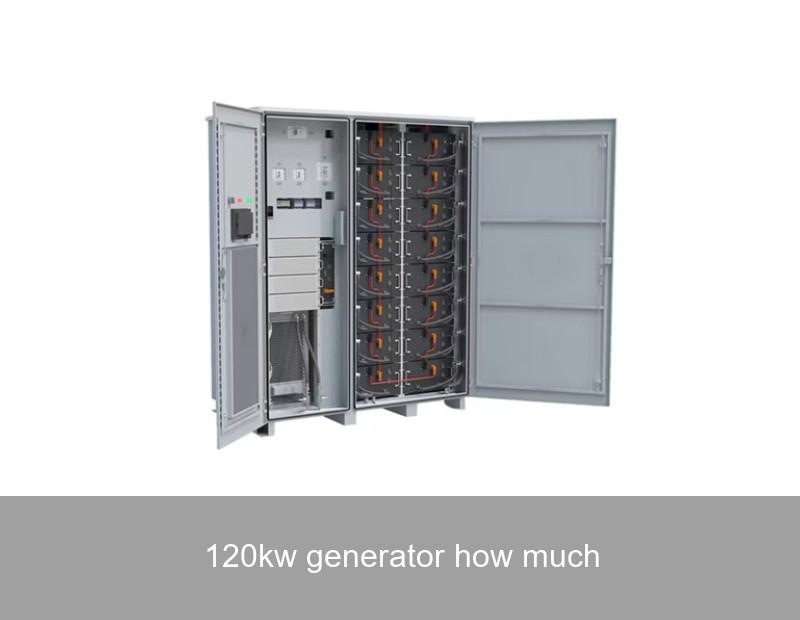
Facing these costs and a commitment to sustainability, the winery sought a new solution. They partnered with Highjoule to deploy a hybrid Solar + Battery Storage + Grid system, anchored by a Highjoule H-Stack Commercial Battery Energy Storage System (BESS) with a 150kW / 300kWh capacity. The results? During grid outages, the BESS seamlessly powers critical loads (fermentation tanks, cooling) for hours without noise or fumes. Solar production during the day offsets grid consumption and recharges the batteries. The system also participates in a local demand response program, generating revenue. Their diesel generator is now a rarely used last resort, slashing their annual backup power costs by over 80% and eliminating runtime fuel costs and emissions.
The Modern Solution: Hybrid Energy Systems
The future of reliable power isn't a single, fuel-dependent source. It's an integrated, intelligent system. For a 120kW power need, the answer is increasingly a hybrid system combining:
- Solar PV Array: Generates clean, free energy during the day.
- Battery Energy Storage System (BESS): The heart of the modern solution. It stores solar or cheap off-peak grid energy for use during outages, peak hours, or at night.
- Intelligent Energy Management System (EMS): The brain that optimizes when to charge, discharge, or import/export power, maximizing savings and reliability.
- Optional Generator Backup: A smaller, automated generator can serve as a final backup for extended low-renewable periods, but its runtime is drastically reduced.
According to a U.S. Department of Energy study, the declining cost of solar and storage is making hybrid systems economically viable for a wide range of commercial applications.
The Highjoule Advantage: Smart, Sustainable Power
At Highjoule, we've been pioneering advanced energy storage solutions since 2005. We understand that the question "120kW generator, how much?" is fundamentally about value, not just price. Our approach is to provide a comprehensive, intelligent power resilience platform.
For commercial and industrial clients in Europe and the U.S., our H-Stack Commercial BESS is the ideal cornerstone. Its modular design allows you to scale from 100kW to multi-megawatt configurations. When paired with our Aurora Energy Management Platform, it doesn't just provide backup; it actively manages your energy ecosystem:
- Peak Shaving: Automatically discharges batteries during expensive peak demand charges, slashing utility bills.
- Solar Self-Consumption Optimization: Stores excess solar energy for use later, maximizing your on-site renewable investment.
- Grid Services: In some markets, systems can provide frequency regulation, generating an additional revenue stream.
- Seamless Backup: Provides instantaneous, silent, and emissions-free backup power during grid failures.

Image Source: Unsplash (License: Free to use)
For residential and smaller commercial applications, our Home & Business PowerWall solutions offer the same intelligence in a compact form factor, ensuring your home or small business stays powered and efficient.
Making Your Decision: Key Factors to Consider
So, when evaluating your 120kW power needs, move beyond the simple generator quote. Ask yourself and your energy partner these questions:
- What are my critical loads? Do you need 120kW for 2 hours or 50kW for 10 hours? A BESS can be sized precisely for your needs.
- What is my total cost of ownership over 10-15 years? Model fuel, maintenance, carbon costs vs. solar/storage with minimal ongoing costs.
- What are my sustainability goals? Reducing carbon footprint is a powerful driver for modern businesses.
- Can my system generate revenue or savings? A smart BESS is an asset, not just an expense.
For more on calculating the levelized cost of storage, which helps compare technologies, reputable sources like the Lazard's Levelized Cost of Storage analysis provide valuable benchmarks.
Is your business ready to transition from a costly, noisy generator to a smart, clean, and financially savvy energy resilience system?
Contact Highjoule's energy experts today for a free, customized analysis. Let's calculate what your current backup power truly costs and design a system that powers your operations while protecting your bottom line and the planet. What's the first load you would want to secure with clean, reliable power?
 Inquiry
 Online Chat