


Understanding the Factors Behind a 15 kVA Solar Inverter Price in Sweden
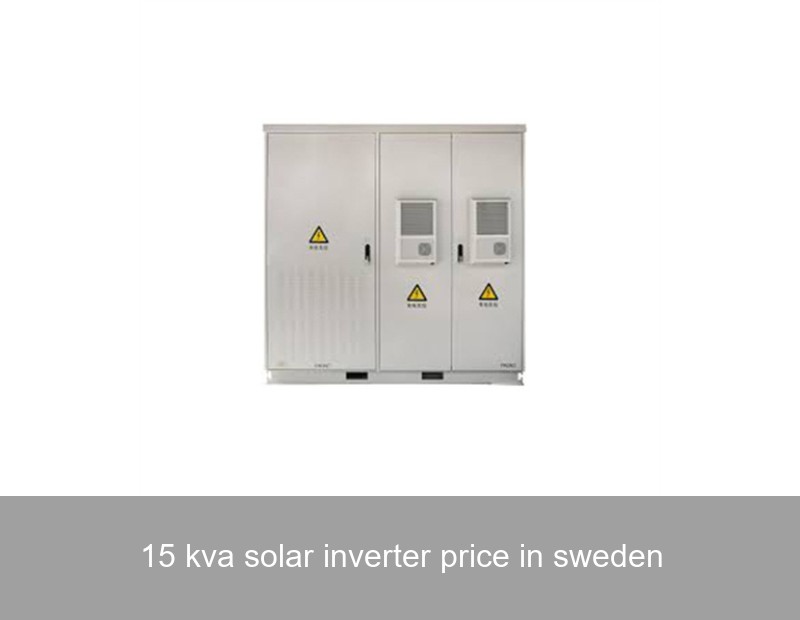
If you're planning a solar installation in Sweden, you've likely encountered the term "15 kVA solar inverter." This component is the intelligent heart of your photovoltaic (PV) system, converting the direct current (DC) produced by your panels into usable alternating current (AC) for your home or business. But when you start searching for a 15 kVA solar inverter price in Sweden, you'll quickly find a range of figures. Why is that? The price isn't just for a box with a label; it's an investment in technology, reliability, and long-term energy independence. In this article, we'll demystify the costs, explore the Swedish context, and explain what truly defines value in a solar inverter.
Table of Contents
- The Swedish Solar Landscape: More Than Just Midnight Sun
- Decoding the 15 kVA Solar Inverter: Capabilities and Applications
- Key Factors Influencing 15 kVA Inverter Pricing in Sweden
- Beyond the Price Tag: The Highjoule Difference in Smart Energy Management
- A Real-World Case: Värmdö Family Home's Year-Round Energy Solution
- Making an Informed Choice for Your Swedish Property
The Swedish Solar Landscape: More Than Just Midnight Sun
Sweden's energy journey is inspiring. With a national target of 100% renewable electricity production by 2040, solar power is playing an increasingly crucial role, even beyond the bright summer months. Contrary to popular belief, solar panels generate electricity effectively in cold, clear weather, and modern systems are designed to capture the long daylight hours of Swedish summers and the lower-angle light of winter. This growing market means a wide selection of equipment, but also requires products specifically engineered for Nordic conditions—think robust performance in temperature fluctuations and efficient operation under partial shading from trees or snow.
Decoding the 15 kVA Solar Inverter: Capabilities and Applications
A 15 kVA (kilovolt-ampere) inverter, often equated to a 15 kW (kilowatt) unit in solar contexts, is a powerful system suitable for larger residential properties, agricultural operations, or small-to-medium commercial buildings in Sweden. But what does 15 kVA really mean for you?
- Power Capacity: It can continuously handle up to 15,000 watts of AC power output, enough to manage a significant solar array (often 18-22 kWp) and heavy household loads like EV chargers, heat pumps, and saunas simultaneously.
- Three-Phase Power: In Sweden, 15 kVA inverters are almost exclusively three-phase. This is the standard for larger installations, providing balanced, stable power that is gentler on the grid and essential for running three-phase machinery.
- System Integration: Today's premium inverters are not just converters; they are energy managers. They coordinate with battery storage, grid interaction, and even home energy management systems.
Key Factors Influencing 15 kVA Inverter Pricing in Sweden
When you receive a quote, the 15 kVA solar inverter price in Sweden is shaped by several technical and market factors. Understanding these will help you compare offers effectively.
| Factor | Impact on Price & Performance |
|---|---|
| Inverter Topology & Efficiency | Transformers models are robust but slightly less efficient (~97%). Transformerless designs offer peak efficiencies over 98.5%, converting more sunlight into usable electricity, which is crucial for maximizing ROI in Sweden's varying light conditions. |
| Brand & Warranty | Established European brands with local service networks often command a premium. A 10-year standard warranty is common, but some, like Highjoule, offer extendable warranties, protecting your investment for the system's long life. |
| Smart Features & Grid Services | Advanced features like dynamic grid support, integrated energy management software, and readiness for virtual power plant (VPP) participation add value. These features future-proof your system against evolving grid regulations. |
| Installation & System Design | The inverter cost is part of a whole-system price. A qualified installer will design for optimal string configuration, shading mitigation, and proper ventilation, ensuring the inverter operates at its best. |
As a ballpark, for a quality 15 kVA three-phase inverter in Sweden, you can expect a price range of roughly SEK 25,000 to SEK 40,000 for the unit itself, with the total installed system cost being significantly higher when including panels, mounting, and labour.
Beyond the Price Tag: The Highjoule Difference in Smart Energy Management
At Highjoule, we believe the true value of an inverter lies in its intelligence and integration capabilities. Our HPS Series Hybrid Power Station, available in a 15 kVA configuration, is engineered for markets like Sweden where energy needs are dynamic.
It's more than an inverter; it's a unified DC-coupled storage system. This means higher round-trip efficiency for battery storage—a critical factor when storing precious summer sun for a dark winter evening. Our proprietary Adaptive Grid Interface (AGI) technology ensures seamless, compliant interaction with the Swedish grid, providing stability and even enabling potential revenue streams through grid services.

Image Source: Unsplash (Representative image of a modern energy system)
For commercial or microgrid applications, our Intelligent Microgrid Controller (IMC) can orchestrate multiple Highjoule systems, diesel generators, and load banks to create resilient, off-grid or grid-supportive energy islands—a solution gaining traction in remote Swedish communities and industrial sites.
Why Integration Matters for Swedish Homes
Imagine your system on a crisp March day in Stockholm. The sun is shining, your panels are producing, but your home demand is low. A basic inverter might simply export all excess to the grid. A Highjoule system, however, intelligently prioritizes charging your home battery bank. Later, when clouds roll in and electricity prices peak, it powers your home from the battery, not the grid. This smart autonomy is where real savings are unlocked.
A Real-World Case: Värmdö Family Home's Year-Round Energy Solution
Let's look at a concrete example. The Nilsson family in Värmdö, near Stockholm, wanted to achieve energy self-sufficiency for their 250 sqm home equipped with underfloor heating and an electric vehicle. Their installer designed a system with a 21 kWp solar array and a Highjoule HPS-15 hybrid inverter coupled with 25 kWh of lithium-ion storage.
- Challenge: High winter energy costs and desire for backup power during occasional grid outages.
- Solution: The Highjoule HPS-15 manages the entire ecosystem. In summer, surplus production charges the battery and intelligently exports to the grid when tariffs are favorable.
- Data & Outcome: System monitoring from 2023 shows an average 82% self-consumption rate—meaning they use over 80% of the solar energy they produce directly. Their annual electricity bill has been reduced by over 90%. During a 12-hour grid outage in December, the system automatically switched to island mode, powering essential circuits and keeping the house warm without interruption.

Image Source: Unsplash (Representative image of solar panels on a Scandinavian home in snow)
Making an Informed Choice for Your Swedish Property
So, how should you approach your decision? Focus on the total system value. Ask potential suppliers not just for the 15 kVA solar inverter price in Sweden, but for a detailed proposal that includes expected self-consumption rates, compatibility with future battery expansion, and the software capabilities for monitoring and control. Insist on products that comply with Swedish and EU grid codes, which are continuously evolving, as noted by the European Network of Transmission System Operators (ENTSO-E).
Highjoule's solutions are designed with this future in mind. We provide our partners and end-users with clear, actionable data through our energy management platform, turning a complex system into a simple tool for energy independence.
Ready to See the Full Picture?
What specific energy goals do you have for your property in Sweden, and how could a smarter inverter transform not just your energy bill, but your overall resilience and carbon footprint?
 Inquiry
 Online Chat