


Is a 1500 kWh per Month Solar System Right for Your Home or Business?
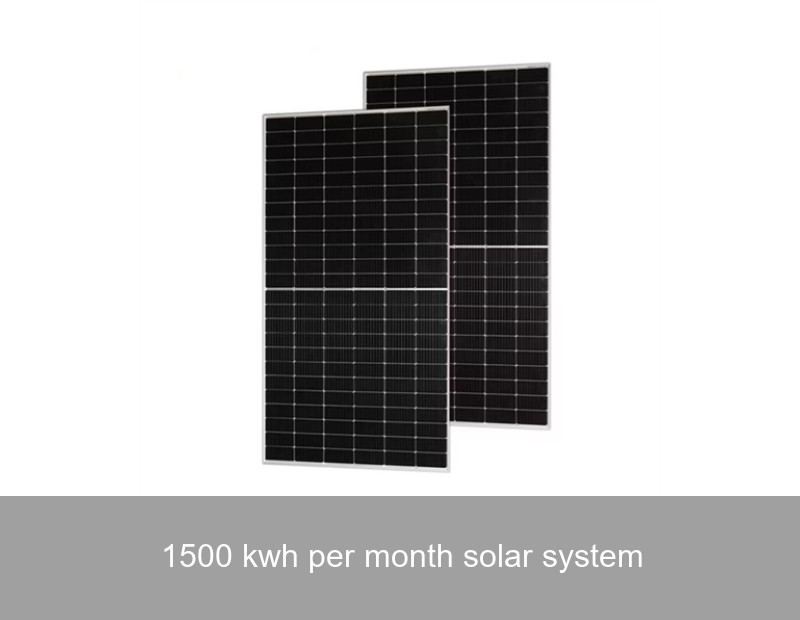
You've likely seen your electricity bill creeping up, or maybe you're simply planning for a more resilient and sustainable future. For many households and small businesses, a 1500 kWh per month solar system emerges as a powerful and popular target. But what does that number really mean, and how do you translate it into a reliable, cost-saving reality? As a product technology expert at Highjoule, I spend my days demystifying solar and storage. Let's break down the journey from a monthly energy goal to a complete, intelligent power solution on your roof and in your utility room.
Table of Contents
- Understanding the 1500 kWh Benchmark
- Sizing Your System: It's More Than Just Panels
- The Storage Imperative: Maximizing Your Solar Investment
- Real-World Case Study: A California Winery's Transformation
- Highjoule's Integrated Approach to Solar & Storage
- Your Energy Independence Journey
Understanding the 1500 kWh Benchmark
First, let's ground ourselves. A system designed to produce 1500 kilowatt-hours (kWh) per month averages about 50 kWh per day. To put that in perspective, the average U.S. household consumes approximately 899 kWh per month, according to the U.S. Energy Information Administration. So, a 1500 kWh/month target typically suits:
- Larger homes (3,000+ sq. ft.) with electric heating/cooling or pools.
- Energy-intensive households with multiple electric vehicles.
- Small to medium commercial operations like workshops, farms, or retail stores.
It's a significant amount of energy, representing a serious step towards energy independence. But here's the crucial first insight: solar production isn't constant. You'll overproduce on sunny summer days and underproduce on short, cloudy winter days. This variability is the core challenge a modern system must solve.

Image: A well-sized residential solar array. Credit: Unsplash
Sizing Your System: It's More Than Just Panels
So, how many panels make a 1500 kWh per month solar system? The answer depends heavily on your location. A system in sun-drenched Arizona will need fewer panels than one in Germany to hit the same monthly output.
Let's use a practical example with a simple formula:
| Location | Average Sun Hours (Peak) | Estimated System Size (kW) | Approx. Number of Panels (400W each) |
|---|---|---|---|
| Southern California, USA | 5.5 | 9.1 kW | 23 |
| Florida, USA | 4.5 | 11.1 kW | 28 |
| Northern Germany | 2.8 | 17.9 kW | 45 |
Calculation: Monthly Target (1500 kWh) / 30 days / Daily Sun Hours = Required kW size. (e.g., 1500 / 30 / 5.5 = ~9.1 kW).
This table reveals a key truth: geography is destiny in solar planning. A cookie-cutter approach fails. At Highjoule, our design process begins with a hyper-local analysis using satellite data and historical weather patterns to model production down to the kilowatt-hour, ensuring your system is neither undersized nor an overcapitalized behemoth.
The Storage Imperative: Maximizing Your Solar Investment
Now, let's address the elephant in the room: what happens when the sun goes down, or when the grid has an outage? A solar-only system often exports excess daytime power to the grid for credits (net metering), but these policies are changing rapidly in many U.S. states and European markets. The value of exported power is decreasing.
This is where Battery Energy Storage Systems (BESS) become non-negotiable for a true 1500 kWh per month solution. Think of it this way: your solar panels are the generators, but the battery is your intelligent energy manager. It:
- Stores Excess Daytime Energy: Captures your surplus solar for use at night, slashing your grid dependence.
- Provides Backup Power: Keeps critical loads running during grid outages—a growing concern.
- Optimizes Economics: Allows you to use cheap stored solar power during expensive peak-rate periods (time-of-use rates).
Without storage, a significant portion of your meticulously generated 1500 kWh may not deliver its full financial or resilience value.
Real-World Case Study: A California Winery's Transformation
Let's move from theory to practice. Consider a mid-sized winery in Sonoma County, California. Their challenge: high and unpredictable energy costs (over $3,000/month), critical refrigeration needs, and vulnerability to Public Safety Power Shutoffs (PSPS) during fire season.
- Goal: Achieve 85% energy self-sufficiency and ensure 48-hour backup for critical tanks and cold storage.
- Solution: A 45 kW solar array (designed to produce ~1,800 kWh/month in their location) paired with a Highjoule H-Joule 30 Commercial battery storage system (30 kWh capacity, scalable).
- Results (12 months post-installation):
- Grid electricity purchases reduced by 82%.
- During a 36-hour grid outage, the system maintained all critical operations seamlessly, preventing tens of thousands in potential product loss.
- By leveraging the battery's intelligent software to avoid peak demand charges, the winery achieved a full return on investment in under 7 years.

Image: Agrivoltaics, combining solar and agriculture. Credit: Unsplash
This case underscores that a "1500 kWh per month solar system" is rarely just solar. It's an integrated energy ecosystem.
Highjoule's Integrated Approach to Solar & Storage
Since 2005, Highjoule has evolved from a battery innovator to a global provider of complete, intelligent storage solutions. For a homeowner or business targeting a 1500 kWh/month energy profile, we don't just sell components; we deliver a guaranteed performance outcome.
Our H-Joule Residential Series and Commercial ESS products are built around a core philosophy: intelligence and durability. Our batteries use lithium iron phosphate (LFP) chemistry, renowned for its safety and long cycle life. More importantly, our proprietary EnergyOS software is the brain of the operation. It continuously learns your energy patterns, weather forecasts, and utility rate schedules to autonomously decide when to charge, discharge, or hold—maximizing every kilowatt-hour your solar panels produce.
For a system of this scale, we often recommend a modular design. You might start with a 10 kW solar array and a 20 kWh battery, with the clear pathway to scale to 15 kW and 40 kWh as your needs grow (perhaps with that second EV). This future-proofing is a cornerstone of our design service, ensuring your investment is protected for the long term.
Key Components of a Highjoule 1500 kWh/Month Solution:
- High-Efficiency Solar Panels: Partnered with top-tier manufacturers for optimal yield.
- Highjoule Hybrid Inverter: Seamlessly manages DC power from panels and AC power from battery/grid.
- Highjoule LFP Battery Bank: Scalable, safe storage with a industry-leading warranty.
- EnergyOS Monitoring Platform: Real-time and historical data on production, consumption, and savings at your fingertips.
This integrated stack, designed and installed by our certified network of partners, ensures all components communicate perfectly, avoiding the inefficiencies and finger-pointing that can plague mixed-vendor projects.
Your Energy Independence Journey
Embarking on a project of this scale requires trusted expertise. The landscape of incentives, like the U.S. Residential Clean Energy Credit or various European Union grants, is complex but can dramatically improve economics. A credible provider will help you navigate these.
So, as you contemplate a 1500 kWh per month solar system, ask yourself this: Is your goal simply to offset a bill, or is it to build a resilient, intelligent, and truly sustainable energy foundation for your home or business for the next 25 years? The technology and expertise exist today to achieve the latter.
What's the first energy load you would want to secure during a power outage, and how would that priority shape the design of your ideal solar and storage system?
 Inquiry
 Online Chat