


Solar Energy Storage Cabinet Batteries: The Ultimate Guide for Homeowners and Businesses
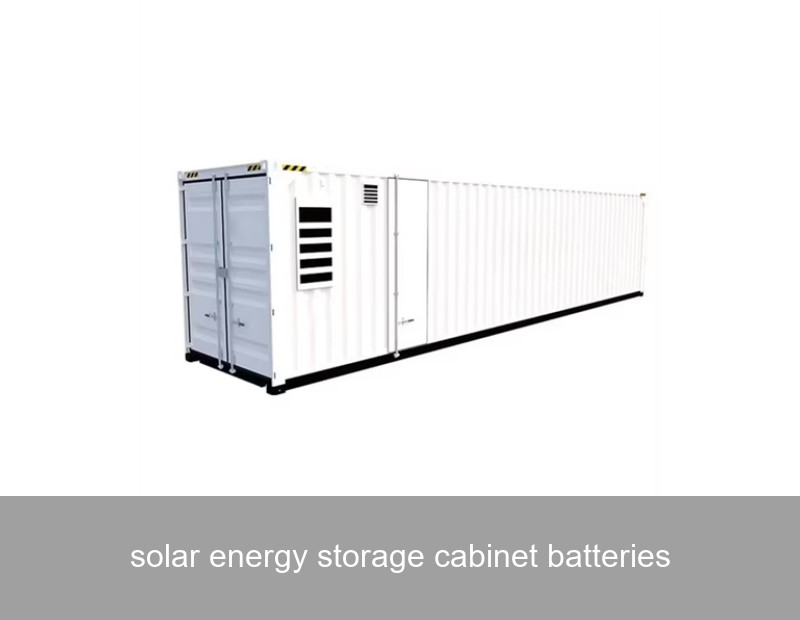
Have you ever watched your solar panels work hard under the midday sun and wondered, "Where is all that fantastic, clean energy going?" If you're not home using it, a significant portion might be feeding back into the grid for minimal compensation. This common frustration is precisely where solar energy storage cabinet batteries come into play, transforming how we capture and consume renewable power. These intelligent systems are more than just boxes of batteries; they are the keystone for energy independence, allowing you to store excess solar generation for use at night, during peak rate periods, or even during a grid outage. For forward-thinking energy users in Europe and the US, integrating a high-performance storage cabinet is the logical next step to maximizing a solar investment. As a leader in advanced energy storage since 2005, Highjoule designs smart, efficient, and sustainable solar energy storage cabinet batteries that empower commercial, industrial, and residential clients to take full control of their energy destiny.
Table of Contents
- The Problem: Wasted Sunlight and Rising Costs
- The Solution: How Solar Storage Cabinets Work
- Key Benefits of Modern Storage Cabinets
- A Real-World Case Study: Peak Shaving in Action
- Choosing the Right System: What to Look For
- Future Trends and Your Next Step
The Problem: Wasted Sunlight and Rising Costs
Let's face it: the sun's schedule doesn't align with our energy consumption habits. Most households see peak energy use in the early morning and evening, while solar production peaks around noon. This creates a mismatch. Without storage, excess solar energy is exported to the grid. While net metering policies exist, they are evolving, and compensation rates are often far lower than retail electricity prices. In some regions, feed-in tariffs have dropped by over 50% in the last decade. Furthermore, utility rate structures are increasingly shifting towards Time-of-Use (TOU) models, where electricity is significantly more expensive during "peak" evening hours. This means you might be selling your solar power cheaply at noon only to buy it back at a premium a few hours later. A solar energy storage cabinet battery system solves this core economic inefficiency.

Image: A modern home solar installation paired with a sleek battery storage cabinet. Source: Unsplash
The Solution: How Solar Storage Cabinets Work
Think of a solar energy storage cabinet as a sophisticated energy bank. It's a fully integrated system, typically comprising lithium-ion battery modules, a built-in battery management system (BMS), thermal controls, and power conversion electronics all housed in a secure, durable enclosure. Here's the simple cycle:
- Capture: During sunny hours, your solar panels generate DC electricity.
- Convert & Store: An inverter converts it to AC power for your home. Any surplus, instead of going to the grid, is directed to charge the batteries within the cabinet.
- Dispatch: When solar production drops (at night) or energy demand spikes, the system seamlessly draws power from the stored energy in the cabinet.
The intelligence lies in the system's software. Advanced energy management systems can be programmed to optimize for self-consumption, avoid peak demand charges (for businesses), or provide backup power during outages, all without any manual intervention.
Key Benefits of Modern Storage Cabinets
Investing in a quality storage system delivers a multi-faceted return on investment:
- Maximized Self-Consumption: Increase the portion of your own solar energy you use from 30-50% to 70% or more, drastically reducing grid reliance.
- Reduced Energy Bills: Avoid purchasing expensive grid power during peak times. For commercial users, storage can "shave" peak demand, leading to substantial savings on utility capacity charges.
- Backup Power Resilience: Weather events are becoming more frequent. A storage cabinet provides critical backup power, keeping lights on, refrigerators running, and, for businesses, operations functional.
- Grid Support & Sustainability: By reducing peak demand on the grid, you contribute to community-wide grid stability and further decrease collective reliance on fossil-fuel peaker plants.
A Real-World Case Study: Peak Shaving in Action
Consider the case of a mid-sized dairy processing plant in Bavaria, Germany. The facility had a 500 kW rooftop solar array but faced crippling demand charges due to high-energy cooling processes kicking in simultaneously in the late afternoon, coinciding with the end of solar production.
The Challenge: High peak demand from the grid, leading to over €45,000 annually in demand charges alone.
The Solution: The plant installed a 360 kWh Highjoule solar energy storage cabinet battery system, the H-Cube Industrial Series. This system was configured specifically for peak shaving.
| Metric | Before Installation | After Installation |
|---|---|---|
| Average Peak Demand from Grid | 850 kW | 620 kW |
| Monthly Demand Charge Cost | ~€3,800 | ~€2,100 |
| Annual Savings on Demand Charges | €20,400+ | |
| Solar Self-Consumption Rate | 41% | 89% |
The system paid for itself in under five years, providing a clear financial return while enhancing the plant's operational resilience. You can read more about the importance of demand charge management for businesses in this guide by the U.S. Department of Energy.
Choosing the Right System: What to Look For
Not all storage cabinets are created equal. When evaluating options, key technical and commercial factors include:
- Usable Capacity & Power: How many kilowatt-hours (kWh) can it store, and what is its continuous power output (kW)? Ensure it matches your nightly consumption or critical load needs.
- Depth of Discharge (DoD) & Cycle Life: Quality lithium-ion systems allow a DoD of 90%+ and are rated for thousands of cycles, ensuring a long service life.
- Round-Trip Efficiency: This measures how much energy you get out versus what you put in. Look for systems with >90% efficiency.
- Scalability & Integration: Can you easily add more battery modules later? Does it seamlessly integrate with existing and future solar inverters?
- Software & Smart Features: The brain of the system. Look for user-friendly apps, customizable operating modes, and compatibility with smart home ecosystems.
- Warranty & Support: A strong warranty (often 10 years) on both performance and capacity retention is a must.
The Highjoule Approach: Engineered for Reliability
At Highjoule, we've spent nearly two decades refining our approach to energy storage. We understand that a solar energy storage cabinet battery is a long-term investment in security and sustainability. Our product philosophy centers on three pillars:
- Intelligent Design: Our H-Cube (residential) and H-Cube Industrial cabinets are built with industry-leading LiFePO4 (LFP) battery chemistry, known for its exceptional safety, long cycle life, and thermal stability. The integrated Highjoule Energy Operating System (HEOS) provides predictive energy management, learning your patterns to optimize savings and performance automatically.
- Uncompromising Safety: From cell-level fusing and advanced BMS monitoring to robust, UL-certified enclosures, every layer of our design prioritizes safety for your home or business.
- Seamless Service: We offer comprehensive support, from initial site assessment and system design through installation by our certified partner network and ongoing performance monitoring. Our systems are designed for both new solar installations and retrofits to existing arrays.
For a deeper dive into battery chemistries, the National Renewable Energy Laboratory (NREL) provides excellent resources.

Image: Interior of a professionally engineered battery storage cabinet system. Source: Unsplash
Future Trends and Your Next Step
The landscape of home and business energy is shifting from passive consumption to active management. We're moving towards integrated energy ecosystems where solar energy storage cabinet batteries interact with electric vehicle chargers, smart appliances, and even the grid itself through virtual power plants (VPPs). This not only maximizes personal savings but also plays a vital role in building a more resilient and decarbonized grid. Highjoule is actively developing solutions for these next-generation applications, ensuring our clients are ready for the future of energy.
So, here's a question to ponder: With the technology available today to capture, store, and intelligently manage your own clean power, what does true energy independence look like for your home or business? Are you ready to stop watching your solar potential go to waste and start harnessing every kilowatt-hour?
 Inquiry
 Online Chat