


Understanding the True Cost: What's Behind the 1500 Watt Solar Panel Price?
So, you're considering a solar installation and have your eyes on a 1500-watt system. It's a popular size for many homes, offering a solid balance between energy production and upfront investment. But when you search for "1500 watt solar panel price," you're likely met with a dizzying range of figures. Why is that? The truth is, the sticker price of the panels themselves is just one piece of the puzzle. The real story of solar value is about the complete system, long-term performance, and the intelligence that manages it all. Let's demystify the costs and explore what truly powers your return on investment.
Table of Contents
- The Price Puzzle: More Than Just Panels
- Breaking Down the Costs of a 1500W Solar System
- The Storage Factor: Unlocking True Energy Independence
- A Real-World Case: The German Household Story
- The Highjoule Solution: Smart Integration for Maximized Value
- Future-Proofing Your Investment
The Price Puzzle: More Than Just Panels
Focusing solely on the per-panel or per-watt cost is like buying a car based only on the engine price, ignoring the chassis, transmission, and safety features. A 1500-watt (1.5kW) solar system typically comprises 4-5 high-efficiency panels. While commodity panel prices have decreased globally, the balance of system (BOS) costs—inverters, mounting, wiring, and critically, installation labor—now dominate the project budget, especially in markets like Europe and the U.S.
Furthermore, system design drastically impacts value. A 1500-watt system facing south in Arizona will produce far more energy than an identical system facing east in Scotland. This production difference, measured in kilowatt-hours (kWh), is what actually saves you money on your utility bill. Therefore, the key metric isn't just the system's cost, but the cost per generated kilowatt-hour over its 25+ year lifespan.

Image Source: Unsplash. A quality installation is a critical part of the long-term value, beyond just the panel price.
Breaking Down the Costs of a 1500W Solar System
Let's itemize a typical residential 1.5kW system installation in Western Europe or North America. Prices are approximate and pre-incentive.
| Component | Function | Estimated Cost Share |
|---|---|---|
| Solar Panels (4-5 units) | Convert sunlight to DC electricity | 20-25% |
| Inverter(s) (Micro or String) | Convert DC electricity to usable AC | 15-20% |
| Mounting Hardware & Racking | Securely attach panels to roof/ground | 10-15% |
| Electrical Components & Wiring | Connect system safely to your home grid | 10% |
| Permitting, Inspection, & Interconnection Fees | Meet local regulations and utility requirements | 5-10% |
| Installation Labor | Professional design and installation | 25-30% |
As you can see, the panels themselves are a minority of the total investment. This is why choosing a provider based on the lowest panel quote can be risky. Compromises on inverter quality, mounting durability, or installer expertise can lead to significant underperformance or maintenance costs down the line, erasing any initial savings.
The Storage Factor: Unlocking True Energy Independence
Here's a modern twist: a standalone solar system without storage often leaves money on the table. You generate power midday, but your consumption peaks in the morning and evening. Without a battery, excess energy is sold back to the grid at a low rate, only for you to buy it back later at a higher price.
Integrating a battery storage system transforms this dynamic. It allows you to store your solar surplus for use when the sun isn't shining, dramatically increasing your self-consumption rate. While this adds to the initial investment, it fundamentally changes the economics and resilience of your system. In regions with time-of-use rates or less stable grids, the payback period for a solar-plus-storage system can be highly attractive. According to the U.S. Department of Energy, pairing storage with solar is becoming increasingly common for maximizing bill savings and backup power.
A Real-World Case: The German Household Story
Let's look at data from a real project. A family in Munich, Germany, installed a 1.52kW rooftop system in 2022. Their goal was to reduce grid dependence and hedge against rising energy prices.
- System: 4 x 380W bifacial panels + a 5kWh integrated battery system.
- Challenge: High evening consumption despite good daytime solar yield.
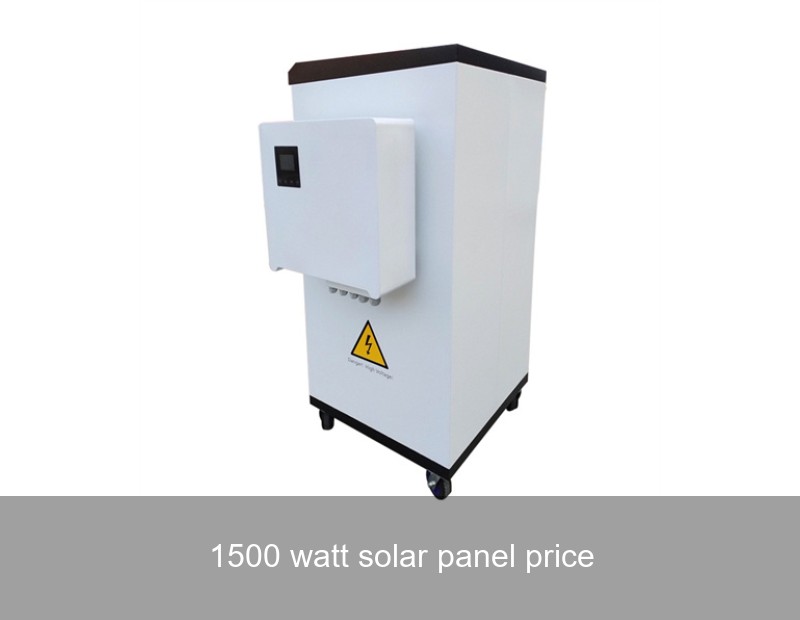
- Solution: They chose a solution from Highjoule, specifically the Highjoule HomePower SMI system. This all-in-one unit combines a hybrid inverter and a modular lithium-iron-phosphate (LiFePO4) battery in one compact cabinet, simplifying installation and management.
- Result: Within the first year, their self-consumption rate jumped from 35% (solar-only) to over 80%. The intelligent energy management software automatically optimized when to charge the battery from solar, when to power the home from the battery, and when to draw from or export to the grid based on real-time pricing signals. This smart operation increased their annual energy bill savings by approximately 140% compared to a solar-only scenario.
This case highlights that the value of a "1500 watt solar panel" installation is profoundly amplified by the intelligence of the accompanying storage and energy management system.

Image Source: Unsplash. Modern, integrated storage systems like Highjoule's HomePower series are key to maximizing solar investment.
The Highjoule Solution: Smart Integration for Maximized Value
At Highjoule, we view the solar panels as the engine, but the real magic lies in the powertrain and brain. Our approach is to provide seamlessly integrated systems where every component is optimized to work together. For residential and commercial clients exploring systems of all sizes, including 1500-watt configurations, we offer:
- The Highjoule HomePower Series: All-in-one energy storage systems that combine a hybrid inverter, a scalable LiFePO4 battery, and advanced management software. They are designed for easy installation and can be paired with any high-quality solar panels.
- Highjoule EnergyOS: Our proprietary software platform is the brain of the system. It uses AI and weather forecasting to predict energy production and consumption, making real-time decisions to save you the most money and ensure backup power readiness.
- Professional System Design & Support: Our network of certified installers doesn't just sell hardware; they design energy ecosystems. We ensure your 1500-watt system is perfectly sized, oriented, and integrated with storage to meet your specific consumption patterns and financial goals.
By focusing on the total system performance, we help customers navigate beyond the simplistic "panel price" question. The International Energy Agency (IEA) notes that innovation in system integration and digitalization is crucial for future cost reductions and value increases, a principle at the core of our product development.
Future-Proofing Your Investment
The energy landscape is shifting. Electric vehicles, smart appliances, and dynamic utility tariffs are becoming the norm. A system bought today on panel price alone might not be adaptable tomorrow. Modular, software-upgradable systems like those from Highjoule are built for this evolution. You can start with a 1500-watt solar array and a 5kWh battery, and easily expand storage capacity later as your needs grow—without replacing the core inverter.
So, the next time you evaluate a "1500 watt solar panel price," we encourage you to ask a different set of questions: What is the total cost for a fully installed, permitted system? How does the proposed inverter and software maximize the yield from my panels? What is the pathway to adding storage, and how will that impact my long-term savings and energy resilience?
What energy challenge in your home or business—be it unpredictable bills, a desire for backup power, or a step toward sustainability—are you hoping a solar investment will solve?
 Inquiry
 Online Chat