


Finding the Right Supplier of 22U Cabinet for Your Scalable Energy Storage Needs
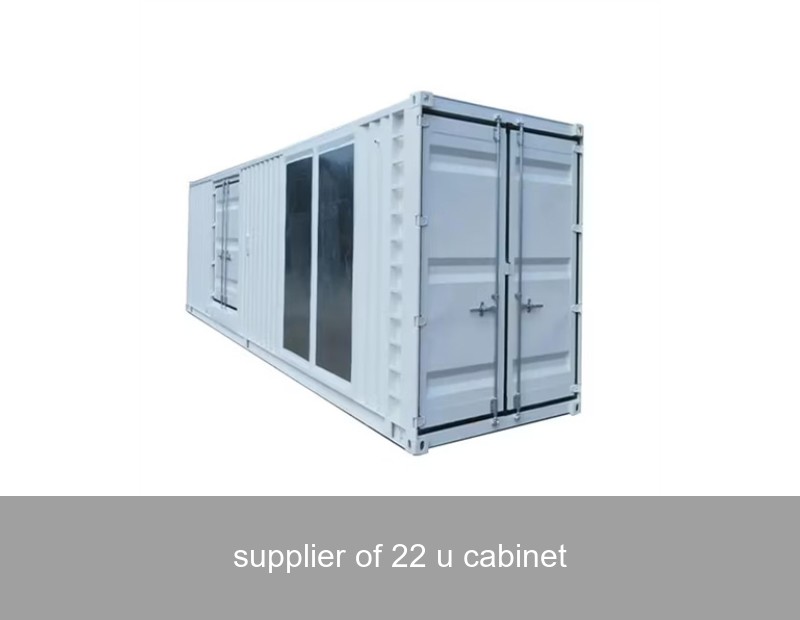
Let's talk about a common challenge in the renewable energy world. You have a commercial or industrial facility with growing energy demands and ambitious sustainability goals. You've decided that battery energy storage is the key to managing costs, increasing resilience, and integrating solar power. But then you hit a practical wall: space. Not every business has a vast warehouse to dedicate to a massive battery system. This is where the choice of a supplier of 22U cabinet becomes absolutely critical. It's not just about buying a metal box; it's about procuring a dense, intelligent, and future-proof power node that fits into your real-world constraints.
In data centers, a "U" (or rack unit) is a standard measure of vertical space in a server rack, equal to 1.75 inches. A 22U cabinet, therefore, offers about 38.5 inches of vertical mounting space. When applied to energy storage, this compact form factor is a game-changer. It represents a shift from sprawling, custom-built battery rooms to modular, pre-engineered systems that deliver significant power and capacity in a footprint that can often fit through a standard doorway. For project developers and facility managers across Europe and the US, selecting a supplier of 22U cabinet systems is a strategic decision impacting everything from installation cost to long-term operational flexibility.
The Space Squeeze: Why Density and Scalability Are Non-Negotiable
The phenomenon is clear: energy prices are volatile, grid stability is a growing concern, and the push for decarbonization is stronger than ever. The data tells a compelling story. According to the U.S. Energy Information Administration, commercial electricity demand is steadily rising, while in Europe, the IEA highlights record growth in renewable capacity, creating a pressing need for storage to balance intermittent generation.
This leads to a tangible problem. A manufacturing plant in Bavaria wants to add 500 kWh of storage to shave peak demand charges. A chain of grocery stores in California aims to back up each location with 2 hours of runtime. A university microgrid needs to expand capacity incrementally over five years. In each case, the available indoor or sheltered space is limited, expensive, or needs to be shared with other operations. A traditional, low-density battery system might require 50-100% more floor space than a high-density 22U cabinet-based solution. That's not just square footage; it's increased cabling, more complex thermal management, and higher overall balance-of-system costs.

Image Source: Unsplash - Illustrating efficient, high-density equipment installation.
The Highjoule Solution: Intelligent 22U Cabinet Systems
At Highjoule, we've been tackling this space and scalability challenge since 2005. Our approach as a leading supplier of 22U cabinet systems is to think beyond the enclosure. We provide fully integrated, smart energy storage units. Our flagship product line in this category, the Highjoule Nexus Series, is designed from the ground up for high energy density and seamless scalability.
What does this mean in practice? A single Highjoule 22U cabinet is a self-contained power station. It integrates:
- High-Density LiFePO4 Battery Modules: Utilizing the latest cell technology for safety, longevity (typically over 6,000 cycles), and maximum energy storage per cubic foot.
- Integrated Power Conversion System (PCS): Built-in inverters and converters that handle AC/DC transformation, eliminating the need for separate, bulky components.
- Advanced Thermal Management: A silent, efficient cooling system specifically engineered for the thermal dynamics of a densely packed cabinet, ensuring optimal performance and lifespan in diverse climates.
- Highjoule EnergyOS: The brain of the system. This proprietary software platform provides real-time monitoring, sophisticated energy management (like peak shaving and solar self-consumption optimization), and remote diagnostics.
Think of it this way: you're not just stacking batteries in a rack. You are deploying pre-assembled, tested, and intelligent "energy blocks." Need more capacity? Simply add another 22U cabinet alongside the first. Our systems are designed for parallel connection, allowing projects to start small and grow in modular increments, protecting your initial investment and providing unparalleled planning flexibility.
| Feature | Highjoule Nexus 22U Cabinet | Traditional Custom Rack System |
|---|---|---|
| Energy Density | Very High (Optimized cell packing & integrated PCS) | Moderate to Low |
| Installation | Plug-and-play, minimal on-site integration | Complex, requires multiple trades |
| Scalability | Fully modular, add cabinets as needed | Often requires complete system redesign |
| Footprint for 250 kWh | ~2-3 cabinets (compact) | Can require 50-100% more floor space |
| System Intelligence | Embedded (EnergyOS in every unit) | Often external, added separately |
A Real-World Case: Peak Shaving for a Mid-Sized Factory in Germany
Let's move from theory to hard data. In 2023, Highjoule partnered with a medium-sized automotive parts supplier in Stuttgart, Germany. The facility faced steep "netzentgelt" (grid fee) peaks and wanted to increase the consumption of power from its existing rooftop PV array.
- Challenge: Limited available space in the utility room; needed a solution to reduce peak grid draw by at least 150 kW for 2-hour periods.
- Solution: Installation of a cluster of three Highjoule Nexus 22U cabinets, providing a total of 270 kWh of usable energy and a continuous power output of 150 kW.
- Result: Within the first year of operation, the system achieved:
- A 22% reduction in peak demand charges.
- An increase in solar self-consumption from 35% to over 60%.
- The entire system was installed and commissioned in under three days, thanks to the pre-integrated, cabinet-based design.
The facility manager noted, "The ability to place these uniform cabinets right next to our main distribution board, without needing a major construction project, was decisive. It felt more like installing high-end IT equipment than a traditional power system."

Image Source: Unsplash - Representing professional installation and commissioning of industrial energy systems.
Beyond the Spec Sheet: Choosing the Right Supplier of 22U Cabinet Systems
So, you're convinced of the "what" and the "why." How do you choose the right partner? As a seasoned supplier of 22U cabinet solutions, we advise looking beyond the basic kWh and kW ratings. Here are the key questions to ask any potential vendor:
- Is it truly integrated? Does the cabinet contain just batteries, or does it include a UL/IEC-certified PCS, safety systems, and controls in one tested unit?
- How does it communicate and manage energy? The software is what turns stored electrons into savings. Can it interface with your building management system? Does it offer automated, market-aware strategies?
- What is the total cost of ownership? Consider efficiency (round-trip losses), expected cycle life, and cooling energy consumption. A slightly cheaper cabinet with lower efficiency can cost far more over a decade.
- What support and warranty come standard? Look for a supplier with a proven global service network and a comprehensive warranty that covers both performance and degradation.
Future Trends: Where is 22U Cabinet Technology Heading?
The evolution of the 22U cabinet is ongoing. At Highjoule, our R&D is focused on two key areas. First, increased energy density through solid-state and other next-generation cell chemistries, promising even more capacity in the same footprint. Second, enhanced grid services functionality. Future cabinets will act as autonomous grid agents, capable of providing ultra-fast frequency response (FFR) or virtual inertia services directly, creating new revenue streams for owners. The role of a supplier of 22U cabinet systems is evolving from hardware provider to a partner in grid intelligence.
Given the critical role these compact powerhouses will play in our energy transition, what specific challenge related to space, scalability, or grid interaction is the most pressing for your next project?
 Inquiry
 Online Chat