


Understanding the 20kWh Lithium Battery Price in Nigeria: A Guide to Smart Energy Investment
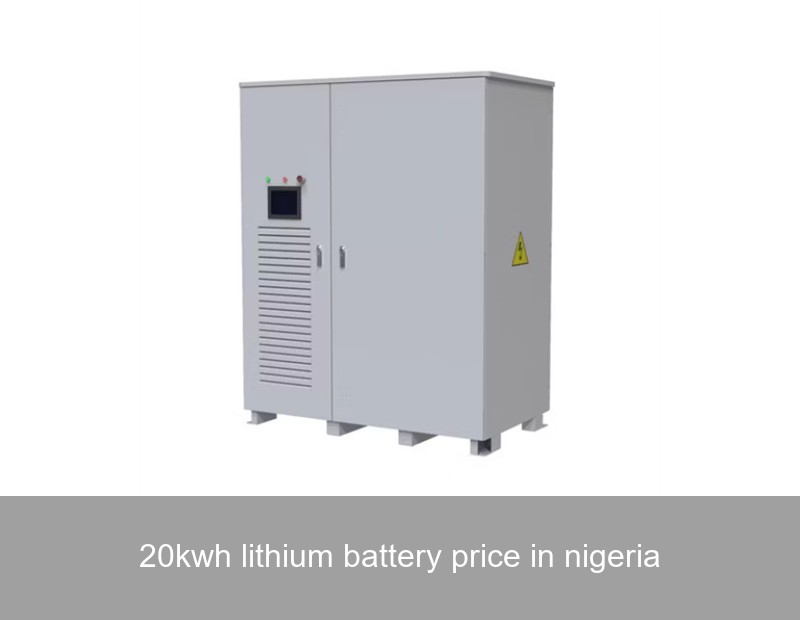
If you're researching a 20kWh lithium battery price in Nigeria, you're likely looking beyond just a product cost. You're investigating a key to energy independence, business continuity, and a sustainable power solution for a challenging grid environment. The quoted price is more than a number; it's a gateway to understanding value, technology, and long-term operational savings. In this guide, we'll demystify the factors influencing pricing and explore how advanced energy storage is transforming power access across Nigeria.
Table of Contents
- The Real Cost: Breaking Down the 20kWh Battery Price
- The Nigerian Energy Context: More Than Just Blackouts
- From Price to Value: The Long-Term Economics
- Highjoule's Tailored Approach for Robust Nigerian Solutions
- Case Study: Lagos Retail Complex Achieves 24/7 Power
- Making the Right Choice for Your Needs
The Real Cost: Breaking Down the 20kWh Battery Price
When you receive a quote for a 20kWh lithium battery price in Nigeria, it's essential to understand what you're paying for. The core battery cells are just one component. A complete, safe, and reliable Battery Energy Storage System (BESS) includes:
- Battery Cells & Module Assembly: The quality (e.g., Lithium Iron Phosphate/LFP vs. NMC) and brand of cells significantly impact cost and lifespan.
- Battery Management System (BMS): The intelligent "brain" that ensures safety, monitors cell health, and prevents overcharge or deep discharge. A premium BMS is non-negotiable for system longevity.
- Hybrid or Off-Grid Inverter: This critical component converts DC battery power to AC for your appliances and manages energy flow between solar panels, the grid, and the battery.
- Thermal Management & Enclosure: Systems designed for Nigeria's heat require robust cooling and protective enclosures.
- Installation, Wiring, and Commissioning: Professional installation ensures safety and optimizes performance.
- Import Duties, Logistics, and Warranty: These often-overlooked factors add substantially to the final price in the Nigerian market.
Therefore, comparing two "20kWh" quotes can be misleading. One might be for a barebones battery pack, while the other is for a fully integrated, UL-certified power solution designed for harsh conditions.
The Nigerian Energy Context: More Than Just Blackouts
The demand for systems like a 20kWh lithium battery in Nigeria isn't driven by trend but by necessity. The phenomenon of frequent grid outages (locally called "light out") is well-known. But let's look at the data: The World Bank reports that over 85 million Nigerians lack access to grid electricity, and those connected face unreliable supply. Businesses and households spend a staggering amount on diesel and petrol generators—billions of dollars annually—facing high fuel costs, noise, and pollution.
This creates a clear logical progression: Phenomenon (unreliable grid) → ReactionNeed (a clean, quiet, and sustainable alternative). A 20kWh lithium battery system, especially when paired with solar panels, directly addresses this need, transitioning users from constant fuel dependence to energy autonomy.

Image Source: Unsplash - Representative image of commercial solar installation.
From Price to Value: The Long-Term Economics
Focusing solely on the upfront 20kWh lithium battery price in Nigeria misses the bigger financial picture. The true metric is Levelized Cost of Storage (LCOS) – the total cost of owning and operating the system over its lifetime, divided by its total energy output.
| Cost Factor | Diesel Generator (Typical 20kVA) | 20kWh LiFePO4 Battery + Solar Hybrid System |
|---|---|---|
| Upfront Investment | Moderate | Higher |
| Fuel Cost (10-year period) | Extremely High & Volatile | ZERO (sunlight is free) |
| Maintenance Cost | High (oil changes, part replacements) | Very Low |
| Operational Noise & Fumes | High | None |
| System Lifespan | ~5-7 years (with heavy use) | 10-15+ years (for quality LFP batteries) |
As the table shows, while the initial battery system price is higher, the elimination of perpetual fuel costs and lower maintenance lead to a break-even point typically within 3-6 years, followed by years of virtually free backup power.
Highjoule's Tailored Approach for Robust Nigerian Solutions
At Highjoule, with nearly two decades of global experience, we understand that a system for Lagos or Abuja must be engineered differently than one for Berlin or California. Our products and services are designed with these specific challenges in mind.
For the Nigerian market, we emphasize our HPS (Highjoule PowerStack) Commercial Series. These modular lithium iron phosphate (LiFePO4) battery systems are built for resilience:
- Heat-Tolerant Design: Advanced passive cooling systems maintain optimal cell temperature, extending life in hot climates.
- Grid-Interactive Intelligence: Our systems seamlessly blend solar, battery, and generator input, prioritizing solar to maximize fuel savings.
- Robust Monitoring: Remote monitoring via the Highjoule Energy Cloud platform allows users and our support team to track performance and preempt issues.
We don't just sell a box with a 20kWh lithium battery price tag; we provide a comprehensive power audit, system design, and long-term performance guarantee backed by local technical partners. Our service ensures the solution fits the exact load profile of a home, clinic, telecom tower, or SME.
Case Study: Lagos Retail Complex Achieves 24/7 Power
Consider "The Apex Plaza," a medium-sized retail complex in Ikeja, Lagos. Their challenge was crippling: 8-10 hours of daily grid outage, requiring two 50kVA diesel generators running alternately, with a monthly fuel bill exceeding ₦2.5 million (approx. $2,700 USD in 2023).
The Solution: Highjoule and its local partner deployed a hybrid system featuring 45kW of rooftop solar and a 120kWh battery bank (scalable using our modular HPS units). The system was designed to cover critical loads and lighting.
The Data-Driven Outcome: Within 12 months of operation:
- Diesel generator runtime reduced by over 85%.
- Annual fuel savings: ~₦28 million (~$30,000 USD).
- Projected payback period: 4.2 years.
- Carbon emissions reduced by an estimated 42 tonnes annually.
This real-world example, verified by the complex's management, moves from phenomenon (high cost of outages) to data (specific savings) to a powerful case, leading to a clear insight: The investment in a correctly sized solar-plus-storage system is not an expense but a high-return asset that guarantees power and cuts operational costs.

Image Source: Unsplash - Representative image of a professional battery storage system interior.
Making the Right Choice for Your Needs
So, how should you approach your decision? Start by asking the right questions before fixating on a specific 20kWh lithium battery price in Nigeria:
- What are my critical loads (in watts) and how long do I need to power them during an outage?
- Do I have, or will I install, solar panels to charge the battery sustainably?
- What is the total cost of ownership over 10 years, including replacement, for my current generator vs. a battery system?
- Does the supplier offer local technical support, warranty enforcement, and system monitoring?
A reputable provider like Highjoule will start this conversation with an energy assessment, not just a product catalog.
Given your research into energy storage for Nigeria, what specific operational challenge—be it unpredictable fuel costs, noise complaints, or the need for silent, fume-free power for sensitive equipment—is most critical for you to solve right now?
 Inquiry
 Online Chat