


Demystifying the 2.5 Megawatts Solar Panel Price: A Complete Investment Guide
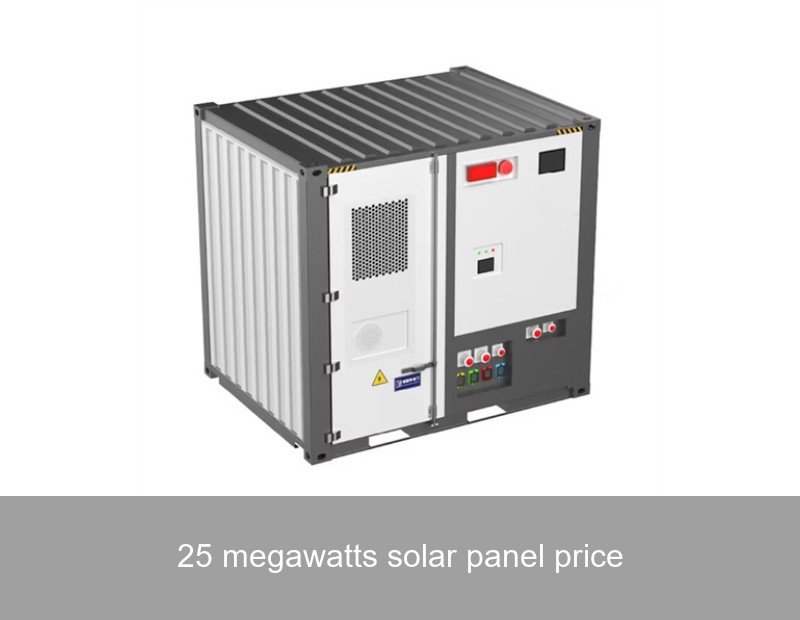
So, you're exploring a 2.5 megawatt (MW) solar installation. That's a serious commitment to clean energy and a significant financial decision. One of the first questions that comes to mind is, of course, "What's the 2.5 megawatts solar panel price?" While it's tempting to search for a simple per-watt figure, the reality is far more nuanced. The price tag of the panels themselves is just one piece of a much larger puzzle. In this guide, we'll break down the true cost drivers, showcase real-world data, and explain how partnering with an experienced system provider like Highjoule can transform your solar project from a capital expense into a strategic, value-generating asset.
Table of Contents
- Beyond the Panels: What Really Drives the Cost of a 2.5 MW System
- The 2.5 MW Solar System Price Breakdown: A Realistic Table
- Case Study: A 2.5 MW Commercial Rooftop in Germany
- Maximizing Your ROI: The Critical Role of Energy Storage
- How Highjoule Integrates Solutions for Optimal Performance
- Is Your Business Ready for a 2.5 MW Solar Power Shift?
Beyond the Panels: What Really Drives the Cost of a 2.5 MW System
Let's address the elephant in the room first. As of 2023-2024, the module price for solar panels can range from $0.20 to $0.40 per watt for tier-1 manufacturers, depending on technology (monocrystalline PERC, TOPCon, etc.). For a 2.5 MW system, that translates to a rough 2.5 megawatts solar panel price component of $500,000 to $1,000,000. However, this module cost typically only represents 25-35% of the total installed system cost, known as the "balance of system" (BOS).
Why is the BOS so significant? A 2.5 MW installation is an engineered power plant. It involves structural engineering for rooftop or ground mounts, high-efficiency inverters to convert DC to AC, a complex electrical wiring and switchgear setup, and most importantly, interconnection studies and approvals from your local utility. Labor, permitting, and soft costs can vary dramatically between, say, a sunny warehouse roof in Texas and a industrial facility in the Netherlands.

Furthermore, market dynamics play a huge role. The U.S. Inflation Reduction Act (IRA) and various European Green Deal initiatives offer substantial tax credits, grants, or accelerated depreciation. These incentives don't lower the upfront 2.5 megawatts solar panel price quote, but they dramatically improve the net cost and payback period, making the investment far more attractive.
The 2.5 MW Solar System Price Breakdown: A Realistic Table
To bring clarity, here's a simplified cost breakdown for a typical 2.5 MW commercial/industrial system in the U.S. or Europe. Remember, these are estimated ranges, and a detailed site-specific quote is essential.
| Cost Component | Estimated Cost (USD) | Percentage of Total | Notes |
|---|---|---|---|
| Solar Panels (Modules) | $500,000 - $900,000 | 25% - 35% | Varies by efficiency, brand, and supply chain. |
| Inverters & Power Conversion | $150,000 - $250,000 | 10% - 15% | Central or string inverters. Crucial for efficiency. |
| Mounting, Racking & Structural | $200,000 - $350,000 | 12% - 18% | Highly site-dependent (roof type, ground conditions). |
| Electrical Balance (Wiring, Switchgear) | $180,000 - $300,000 | 10% - 16% | Includes transformers, combiner boxes, and safety gear. |
| Installation Labor & Soft Costs | $400,000 - $600,000+ | 22% - 30% | Engineering, permitting, utility fees, installation labor. |
| Total Installed Cost (Before Incentives) | $1.43M - $2.4M | 100% | ~$0.57 - $0.96 per watt. |
As you can see, focusing solely on the 2.5 megawatts solar panel price misses over two-thirds of the financial picture. The real expertise lies in optimizing the BOS costs and designing a system that maximizes energy production for your specific location and consumption profile.
Case Study: A 2.5 MW Commercial Rooftop in Germany
Let's look at a real example from our portfolio at Highjoule. A mid-sized automotive parts manufacturer in Bavaria, Germany, approached us with a goal: reduce grid energy costs and hedge against volatile electricity prices. Their facility had a large, suitable rooftop area.
- Challenge: High daytime energy consumption, but significant evening shifts. Solar alone would not cover all usage, leading to continued high grid imports during non-sunny hours.
- Highjoule Solution: We designed and deployed a 2.48 MW rooftop solar PV system integrated with a 1.2 MWh battery energy storage system (BESS) using our Highjoule HiveStack™ technology.
- Data & Results:
- Total Project Cost (before incentives): ~€1.8 million.
- Annual Solar Generation: ~2,550,000 kWh.
- BESS enables 70% self-consumption of solar energy, up from an estimated 35% without storage.
- Combined with Germany's EEG framework, the project achieved a payback period of under 7 years.
The key takeaway? The client wasn't just buying solar panels at a price; they were investing in a comprehensive energy resilience and cost management solution. The storage component, often overlooked in initial "solar panel price" inquiries, was the linchpin for financial success.
Maximizing Your ROI: The Critical Role of Energy Storage
This case study highlights a pivotal trend. For commercial and industrial entities, the economics of solar have evolved beyond simple net metering. With time-of-use rates and demand charges, the goal is to use the solar energy you produce, not just sell it back at lower rates.
This is where adding a battery energy storage system (BESS) becomes a game-changer. It allows you to:
- Arbitrage: Store cheap solar energy for use during expensive peak grid periods.
- Demand Charge Reduction: Smooth out peak power draws from the grid, significantly lowering a major line item on utility bills.
- Backup Power: Ensure critical operations continue during grid outages.
When evaluating a 2.5 megawatts solar panel price, the most forward-thinking question is: "What is the price and value of a 2.5 MW solar + storage system?"
How Highjoule Integrates Solutions for Optimal Performance
Since 2005, Highjoule has moved beyond being just a component supplier. We are a provider of intelligent, integrated energy systems. For a 2.5 MW project, our process ensures every dollar is optimized:
- Smart Design & Simulation: Using advanced modeling tools, we predict not just solar yield, but the optimal storage size (like our HiveStack™ BESS) to match your load profile, maximizing ROI.
- Technology Agnostic Sourcing: We select from tier-1 solar panels and components based on the best performance-to-cost ratio for your project, not a single brand.
- Streamlined Project Execution: We manage the complex web of engineering, permitting, and utility interconnection, drawing on nearly two decades of global experience in Europe and North America.
- Long-Term Performance Management: Our Highjoule Horizon™ monitoring platform gives you real-time insights into system health, energy flows, and savings, ensuring your asset performs for decades.

By bundling the hardware, software, and services, we turn the complex variables behind the 2.5 megawatts solar panel price into a single, predictable, and high-performance outcome. You gain a partner focused on your levelized cost of energy (LCOE), not just the lowest upfront cost.
Is Your Business Ready for a 2.5 MW Solar Power Shift?
The journey to a 2.5 MW solar installation starts with understanding the full scope, but it culminates in asking the right strategic questions. What are your true drivers: pure cost savings, sustainability goals, energy independence, or resilience? How does your energy consumption pattern align with solar production? Have you considered the multiplier effect of adding storage, not just for savings but for future-proofing against grid instability?
The landscape of incentives, like those detailed by the U.S. Department of Energy, is more favorable than ever. The conversation is no longer about if solar is viable, but how to implement it most intelligently.
We invite you to share your initial thoughts: What is the biggest hurdle or question you have when considering a solar project of this scale for your business? Is it the upfront capital, the complexity of implementation, or quantifying the long-term value?
 Inquiry
 Online Chat