


Energy Storage Cabinet High Voltage: The Backbone of Modern Power Resilience
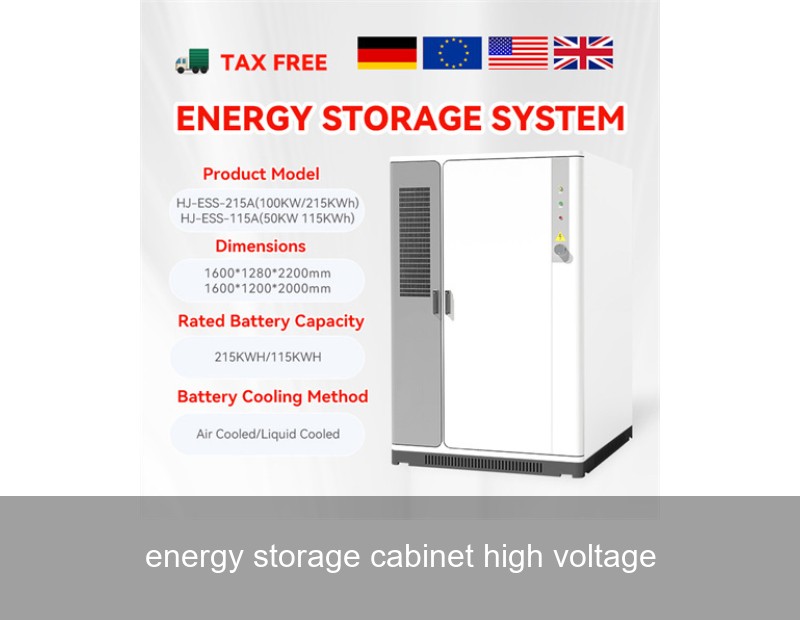
Have you ever wondered what keeps a large factory running smoothly during a grid outage, or how a solar farm continues to supply power long after the sun sets? The answer increasingly lies in a robust, centralized piece of technology: the high-voltage energy storage cabinet. As industries and utilities worldwide push for greater efficiency and sustainability, these systems are moving from the background to the very forefront of energy strategy. This article delves into why high-voltage energy storage is becoming the preferred choice for demanding applications and how it's shaping a more resilient energy future.
Table of Contents
The Voltage Shift: Why High Voltage is Winning
For years, many commercial and industrial energy storage systems operated at lower voltages (typically around 400V-600V). However, a significant trend is underway. System designers are now opting for energy storage cabinet high voltage configurations, often operating at 800V, 1000V, or even 1500V DC. Why this shift? The reasons are rooted in fundamental physics and economics.
Think of it like transporting water. Moving a large volume through a small pipe requires high pressure and results in significant losses. But if you use a wider pipe, you can move more water with less effort. Similarly, higher voltage acts as that "wider pipe" for electricity. It allows for the transmission of more power (kilowatts or megawatts) with lower current. Lower current means:
- Reduced Energy Loss: Heat loss in cables and components is proportional to the square of the current (I²R loss). Halving the current reduces these losses by 75%, directly boosting overall system efficiency.
- Lower Component Costs: With lower current, you can use cables with smaller cross-sections and less expensive switchgear, leading to material savings and simpler installation.
- Higher Power Density: A high-voltage energy storage cabinet can pack more power into a smaller footprint, a critical factor when real estate is expensive.
This isn't just theory. A report by the National Renewable Energy Laboratory (NREL) highlights that moving to 1500V systems from 1000V can reduce balance-of-system costs by up to 20%. This compelling data is driving adoption across the sector.
Inside the High-Voltage Energy Storage Cabinet
So, what exactly makes up a modern high-voltage energy storage cabinet? It's far more than just a box of batteries. It's an integrated, intelligent power ecosystem. Let's break down the core components you'll find in a top-tier system, like those engineered by Highjoule.
| Component | Function | Highjoule's Approach |
|---|---|---|
| Battery Modules | The core energy storage medium, using Li-ion phosphate (LFP) chemistry for safety and longevity. | High-density, UL9540A certified modules with built-in thermal management channels. |
| Battery Management System (BMS) | The "brain" that monitors cell voltage, temperature, and state of charge to ensure safety and health. | A multi-layer BMS with active balancing and predictive analytics for proactive maintenance. |
| Power Conversion System (PCS) | Bi-directional inverter that converts DC battery power to AC for the grid/load, and vice-versa for charging. | High-efficiency (>98.5%) inverters specifically tuned for high-voltage DC link, reducing conversion losses. |
| Thermal Management | Critical for safety and performance; maintains optimal battery temperature. | Liquid cooling systems for precise temperature control, ensuring consistent performance in all climates. |
| Energy Management System (EMS) | The supervisory controller that optimizes charging/discharging based on tariffs, weather, and load patterns. | Highjoule's AI-powered GridSynkTM EMS, enabling automated peak shaving, demand response, and microgrid control. |
Image: A modern, well-organized energy storage cabinet interior. Credit: Unsplash (Representative image)

Highjoule's HVS Series High-Voltage Storage Cabinets embody this integrated philosophy. Designed for commercial and industrial scale, they are pre-assembled and tested for rapid deployment. Their modular architecture allows capacities from 500 kWh to multi-MWh configurations, all managed as a single, seamless asset. This plug-and-play approach significantly reduces on-site installation time and complexity, a major concern for project developers.
Real-World Impact: A Case Study from Bavaria
Data and specs are one thing, but real-world performance is what truly matters. Let's look at a concrete example of a high-voltage energy storage cabinet system in action.
Project: Mittelstand Automotive Parts Manufacturer, Bavaria, Germany.
Challenge: High demand charges from short, intense periods of machinery use (stamping presses), coupled with a desire to increase on-site consumption of rooftop solar PV and ensure backup power for critical processes.
Solution: Installation of a 1.2 MWh Highjoule HVS-1500 cabinet system, operating at 1500V DC, integrated with their existing 800 kWp solar array and manufacturing load center.
Results (12-month period):
- Demand Charge Reduction: Peak grid draw was shaved by 40%, leading to an estimated annual savings of €68,000 on power costs.
- Solar Self-Consumption: Increased from 35% to over 80%, maximizing their ROI on solar panels.
- Backup Power: Provides 4 hours of full critical load coverage, mitigating the risk of production stoppages.
- Efficiency: The high-voltage architecture achieved a round-trip efficiency of 94% from AC to AC, ensuring minimal energy was wasted in storage cycles.
This case illustrates the multi-faceted value proposition: direct cost savings, enhanced sustainability, and operational resilience—all delivered by a single, centralized energy storage cabinet high voltage system.
Key Applications for High-Voltage Cabinets
The versatility of these systems is remarkable. Their ability to deliver large amounts of power quickly makes them ideal for several critical applications:
- Industrial & Commercial Peak Shaving: This is the "killer app." By discharging the cabinet during a facility's short periods of highest electricity demand, businesses can avoid punitive demand charges, which often constitute 30-50% of a commercial electricity bill.
- Renewable Energy Firming: Solar and wind are intermittent. A high-voltage storage cabinet can soak up excess generation during peak production and release it when generation falls, creating a smoother, more dispatchable output. This is crucial for meeting grid connection requirements and maximizing revenue.
- Microgrids & Critical Infrastructure: For hospitals, data centers, or remote communities, these cabinets form the heart of an islandable microgrid. They provide seamless transition during grid failures and stabilize the local network. Highjoule's systems are often the core of turnkey microgrid solutions for remote industrial sites.
- Electric Vehicle Charging Hubs: Deploying high-power EV chargers (350kW+) can strain local grid infrastructure. A high-voltage storage cabinet acts as a buffer, charging slowly from the grid and then dumping high power into EVs as needed, avoiding costly grid upgrades.
Image: A solar farm paired with containerized battery storage. Credit: Unsplash (Representative image)

Choosing the Right System: What to Consider
Selecting a high-voltage energy storage cabinet is a significant investment. Beyond basic specs like power (kW) and capacity (kWh), here are the crucial factors to discuss with any provider:
- Safety Certifications: Insist on UL 9540 and UL 9540A (cell level) certifications. These are the gold standard for fire safety, especially for indoor installations.
- Thermal Management: Ask: Is it air-cooled or liquid-cooled? For high-power, high-density applications, liquid cooling offers superior temperature uniformity, which extends battery life and maintains performance.
- Software Intelligence: The hardware stores energy, but the software creates value. Can the EMS integrate with your building management system? Does it offer sophisticated, forecast-based optimization?
- Service and Warranty: Look for a provider with a strong global service network. Highjoule, for instance, offers a comprehensive 10-year performance warranty with remote monitoring, ensuring long-term peace of mind.
The Future of High-Voltage Energy Storage
The trajectory is clear. As battery chemistry continues to evolve, with solid-state batteries on the horizon, the underlying architecture of the energy storage cabinet high voltage is set to dominate. We are moving towards systems that are not only more powerful and efficient but also more interactive. Imagine cabinets that autonomously participate in grid services markets, forming decentralized virtual power plants (VPPs) that support grid stability while generating revenue for their owners. The integration of AI for predictive maintenance and energy arbitrage will make these assets even smarter.
For a deeper dive into grid-scale storage trends, the U.S. Department of Energy's Energy Storage Hub is an excellent resource.
Is your organization ready to assess how a high-voltage energy storage system could transform your energy costs, reliability, and sustainability goals? What would a 30% reduction in your peak demand charges mean for your bottom line this year?
 Inquiry
 Online Chat