


Unlocking Grid Stability and Renewable Integration: The Role of 40MW On-Grid Energy Storage Cabinets
a sunny afternoon in California, solar farms are producing at peak capacity. Suddenly, a cloud bank rolls in, causing a rapid, multi-megawatt drop in generation. How does the grid operator maintain stability? Or imagine a frigid winter evening in Germany, with wind power low and demand soaring. The answer to both scenarios increasingly lies in a powerful, responsive technology: the on-grid energy storage cabinet. And when we talk about utility-scale impact, systems like a 40MW on-grid energy storage cabinet are becoming the workhorses of the new energy paradigm.
The Modern Grid Challenge: Intermittency Meets Demand
The global push towards renewable energy is undeniable and essential. However, the inherent variability of solar and wind power creates a complex challenge for grid operators. The grid must be balanced in real-time—generation must always equal consumption. This is where large-scale battery energy storage systems (BESS) step in as the critical buffer. A 40MW on-grid energy storage cabinet represents a substantial building block in this infrastructure, offering a controlled, instantaneous resource to inject or absorb power as needed.

According to the International Energy Agency (IEA), global grid-scale battery storage capacity is set to multiply exponentially, driven by the need for grid flexibility. The 40MW scale is particularly significant for several key grid services:
- Frequency Regulation: Correcting minute-to-second deviations in grid frequency, a service where batteries excel due to their sub-second response times.
- Renewable Firming: "Smoothing out" the power output from a solar or wind farm, making it more predictable and reliable for the grid.
- Peak Shaving: Discharging stored energy during periods of high demand (peak hours) to avoid firing up expensive and polluting "peaker" plants.
- Voltage Support: Providing reactive power to maintain voltage levels within required limits, ensuring power quality.
What is a 40MW On-Grid Energy Storage Cabinet?
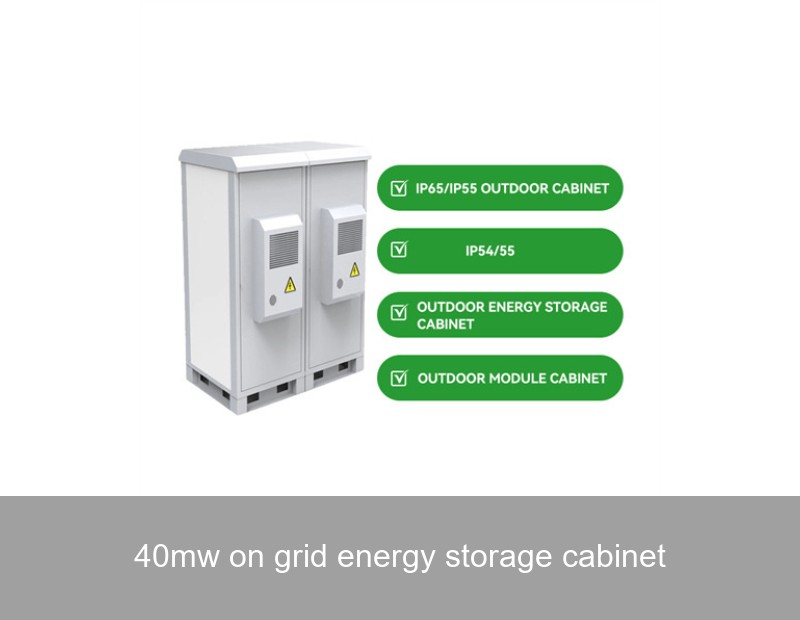
Let's demystify the terminology. A 40MW on-grid energy storage cabinet is not a single, giant box. It's a modular, containerized system that aggregates multiple battery racks, power conversion systems (PCS), and thermal management into a scalable unit. The "40MW" refers to its power rating—its instantaneous discharge (or charge) capacity. The energy capacity (MWh) is determined by the battery technology and duration, typically 2-hour (80MWh) or 4-hour (160MWh) systems.
| Component | Function | Importance |
|---|---|---|
| Battery Modules (Li-ion, LFP) | Store electrical energy chemically | LFP (Lithium Iron Phosphate) is now the dominant chemistry for grid-scale due to its safety, longevity, and cost-effectiveness. |
| Power Conversion System (PCS) | Converts DC battery power to AC grid power and vice versa | The "brain" of the operation, managing grid connection, charge/discharge cycles, and grid services. |
| Energy Management System (EMS) | Controls the system based on market signals or grid needs | Optimizes revenue or grid value by deciding when to charge (often when power is cheap/abundant) and when to discharge. |
| Thermal Management | Cooling/heating system for batteries | Critical for safety, performance, and extending battery lifespan to 15+ years. |
Key Benefits & Commercial Applications
For commercial and industrial (C&I) entities, independent power producers (IPPs), and utilities, deploying a 40MW-scale system is a strategic investment. The benefits are both economic and operational.
- Revenue Generation: Systems can participate in wholesale energy markets (arbitrage), sell frequency regulation services, or provide capacity payments.
- Infrastructure Deferral: Utilities can use storage to relieve congestion on transmission lines, delaying costly upgrades. Enhanced Renewable ROI: A solar or wind farm paired with storage can sell power during more lucrative evening hours, increasing project revenue.
- Backup Power & Resilience: While primary frequency response is their main grid role, these systems can provide critical backup during extreme events.
Case Study: A 40MW System in Action – The UK's Stability Pathfinder
A compelling real-world example comes from the United Kingdom. National Grid ESO (the system operator) launched its "Stability Pathfinder" program to address declining system inertia. In 2022, a project utilizing multiple 40MW-class battery storage systems was commissioned in Scotland.
Phenomenon: High levels of renewable penetration in Scotland required new ways to maintain grid frequency stability without traditional fossil-fuel plants.
Data & Solution: The project deployed a total of 201MW of battery-based synchronous compensation. Individual systems, including 40MW units, are configured to provide virtual inertia and short-circuit level support. These batteries can respond to grid frequency drops within milliseconds, injecting power to stabilize the system.
Insight: This case demonstrates a paradigm shift. Storage is no longer just for energy shifting; it's providing essential stability services that were once the sole domain of spinning turbines. It proves that a 40MW on-grid energy storage cabinet is a key tool for enabling higher renewable penetration while maintaining a secure grid. You can read more about the technical approach in this report from National Grid ESO.
The Highjoule Solution: Engineered for Performance and Safety
At Highjoule, with nearly two decades of experience since 2005, we understand that a 40MW on-grid energy storage cabinet is more than just hardware—it's a mission-critical grid asset. Our HiveGrid Utility-Scale ESS is engineered to meet the rigorous demands of TSOs, utilities, and IPPs.

What sets the HiveGrid system apart?
- Cell-to-Grid™ Intelligence: Our proprietary EMS integrates advanced algorithms for multi-service stacking, maximizing the asset's financial return by allowing it to perform frequency regulation and energy arbitrage simultaneously.
- Ultra-Safe LFP Architecture: We exclusively use Lithium Iron Phosphate chemistry with a multi-layer safety design encompassing passive cell safety, active thermal runaway containment, and cabinet-level fire suppression.
- Grid-Forming Inverter Ready: Our systems are designed to be future-proofed with grid-forming capabilities, allowing them to "black start" sections of the grid and operate independently if needed—a crucial feature for microgrids and grids with very high renewable penetration.
- Global Support & Commissioning: From site assessment and financial modeling to grid compliance (like UL 9540 in the US and CE/IEC in Europe) and long-term performance monitoring via our Highjoule Horizon platform, we provide end-to-end partnership.
The Future Outlook for Grid-Scale Storage
The trajectory is clear. As noted by research from BloombergNEF, investment in grid-scale batteries is now rivaling that in new renewable generation itself. The 40MW modular block will continue to be a fundamental unit of this expansion, aggregated into larger hundreds-of-MW sites. The next evolution involves software and market structures that unlock the full value of these assets.
We are moving towards AI-driven, autonomous energy storage networks that not only react to grid conditions but predict them. The question for energy stakeholders is no longer if storage is needed, but how to optimize its deployment and operation.
A Question for Your Next Grid or Renewable Project
As you plan for grid resilience, renewable integration, or new revenue streams, have you evaluated how a modular, scalable asset like a 40MW on-grid energy storage cabinet could transform your project's economics and operational profile? What specific grid challenge or market opportunity in your region could this technology solve for you?
 Inquiry
 Online Chat