


Wat Kost een 200 kWh Batterij? Unpacking the Investment in Large-Scale Energy Storage
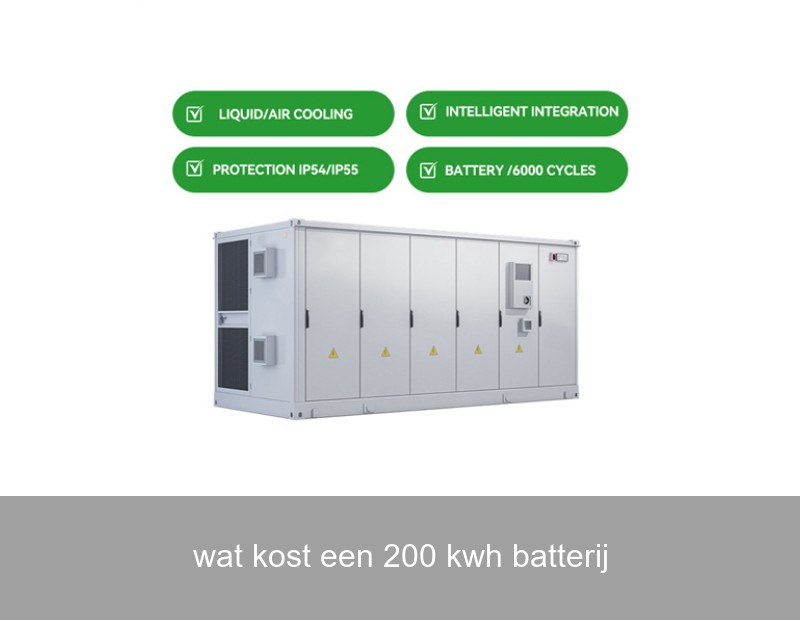
If you're a business owner, facility manager, or involved in a renewable energy project, you've likely asked the question: "Wat kost een 200 kWh batterij?" (What does a 200 kWh battery cost?). It's a crucial starting point, but the answer is more nuanced than a simple price tag. The cost of a 200 kWh battery system is a gateway to understanding value—value in energy independence, operational resilience, and long-term financial savings. At Highjoule, a global leader in advanced energy storage since 2005, we believe in looking beyond the initial quote. This article will guide you through the factors that shape the investment, the tangible benefits it unlocks, and how smart technology transforms a battery into a strategic asset for your commercial, industrial, or microgrid application.
Table of Contents
- Beyond the Sticker Price: What Really Shapes the Cost of a 200 kWh Battery?
- Why Battery Technology Matters: Chemistry, Performance, and Lifespan
- A Real-World Case Study: The Dutch Dairy Cooperative
- The Highjoule Difference: Intelligent Systems for Maximum ROI
- Making Your Investment: Key Considerations and Next Steps
Beyond the Sticker Price: What Really Shapes the Cost of a 200 kWh Battery?
Asking for the price of a 200 kWh battery is like asking "what does a house cost?" Location, materials, and features dramatically influence the final figure. The core battery cells are just one component. The total installed cost of a commercial-scale Battery Energy Storage System (BESS) is a sum of several critical parts:
- Battery Cells & Modules (30-50% of cost): This is the energy core. Prices vary based on chemistry (like Lithium Iron Phosphate - LFP, which is dominant for stationary storage due to safety and longevity) and global commodity markets.
- Power Conversion System (PCS) (15-25%): The inverter(s) that convert DC battery power to AC for your facility. Its power rating (in kW) determines how fast you can charge or discharge your 200 kWh.
- Battery Management System (BMS) & Energy Management System (EMS) (10-20%): The brain of the operation. A sophisticated BMS ensures safety and cell longevity, while an intelligent EMS optimizes charging/discharging based on tariffs, weather, and consumption patterns.
- Thermal Management, Enclosure, and Safety Systems (5-15%): Crucial for reliability. Proper cooling/heating (air or liquid) ensures performance in all climates and extends battery life.
- Installation, Grid Connection, and Permitting (10-30%): Labor, electrical work, potential grid upgrade fees, and navigating local regulations can significantly impact the final project cost.
Therefore, a complete 200 kWh system solution in Europe or the U.S. can range significantly. As of 2024, you might encounter broad estimates between $80,000 to $180,000+ (or €70,000 to €160,000+) for a fully installed, grid-connected system. The wide range underscores why a detailed, site-specific assessment is non-negotiable.
The Value Equation: From Cost Center to Revenue Stream
Shifting the perspective from pure cost to value creation is key. A 200 kWh battery isn't just an expense; it's an investment that can generate returns through:
- Peak Shaving: Avoid costly demand charges from utilities by using stored energy during periods of high power draw.
- Energy Arbitrage: Charge the battery when electricity prices are low (often at night or during high renewable output) and use it when prices are high.
- Backup Power & Resilience: Ensure critical operations continue during grid outages, avoiding costly downtime.
- Renewable Integration: Store excess solar or wind energy for use when the sun isn't shining or the wind isn't blowing, maximizing self-consumption.

Image Source: Unsplash - Representative image of a commercial battery system.
Why Battery Technology Matters: Chemistry, Performance, and Lifespan
Not all 200 kWh batteries are created equal. The choice of battery chemistry directly impacts safety, cycle life, depth of discharge, and ultimately, the total cost of ownership.
| Feature | Lithium Iron Phosphate (LFP) | Traditional NMC (Nickel Manganese Cobalt) |
|---|---|---|
| Typical Cycle Life | 6,000+ cycles (to 80% capacity) | 3,000 - 4,000 cycles (to 80% capacity) |
| Thermal & Safety Profile | Excellent; more stable chemistry | Good; requires more robust BMS and cooling |
| Energy Density | Moderate (sufficient for stationary storage) | Higher (common in EVs) |
| Cost Trend | Becoming highly competitive, lower lifetime cost | Historically higher, sensitive to cobalt prices |
For commercial and industrial applications, LFP has become the preferred chemistry due to its long life, inherent safety, and declining cost. A system with a longer cycle life means more years of revenue-generating operation before significant degradation, making the upfront investment more economical over time. You can read more about the evolution of battery chemistries from authoritative sources like the U.S. Department of Energy.
A Real-World Case Study: The Dutch Dairy Cooperative
Let's move from theory to practice. Consider a dairy processing cooperative in the Netherlands. Their challenge: high, fluctuating energy demand for cooling and processing, rising energy costs, and a commitment to sustainability.
- Phenomenon: Spikes in energy demand led to punitive utility demand charges. Their existing solar PV array often produced excess energy at midday that was sold to the grid at low feed-in tariffs.
- Data & Solution: They installed a 200 kWh LFP battery system coupled with a 250 kW inverter. The system was integrated with their solar PV and controlled by an advanced EMS.
- Outcome: The EMS strategically dispatches the battery:
- It shaves peak demand by 22%, saving over €18,000 annually on demand charges.
- It stores excess solar energy for use during evening processing, increasing self-consumption from 35% to over 70%.
- It provides ride-through power during brief grid sags, preventing spoilage.
Insight: The payback period for their system was calculated at under 7 years. Given the system's 10+ year warranty and expected life beyond that, the subsequent years represent almost pure operational savings and cost avoidance. This case exemplifies how the question "wat kost een 200 kWh batterij?" is answered by its long-term financial and operational benefits.
The Highjoule Difference: Intelligent Systems for Maximum ROI
At Highjoule, we provide more than just hardware. Since 2005, we've specialized in intelligent, integrated storage solutions that maximize the return on your 200 kWh investment. Our approach centers on our proprietary Adaptive Grid OS™ energy management platform.
Think of it this way: a battery without smart software is like a powerful computer without an operating system. Our platform turns your storage asset into an active participant in your energy strategy, capable of:
- Multi-Mode Optimization: Automatically switching between peak shaving, arbitrage, and backup modes based on real-time data and forecasts.
- Predictive Analytics: Using weather and consumption forecasts to optimize charging cycles, especially for solar or wind co-location.
- Remote Monitoring & O&M: Providing full visibility into system health and performance, often predicting maintenance needs before they arise.
Our H-Series Commercial ESS units, scalable to the multi-megawatt hour range, are built with premium LFP cells and are designed for seamless integration into new or existing renewable projects. For microgrid and larger industrial applications, our containerized MegaArray solutions offer plug-and-play deployment of robust, utility-grade storage. By focusing on system intelligence and durability, we ensure that the total lifetime value of your storage system far outweighs its initial cost.

Image Source: Unsplash - Representative image of energy system monitoring.
Making Your Investment: Key Considerations and Next Steps
So, you're seriously considering a 200 kWh battery system. To move forward, here are the essential questions to discuss with a qualified provider like Highjoule:
- What is my primary use case? (Cost savings, resilience, renewable integration?) This dictates system design.
- What is my site's specific load profile and tariff structure? A detailed energy analysis is the foundation of any viable proposal.
- Are there local incentives, grants, or tax benefits? In many U.S. states (via the IRA) and European countries, significant financial incentives exist that can reduce net cost by 20-40%. Resources like the DSIRE database for the U.S. can be a starting point.
- What is the total solution warranty and service model? Look for comprehensive coverage for performance, parts, and labor.
Your Path to Clarity
The journey to answering "wat kost een 200 kWh batterij" begins with a conversation about your unique needs. At Highjoule, we start with a no-obligation Energy Storage Assessment, analyzing your energy data to model the optimal system size, financial savings, and ROI specific to your operation.
Given your location and energy goals, what would be the single most impactful benefit—reducing your next quarterly power bill by 25%, or ensuring your production line never stops due to a blackout?
 Inquiry
 Online Chat