


550 Solar Panel How Much? A Complete Cost and Energy Analysis
So, you're thinking big. A 550 solar panel system is a significant investment, one that speaks to powering a large home, a commercial operation, or even a community project. The first question that naturally comes to mind is, "550 solar panel how much?" While the upfront price tag is a crucial piece of the puzzle, the true value lies in understanding the immense energy output, long-term savings, and the strategic role such a system plays in modern energy independence. This article will break down not just the costs, but the power, the planning, and the advanced technology needed to make a project of this scale a success.
Table of Contents
- The Direct Cost Breakdown: Equipment, Labor, and Variables
- Beyond Price: What Can 550 Solar Panels Actually Power?
- The Critical Role of System Design and Balance
- A Real-World Case Study: From High Bills to Energy Hub
- Why Storage is Non-Negotiable for Large-Scale Solar
- Is a 550-Panel System Right for Your Energy Goals?
The Direct Cost Breakdown: Equipment, Labor, and Variables
Let's address the "how much" directly. For a 550-panel system, we're in the realm of utility-scale or large commercial installations. Assuming modern 400-watt panels, this is a 220-kilowatt (kW) DC system. In the U.S. and European markets, the average installed cost for commercial/utility-scale solar can range from $0.85 to $1.25 per watt.
| Cost Component | Estimated Range (220 kW System) | Notes |
|---|---|---|
| Total Installed Cost | $187,000 - $275,000 | Highly dependent on location and project complexity. |
| Post-Incentives Cost (e.g., ITC) | $130,900 - $192,500 | Assuming a 30% federal Investment Tax Credit in the U.S. Similar schemes exist in parts of Europe. |
This range is influenced by several key factors:
- Panel Type: Premium efficiency models cost more but may require less roof/land space.
- Installation Complexity: Ground-mount vs. flat commercial roof vs. sloped roof—each has different labor and racking costs.
- Inverters & Balance of System (BOS): This includes wiring, conduits, and the crucial inverter(s) that convert DC to AC power. For a system this size, you'd likely use multiple commercial string inverters or a central inverter.
- Local Permits & Grid Connection Fees: These can vary dramatically by municipality and utility company.
The Hidden (and Most Valuable) Part of the Equation
Focusing solely on the sticker price misses the point. The real question transforms from "What does it cost?" to "What does it save and earn?" Over a 25-30 year lifespan, a 220kW system can generate millions in electricity savings and potentially revenue through feed-in tariffs or renewable energy credits.
Beyond Price: What Can 550 Solar Panels Actually Power?
Let's translate panels into power. Using 400W panels and location-specific data is key. For a sunny region like Southern California or Southern Spain, a 220kW system might produce roughly 330,000 to 400,000 kilowatt-hours (kWh) annually.
To put that into perspective:
- It could power 55-65 average American homes for a year (U.S. EIA).
- It could offset the annual electricity consumption of a 50,000 sq. ft. warehouse or a mid-sized manufacturing facility.
- It could charge over 1.5 million electric vehicle miles per year.

Image source: Unsplash (Representative image of a large commercial solar installation)
The Critical Role of System Design and Balance
A project of this magnitude is not about simply buying 550 panels and plugging them in. It's an engineering feat. The Balance of System (BOS) is what makes or breaks your return on investment. This includes:
- Structural Engineering: Can your roof or land support the weight and wind load?
- Electrical Design: Properly sized inverters, transformers, and switchgear are critical for safety and efficiency.
- Performance Monitoring: You need granular data to ensure every panel string is performing optimally.
This is where partnering with an experienced provider pays dividends. At Highjoule, we don't just supply components; we deliver integrated power solutions. For a 550-panel installation, our team of engineers would design the entire ecosystem—optimizing the solar array, selecting the right inverter technology, and crucially, integrating intelligent battery storage to maximize self-consumption and provide backup resilience.
A Real-World Case Study: From High Bills to Energy Hub
Let's look at a concrete example. A food processing plant in Bavaria, Germany, was facing annual electricity costs exceeding €120,000 and needed to meet corporate sustainability targets. Their 12,000 sq. m. facility roof was an ideal candidate.
The Project: A 550-panel (231 kWp) system was installed using high-efficiency monocrystalline panels. The key challenge was the plant's 24/7 operation and high evening energy usage when solar production falls.
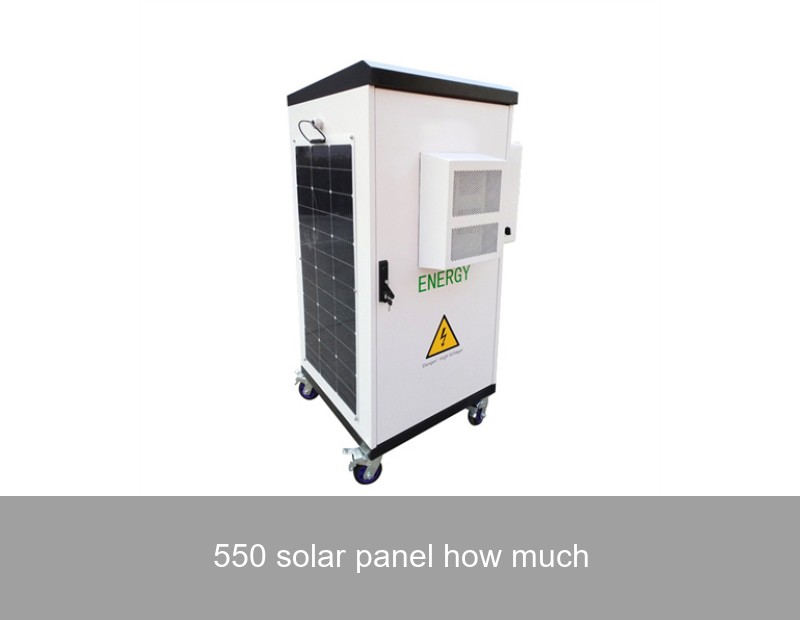
The Highjoule Solution: We paired the solar array with a Highjoule HVC 500 Commercial Battery Storage System with 250 kWh of capacity. The system was designed to:
- Capture excess solar generation during the day.
- Dispatch stored energy during peak evening hours, avoiding expensive grid rates.
- Provide critical process backup during short grid outages.
The Results (Data after 1 Year):
- Annual Solar Generation: 215,000 kWh
- Self-Consumption Rate Increased from 35% to over 80% with storage.
- Annual Energy Cost Savings: €68,000
- Estimated CO2 Reduction: 152 metric tons annually.
- Projected Payback Period: Under 7 years, thanks to the combined solar + storage optimization and available EU renewable energy directives.
Why Storage is Non-Negotiable for Large-Scale Solar
As the case study shows, for a system answering "550 solar panel how much," adding storage transforms the economics. Without it, you're often forced to sell excess midday power back to the grid at low rates, only to buy it back at night at high rates. This is the modern "duck curve" challenge well-documented by grid operators like CAISO.
Highjoule's intelligent energy storage systems solve this. Our HVC Series for commercial and industrial applications uses advanced lithium iron phosphate (LFP) battery chemistry for safety and longevity, coupled with an energy management system (EMS) that learns your load patterns. It automatically decides when to store, when to discharge, and when to interact with the grid, ensuring you get the maximum financial benefit from every one of those 550 panels.

Image source: Unsplash (Representative image of a commercial battery storage installation)
Future-Proofing with Microgrid Capability
For industrial campuses or communities, a 550-panel system with robust storage is the cornerstone of a microgrid. Highjoule's solutions can be configured to island from the main grid during outages, keeping essential operations running on clean, self-generated solar power. This level of resilience is becoming priceless in an era of increasing climate-related grid instability.
Is a 550-Panel System Right for Your Energy Goals?
The journey from asking "550 solar panel how much" to achieving energy independence is complex but incredibly rewarding. It requires viewing the project not as a commodity purchase, but as a strategic infrastructure investment.
Whether you're a factory owner in Italy, a farm cooperative in the Midwest, or developing a sustainable housing community in the Netherlands, the principles are the same: right-size the generation, intelligently manage the storage, and design for decades of performance.
What specific energy challenge—be it peak demand charges, sustainability mandates, or outright energy security—is driving you to consider a solar solution of this scale? Understanding that core driver is the first step in designing a system that truly pays for itself, year after sunny year.
 Inquiry
 Online Chat