


Unlocking Greater Energy Independence: A Deep Dive into 550W Solar Panel Specifications
If you're planning a solar installation for your home or business in 2024, you've likely encountered a powerful new contender: the 550-watt solar panel. But what's behind this number, and is it the right choice for your energy goals? As a product technology expert at Highjoule, I spend my days evaluating how these advanced photovoltaic modules integrate with smart battery storage to create resilient, efficient power systems. The shift to higher-wattage panels like the 550W class isn't just a minor upgrade—it's a transformative step that changes how we design and benefit from solar energy. Let's explore the critical 550w solar panel specifications and what they truly mean for your journey toward energy independence.
Key 550W Solar Panel Specifications Decoded
Moving beyond the headline wattage, the true value of a panel lies in its detailed specifications. These parameters determine not just how much power it can produce, but how reliably and efficiently it will perform on your specific roof over the next 25+ years.
Power Output & Efficiency: The Core Metrics
The "550W" refers to the panel's maximum power output (Pmax) under Standard Test Conditions (STC). However, real-world performance is a symphony of several key specs.
- Cell Technology: Most 550W panels use N-type TOPCon (Tunnel Oxide Passivated Contact) or HJT (Heterojunction) cells. These are superior to traditional P-type cells, offering higher efficiency, lower degradation, and better performance in heat. For instance, N-type cells often have a temperature coefficient of -0.29%/°C versus -0.34%/°C for older models, meaning they lose less power on a scorching summer day.
- Module Efficiency: To achieve 550W, manufacturers pack more power into a standard-sized frame. This results in efficiencies typically ranging from 21.5% to 22.8%. Higher efficiency directly translates to needing fewer panels to meet your energy needs—a crucial factor for roofs with limited space.

Image Source: Unsplash - Representative image of modern, high-wattage solar panels.
Temperature & Durability: Built for the Long Haul
Your panels will face decades of sun, wind, and weather. Two specs are paramount here.
| Specification | Typical Value for 550W Panels | What It Means for You |
|---|---|---|
| Temperature Coefficient (Pmax) | -0.29% / °C to -0.34% / °C | Power loss per degree above 25°C. Closer to zero is better. |
| NOCT (Nominal Operating Cell Temp.) | ~42°C ± 2°C | Estimates real-world operating temperature. Lower can indicate better heat dissipation. |
| Power Warranty | 92% output after 25 years | Guaranteed minimum power output decades from now. |
| Max Snow/Wind Load | 5400Pa / 2400Pa (Common) | Mechanical resilience against extreme weather events. |
Mechanical & Electrical Specifications
- Dimensions & Weight: A standard 550W panel measures approximately 2279mm x 1134mm and weighs around 28-31 kg. This size requires careful structural assessment, especially for residential rooftops.
- Electrical Parameters: Higher power means higher current (Imp) and voltage (Vmp). A typical 550W panel may have an Imp of ~13A and a Vmp of ~41.5V. This influences the design of your system's inverters and wiring. You'll need an inverter that can handle the higher input current, or consider module-level power electronics (MLPE) like optimizers for complex roofs.
Why Upgrade to 550W Panels? The System-Level Advantage
The benefits of choosing 550W panels extend far beyond a single component's rating. It's about the holistic improvement of your entire energy system.
- Reduced Balance of System (BOS) Costs: Needing fewer panels to achieve the same system size means fewer roof attachments, less racking, fewer wiring connections, and potentially lower labor costs. The National Renewable Energy Laboratory (NREL) consistently highlights module wattage as a key driver in reducing overall solar $/W cost.
- Optimal Pairing with Energy Storage: This is where the Highjoule perspective becomes critical. A high-density solar array paired with an intelligent battery system like our Highjoule HPS Series creates a perfect synergy. On a bright day, your 550W panels can generate surplus power more quickly, efficiently charging your storage. This ensures a robust energy reserve for nighttime use or during grid outages, maximizing your self-consumption and ROI.
- Future-Proofing: As energy demands grow—perhaps with an EV addition—having a high-output foundation makes expansion simpler and more cost-effective.
Real-World Impact: A Commercial Case Study from Germany
Let's move from theory to practice. In 2023, a medium-sized dairy farm in Bavaria, Germany, faced rising operational costs and sought energy resilience. Their goal: cover 75% of their daytime load and ensure critical cooling systems remained operational during grid fluctuations.
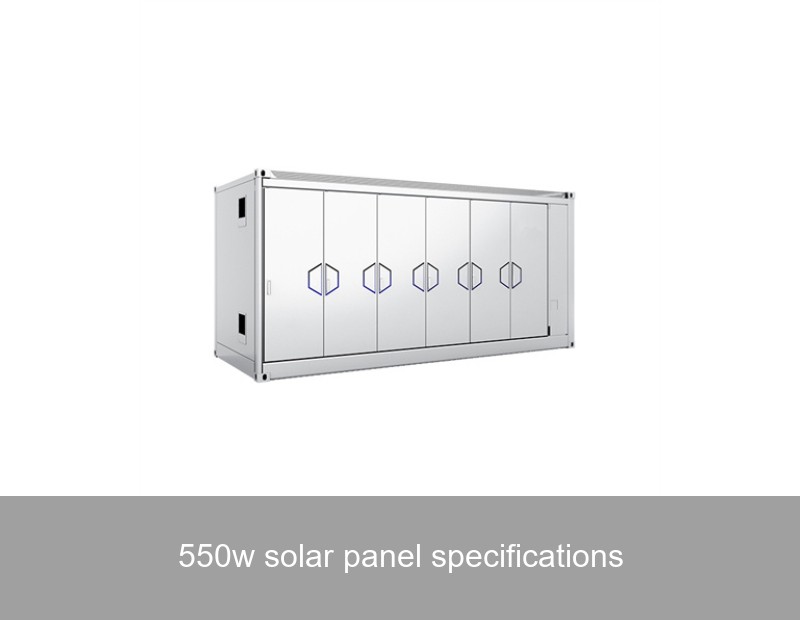
The Solution: A 98.5 kW DC system using 179 of the latest 550W bifacial panels (utilizing light reflected from the ground) was installed. Crucially, it was integrated with a Highjoule C&I Energy Pod, a containerized 240 kWh battery storage system with advanced energy management software.
- Space Optimized: The high-wattage panels allowed the system to fit on the limited roof space of the main barn.
- Performance Verified: On peak summer days, the system regularly exceeds the nameplate rating, hitting instantaneous outputs over 105 kW AC thanks to bifacial gain and cool temperatures.
- Storage Synergy: The Highjoule system's software intelligently directs excess solar generation to charge the battery, which then powers evening milking operations. The farm now achieves over 85% self-sufficiency and is shielded from peak-time grid tariffs.
This case exemplifies how the right 550w solar panel specifications, when paired with smart storage, solve real economic and operational challenges.
Choosing the Right 550W Panel: Beyond the Spec Sheet
With many brands offering 550W modules, selection requires a discerning eye. Prioritize manufacturers with a proven track record, robust warranties (both product and linear power), and independent certification from bodies like TÜV. Crucially, assess the company's bankability and long-term service support. The cheapest panel can become the most expensive asset if it degrades prematurely or the manufacturer vanishes.

Image Source: Unsplash - Technician monitoring large-scale solar performance.
The Highjoule Advantage: Intelligent Storage Meets High Power Solar
At Highjoule, we view powerful solar panels as one essential component of a modern energy ecosystem. Our expertise lies in seamlessly integrating these generation assets with our advanced battery energy storage systems (BESS). Whether for a home, business, or microgrid, our Adaptive Energy Operating System (AEOS) acts as the brain of the installation.
For a residential customer with a roof full of 550W panels, our Highjoule HPS Home system doesn't just store energy. It learns consumption patterns, weather forecasts, and utility rate schedules to autonomously decide when to store solar energy, when to power the home, and when to export to the grid for maximum benefit. For our commercial and industrial partners, like the German farm, our C&I Energy Pods provide scale, safety, and sophisticated control for demand charge management and backup power.
The transition to high-wattage panels is an opportunity to build a smarter, more integrated, and more resilient energy asset. It's about designing a system where every kilowatt-hour generated is used optimally.
Given the rapid evolution in panel technology and storage capabilities, what specific energy challenge—be it reducing a volatile utility bill, achieving true backup power, or meeting sustainability targets—is driving your consideration of a high-power solar solution today?
 Inquiry
 Online Chat