


Unlocking the True Potential of Your 585 Watt Solar Panel Output
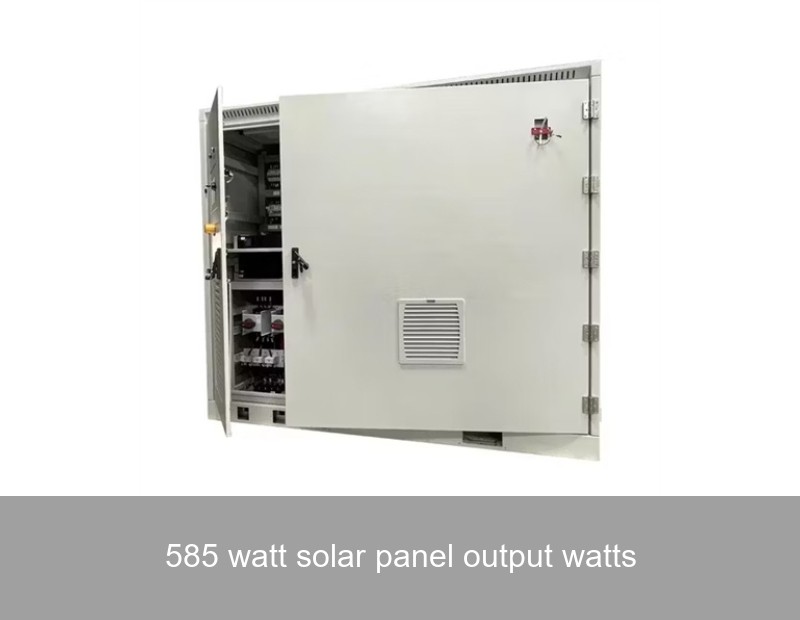
So, you've invested in high-efficiency 585-watt solar panels. That's a fantastic choice for maximizing energy harvest from your roof space. But here's a question many savvy homeowners and business operators are now asking: is your system truly delivering 585 watts of usable power, and where does all that energy go when the sun is shining its brightest? The rated "585 watt solar panel output" is a peak laboratory figure. In the real world, factors like intermittent clouds, time of day, and most importantly, how you manage the surplus, determine the real value you get from your investment. This is where intelligent energy management and storage become not just an add-on, but the critical component for unlocking true energy independence and return on investment.
Table of Contents
- The 585W Output Phenomenon: More Power Than You Can Use?
- What the Data Tells Us: The Curse of the Midday Peak
- A Real-World Case: From Grid Dependence to Energy Resilience
- Thinking Beyond the Kilowatt: The Highjoule Integrated Approach
- Is Your Home or Business Ready for the Next Generation of Energy Management?
The 585W Output Phenomenon: More Power Than You Can Use?
Modern high-wattage panels, like the 585-watt models, are engineering marvels. They pack more photovoltaic cells and use advanced technologies like half-cut cells and PERC (Passivated Emitter and Rear Cell) to achieve higher efficiencies. This means you need fewer panels to reach your target system size, saving on installation space and balance-of-system costs.
However, this creates a new challenge. During peak sunlight hours, a residential or commercial system composed of these panels can generate an immense amount of power—often far exceeding the simultaneous consumption of the building. Without a place to store this valuable energy, the excess is typically fed back to the utility grid, often for a modest feed-in tariff that is significantly lower than the retail price you pay for electricity later. You're essentially producing premium energy but only getting wholesale rates for the surplus. This mismatch between generation and consumption patterns is the central hurdle to maximizing the financial and practical benefits of your solar investment.

High-wattage solar panels generate significant peak power. (Photo by American Public Power Association on Unsplash)
What the Data Tells Us: The Curse of the Midday Peak
Let's look at the typical daily generation curve of a solar system. Production ramps up in the morning, peaks sharply around midday, and tapers off in the evening—precisely when household or business energy demand often spikes (think evenings with lights, cooking, and entertainment).
According to data from the National Renewable Energy Laboratory (NREL), the capacity factor for solar PV in the continental U.S. averages between 15% and 30%. This metric represents the ratio of actual energy output over time to its potential output if it operated at full nameplate capacity continuously. It clearly illustrates that the "585 watt solar panel output" is an intermittent resource. For a significant portion of the day, your system may be producing at 20%, 50%, or 80% of that rated capacity. The key to stabilizing your power supply is not just capturing the peak, but smoothing the curve.
The Energy Storage Imperative
This is where Battery Energy Storage Systems (BESS) transform your solar array from a fair-weather ally into a 24/7 power plant. Instead of exporting your 585-watt panel's peak output, an intelligent storage system:
- Captures Surplus: Stores excess midday generation for use during high-rate evening hours.
- Provides Backup: Keeps essential loads running during grid outages, a feature increasingly valued in both the U.S. and Europe.
- Optimizes Economics: Enables strategies like time-of-use arbitrage—charging batteries with cheap or solar power and discharging during expensive peak periods.
A Real-World Case: From Grid Dependence to Energy Resilience
Consider the case of a medium-sized commercial bakery in Southern Germany. Facing rising electricity costs and seeking sustainability goals, they installed a 120 kW rooftop solar array using high-output panels. While this reduced daytime grid consumption, their evening production shift for the next day's baking still relied heavily on the expensive grid. Their solar system was underutilized.
The solution was integrating a Highjoule H-Ion 30 Commercial battery storage system. Here’s the impact, measured over one year:
| Metric | Before Storage | After Storage Integration |
|---|---|---|
| Solar Self-Consumption | 35% | 82% |
| Grid Energy Purchased (Peak Hours) | ~28,000 kWh/yr | ~6,200 kWh/yr |
| Estimated Annual Cost Savings | Base | €8,400+ |
| CO2 Footprint Reduction | ~15.8 tons/yr | ~34.5 tons/yr |
The bakery now uses the peak output from its solar panels to charge the Highjoule battery bank. During evening operations, the bakery draws from the batteries, drastically cutting peak demand charges and grid reliance. The system also provides seamless backup for refrigeration units. This case, mirrored by many of our installations across Europe and North America, demonstrates that the value of a 585-watt panel is fully realized only when paired with intelligent storage.
Thinking Beyond the Kilowatt: The Highjoule Integrated Approach
At Highjoule, we understand that a kilowatt generated is not the same as a kilowatt utilized. Since 2005, we've evolved from a component provider to a full-solution architect for smart, sustainable power. Our philosophy is to view the solar array, the storage system, and the building's load as one interconnected ecosystem.

Integrated solar and storage systems create resilient homes and businesses. (Photo by Andreas Gücklhorn on Unsplash)
Our Core Technology: The Highjoule Energy Hub
Our Highjoule Energy Hub is the brain of the operation. It's not just an inverter or a battery management system; it's a unified platform that dynamically directs energy flow based on weather forecasts, utility rate schedules, and your consumption patterns.
- For Residential Clients (H-Ion Series): Our scalable home battery systems, like the H-Ion 10, allow you to start small and expand. They integrate seamlessly with new or existing solar installations, ensuring every watt from your 585-watt panels is put to optimal use—whether for savings, backup, or both.
- For Commercial & Industrial (C&I Series): Our modular C&I solutions are engineered for durability and high-cycle performance. They help businesses manage demand charges, participate in demand response programs, and build a resilient microgrid within their facility.
- For Microgrids: Highjoule designs and deploys turnkey storage solutions that are the cornerstone of community or off-grid microgrids, often combining solar, wind, and generator assets into a stable, renewable-first power supply.
By leveraging advanced lithium-iron-phosphate (LiFePO4) battery chemistry, known for its safety and long cycle life, and coupling it with our proprietary energy management software, we ensure that the impressive "585 watt solar panel output" on your spec sheet translates into reliable, cost-effective, and clean power at your outlet.
Is Your Home or Business Ready for the Next Generation of Energy Management?
The conversation around solar energy is shifting. It's no longer just about the number of panels on the roof or their peak wattage. The true metric of success is energy autonomy—the percentage of your power you can generate, manage, and consume on your own terms. With volatile energy markets and increasing grid instability in some regions, as noted by sources like the International Energy Agency (IEA), this autonomy is becoming both economically smart and strategically prudent.
We invite you to think about your current or planned solar setup. Are you simply exporting your valuable peak generation, or are you capturing it to power your future? What would a 80% or higher self-sufficiency rate mean for your electricity bills and your peace of mind?
We challenge you to calculate not just your system's potential peak output, but your potential for true energy independence. What's the first load you would want to secure during an outage, and how could storing the peak output of your solar panels make that a reality today?
 Inquiry
 Online Chat