


Which Solar Hybrid Inverter is Best in Sweden? A Guide to Smart Energy Independence
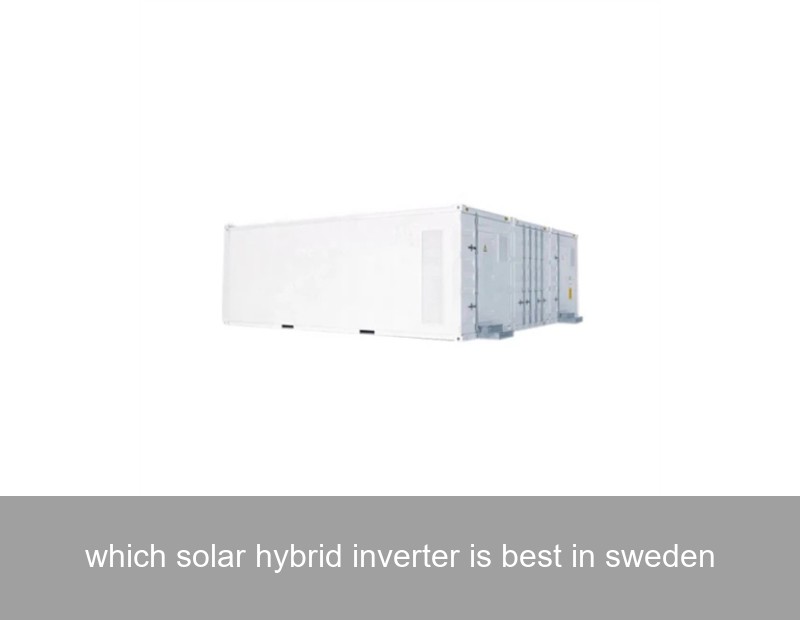
If you're a Swedish homeowner or business looking to harness the midnight sun and shield yourself from volatile energy prices, you've likely asked: which solar hybrid inverter is best in Sweden? It's not just about picking a brand; it's about choosing the brain of your energy system—one that can handle long, dark winters, maximize summer production, and seamlessly integrate with the grid. This guide cuts through the complexity, using real-world data and local case studies to help you find the perfect match for Sweden's unique climate and energy landscape.
Table of Contents
- The Swedish Solar Challenge: More Than Just Sunlight
- Key Criteria for the Best Hybrid Inverter in Sweden
- Beyond the Inverter: The System Integration Advantage
- Making Your Choice: Questions to Ask
The Swedish Solar Challenge: More Than Just Sunlight
Sweden's energy paradox is fascinating. We enjoy nearly 24 hours of sunlight in summer, but face profound darkness in winter. This isn't just a seasonal shift; it's a fundamental design challenge for any solar-plus-storage system. A top-tier hybrid inverter for the Swedish market must excel at energy arbitrage: storing excess summer energy for use in winter, and intelligently drawing from the grid when prices are low (like during windy nights) to charge your batteries.
Furthermore, with Swedish Energy Agency reports highlighting the push towards a decentralized grid, your inverter becomes a gateway. The best systems can participate in grid services, providing stability and potentially creating future revenue streams. It's about resilience and intelligence.

Image: Solar panels must perform in all Swedish seasons, from bright summers to snowy winters.
Key Criteria for the Best Hybrid Inverter in Sweden
Forget one-size-fits-all. Here’s what truly matters when evaluating which solar hybrid inverter is best for your specific location in Sweden:
- Efficiency at Low Light & Partial Load: Swedish winters mean low solar irradiance. The inverter must maintain high conversion efficiency even when the panels are underperforming. Look for European efficiency ratings (like 97% or above).
- Battery Chemistry Compatibility & Smart Charging: It must seamlessly work with modern Lithium-ion batteries (like LiFePO4) and have charging algorithms that adapt to temperature—crucial for battery longevity in an unheated *uthus* (outbuilding).
- Grid Interaction & Peak Shaving: Advanced software should allow you to set limits on grid import to avoid high power tariffs, automatically using battery power during your home's peak consumption hours.
- Robustness and Warranty: Can the hardware withstand -30°C starts and damp, cool conditions? A 10+ year warranty from a manufacturer with a strong local support presence is non-negotiable.
This is where a provider with deep system integration expertise becomes invaluable. At Highjoule, we've spent nearly two decades engineering solutions for harsh and variable climates. Our HPS Series Hybrid Power Systems are built around this very intelligence. The hybrid inverter at their core isn't an off-the-shelf component; it's custom-tuned with software that learns your consumption patterns and Sweden's seasonal price curves, making autonomous decisions to optimize your economic and energy output.
Case Study: The Nilsson Family, Gothenburg
Phenomenon: A family of four with a 25 kWp rooftop installation faced a classic problem: exporting huge amounts of energy for low feed-in tariffs in summer, while buying expensive electricity from the grid in winter.
Data & Solution: In 2022, they installed a Highjoule HPS-12 system with a 15 kWh LiFePO4 battery. The key was the inverter's sophisticated energy management system (EMS). It was programmed with local weather forecasts and connected to the Nord Pool energy price API.
| Metric | Before Installation | After Installation |
|---|---|---|
| Grid Independence | 45% (Summer only) | 92% (Annual Average) |
| Annual Electricity Cost | 48,000 SEK | 6,200 SEK |
| Self-Consumption of Solar | ~35% | ~89% |
Insight: The "best" inverter was the one that acted as an autonomous energy manager. It would charge the battery from the grid on windy, low-price nights in October, then discharge during the morning peak hours, effectively making money from the price difference. This level of grid synergy is essential for a compelling ROI in Sweden.
Beyond the Inverter: The System Integration Advantage
Focusing solely on the inverter unit is like buying a powerful processor without considering the motherboard, RAM, or cooling. True performance comes from seamless integration. Highjoule's approach is to provide a complete, AC-coupled system where the inverter, battery bank, monitoring software, and safety systems are designed to work as one harmonious unit.

Image: A fully integrated storage system, where all components are designed to work together seamlessly.
Our Highjoule Energy Hub platform provides homeowners with an intuitive dashboard, showing not just production and consumption, but also carbon footprint reduction, grid price forecasts, and system health. For commercial clients, this scales to full microgrid control, allowing factories or municipalities to manage multiple generation sources and storage units. This holistic view—from a single-family home in Stockholm to an industrial site in Malmö—is what turns a good hardware choice into a brilliant energy strategy.
Making Your Choice: Questions to Ask Your Provider
So, when you're narrowing down which solar hybrid inverter is best for your Swedish property, move beyond spec sheets. Ask these questions:
- "How does your inverter's software specifically adapt to Sweden's seasonal energy price fluctuations?"
- "Can you show me a simulation of my annual usage and savings based on my location and historical consumption?"
- "What is your local service network like? If I need support in Kiruna, how quickly can a certified technician arrive?"
- "Is the system designed for future expansion, like adding a second battery bank or an EV charger?"
The best choice is a future-proof partnership, not just a product purchase.
Where to Go From Here?
The journey to energy independence is exciting. You've now got the framework to evaluate not just an inverter, but an entire energy ecosystem. We at Highjoule believe the right system should feel effortless, intelligent, and intrinsically reliable—much like the Swedish design principles we all appreciate.
What specific energy goal is driving your search—is it total independence, financial savings, or increasing the resilience of your business against blackouts? Defining this will point you to the perfect hybrid heart for your system.
 Inquiry
 Online Chat