


Understanding 60kVA Inverter Price in Nigeria: A Guide to Smart Power Solutions
If you're operating a business, managing a facility, or powering a community project in Nigeria, you've undoubtedly felt the pinch of unreliable grid power. The search for a robust backup or hybrid power solution often leads to a crucial question: what is the price of a 60kVA inverter in Nigeria? While the price tag is a significant factor, focusing solely on it is like buying a car based only on the sticker price—it ignores the long-term cost of fuel, maintenance, and reliability. The true value lies in a system that delivers not just power, but resilient, intelligent, and cost-effective energy independence. This article will demystify the market, explore the factors that truly matter, and show you how to invest in a solution that powers your progress for years to come.
Table of Contents
Beyond the Price Tag: What a 60kVA Inverter System Really Encompasses
First, let's clarify terminology. When people inquire about a "60kVA inverter price," they are typically referring to a complete Battery Energy Storage System (BESS) with an inverter at its heart. A standalone inverter cannot function without other critical—and costly—components. A functional system includes:
- The Inverter/Charger: The brain of the operation, converting DC battery power to AC for your appliances and managing the charging cycle.
- Battery Bank: The fuel tank. This is often the single largest cost over the system's lifetime. For a 60kVA system, you need substantial capacity, typically using deep-cycle lead-acid or, increasingly, longer-lasting Lithium-Ion (LiFePO4) batteries.
- Balance of System (BOS): Cabling, circuit breakers, fuse boxes, mounting racks, and often a sophisticated energy management system (EMS).
Therefore, the quoted "60kVA inverter price in Nigeria" can vary wildly—anywhere from $15,000 to $45,000+—based on the quality and type of these integrated components. A low initial quote might signal a system with inferior batteries that need replacement in 2-3 years, while a higher investment in quality technology can offer a lower total cost of ownership over a decade.

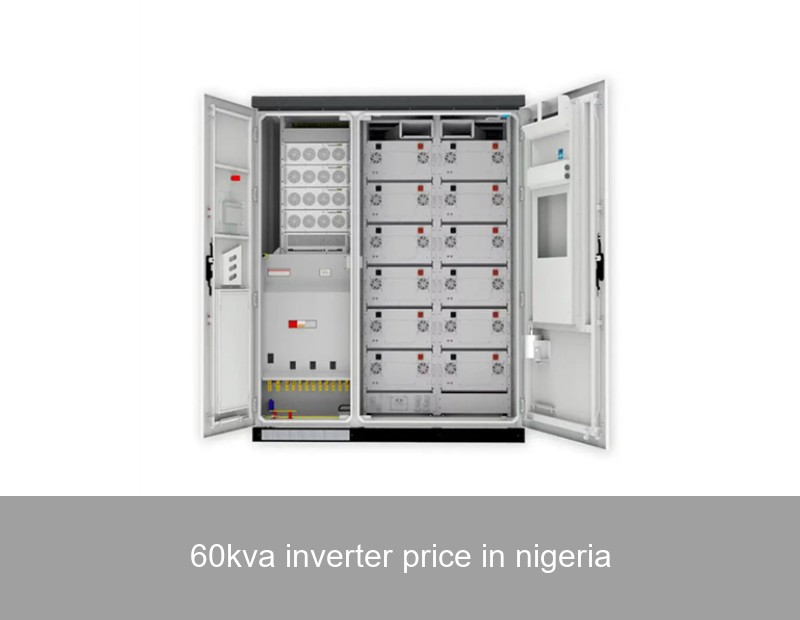
Image: A professional battery energy storage installation. The quality of integration is as critical as the individual components.
Key Factors Influencing 60kVA Inverter Pricing in the Nigerian Market
To navigate the market intelligently, you must understand what you're paying for. Here are the primary drivers of cost and value:
| Factor | Impact on Price & Performance | Long-Term Consideration |
|---|---|---|
| Inverter Technology | Pure Sine Wave vs. Modified Sine Wave; Transformer-based vs. Transformerless. High-efficiency (>98%) pure sine wave inverters protect sensitive equipment. | Lower efficiency wastes fuel/grid power during charging. Poor waveform can damage motors and medical equipment. |
| Battery Chemistry | Lead-Acid (Flooded, AGM, Gel) vs. Lithium-Ion (LiFePO4). Lithium batteries can be 2-3x the upfront cost of lead-acid. | LiFePO4 offers 3-5x longer cycle life, faster charging, and zero maintenance, leading to lower cost per cycle. |
| System Intelligence & Scalability | Basic inverters vs. smart inverters with grid-interactive capabilities, remote monitoring, and modular design. | Smart systems allow for load shedding, solar integration, and future expansion, protecting your investment. |
| Brand & Support | Established global brands with local technical support and warranties command a premium over generic imports. | Local expertise for installation, troubleshooting, and warranty service is invaluable for minimizing downtime. |
According to a 2023 IEA report on energy storage, the global average cost for battery storage systems fell by over 70% between 2015 and 2022, but system design and quality remain paramount for commercial reliability.
The Hidden Cost of "Cheap" Systems
Opting for the lowest upfront quote often leads to higher operational expenses. Frequent battery replacements, inefficient fuel consumption for generators paired with the system, and unexpected downtime can cripple a business's operations. The true metric is Levelized Cost of Storage (LCOS)—the total cost of owning and operating the storage system per unit of energy delivered over its lifetime.
Case Study: The Lagos Manufacturing Hub
Let's ground this discussion in a real-world scenario. A mid-sized plastic manufacturing unit in the Ikeja industrial area of Lagos was spending over ₦4.5 million monthly on diesel for generators to compensate for 8-10 hour daily grid outages. Their primary needs were to keep injection molding machines running and prevent spoilage of materials in process.
They initially received a quote for a basic 60kVA inverter system with lead-acid batteries for ~₦12 million. However, after a detailed energy audit, a different solution was proposed: a smart, hybrid 60kVA system with LiFePO4 batteries and integrated energy management software. The upfront cost was higher at ~₦18 million.
- Diesel consumption reduced by 85%, saving ~₦3.8 million monthly.
- The system's smart load management prioritized critical machinery during grid outages, eliminating production stoppages.
- Remote monitoring allowed preemptive maintenance, avoiding any unplanned downtime.
- The projected battery replacement timeline moved from 3 years (for lead-acid) to 10+ years (for LiFePO4).
The higher initial investment delivered a payback period of less than 5 years and secured the company's operational resilience. This case underscores that the right question isn't "What's the price?" but "What's the value?"
Highjoule's Approach: Delivering Value Beyond the Inverter
At Highjoule, with nearly two decades of experience as a global advanced energy storage provider, we understand that your power challenge is unique. We don't just sell inverters; we deliver intelligent, efficient, and sustainable power solutions tailored for commercial, industrial, and microgrid applications in markets like Nigeria.
For a 60kVA-scale need, our HPS Series Commercial Hybrid Power System is engineered for harsh environments and unreliable grids. It features:
- High-Efficiency, Multi-Mode Inverters: Seamlessly switch between grid, generator, battery, and renewable sources.
- Integrated LiFePO4 Battery Racks: Modular, scalable, and designed for thousands of deep cycles with a 10+ year design life.
- Highjoule Energy OS: Our proprietary monitoring and management platform provides real-time insights, predictive alerts, and optimizes energy flow to minimize your operating costs.
- Global Support, Local Partnership: We work with certified local partners to ensure professional installation, training, and after-sales support, making us a reliable partner for your Nigerian operations.

Image: Advanced system monitoring is key to maximizing uptime and return on investment.
Making the Right Investment for Your Nigerian Operation
So, how do you move forward? Start by shifting the conversation from price to requirements. Ask yourself and potential suppliers:
- What is my critical load (in kW) that must never go down?
- What is my desired backup duration (hours)?
- Do I plan to integrate solar PV now or in the future to combat rising fuel costs?
- What does the total warranty cover, and is local technical support available?
Request a detailed site assessment and energy audit from reputable providers. Compare proposals based on the total system specification, projected lifecycle costs, and the provider's track record, not just the bottom-line number.
As you evaluate the 60kVA inverter price in Nigeria, remember that you are investing in the continuous heartbeat of your enterprise. In a landscape where grid stability is a challenge, your power solution is your competitive advantage.
What single operational cost, if eliminated by a reliable power system, would most dramatically improve your bottom line?
 Inquiry
 Online Chat