


Unlocking Maximum Value: Your Guide to the 610W Solar Panel for Sale
If you're researching solar energy, you've likely seen the buzz around high-efficiency, high-wattage panels. The quest for more power from a single roof footprint is driving innovation, and leading this charge is the impressive 610W solar panel for sale. But what does this number really mean for your home or business? Is it just a bigger panel, or a smarter way to harness the sun? Let's cut through the noise. This isn't just about a product on a shelf; it's about a fundamental shift in how we design solar systems for greater efficiency, lower costs, and a more resilient energy future.
The Power Shift: Why Bigger Panels Are Winning
The solar industry has consistently worked towards a simple goal: generate more electricity from the same amount of sunlight. We've moved from standard 250W panels just a decade ago to today's behemoths. The phenomenon of high-wattage panels, like the 610W class, is driven by several key advancements:
- Larger Silicon Wafers: The shift from M6 and M10 to G12 (210mm) wafer sizes allows for a significantly larger surface area to capture photons.
- Advanced Cell Technology: Widespread adoption of PERC (Passivated Emitter and Rear Cell), half-cut cells, and tunneling oxide passivated contact (TOPCon) designs reduce electrical losses and boost efficiency.
- Denser Module Layout: By packing more cells into a panel using innovative tabbing and stringing, manufacturers maximize the active area.
The result? You need fewer physical panels to reach your target energy output. This translates to lower installation time, reduced balance-of-system costs (like racking and wiring), and optimized use of limited roof space. For commercial and industrial projects, this efficiency gain is a game-changer for profitability.
What Exactly is a 610W Solar Panel?
Let's demystify the specifications. A typical 610W solar panel is a monocrystalline photovoltaic module with a power output of approximately 610 watts under Standard Test Conditions (STC). Here’s a breakdown of what you can expect:
| Specification | Typical Value | What It Means For You |
|---|---|---|
| Dimensions | ~2200mm x 1100mm | Larger than standard panels; crucial to verify roof space and mounting compatibility. |
| Cell Technology | Half-Cut TOPCon or HJT | Higher efficiency, better performance in low-light and high-temperature conditions. |
| Efficiency | 22.5% - 23.5% | More kilowatt-hours generated per square meter of your roof. |
| Power Tolerance | 0 to +5% | Your panel will likely perform at or above its rated 610W. |
It's important to remember that the "for sale" aspect is just the beginning. The true value of these panels is realized only when paired with a correctly sized inverter and a battery energy storage system (BESS) that can handle their high power input. Without intelligent storage, excess energy generated during peak sun hours simply goes to waste or is exported to the grid at low value.

Image: High-wattage panels optimize roof space. (Source: Unsplash, Photographer: Andreas Gücklhorn)
Real-World Impact: A Case Study from Texas
Let's move from theory to practice. Consider a medium-sized manufacturing facility in Austin, Texas, facing high demand charges and an unreliable grid. Their goal: reduce operational costs and ensure production continuity.
The Challenge: A 50,000 sq. ft. roof with space constraints due to HVAC units. Traditional 450W panels would require 555 units to meet their 250kW target, straining the available area.
The Solution: A system designed with 410 units of 610W bifacial panels, achieving a 250.1kW system capacity. The higher output per panel was critical. But the real genius was in the integration. The system was coupled with a 500kWh containerized battery storage system to capture the significant midday surplus.
The Data-Driven Outcome (First Year):
- Energy Generation: 387,000 kWh, exceeding projections by 4% due to the panels' superior temperature coefficient.
- Demand Charge Reduction: By using stored energy during peak grid periods, the facility slashed its demand charges by 68%.
- ROI Acceleration: The combined high-generation solar and strategic storage reduced the payback period from an estimated 9 years to just 6.5 years.
This case illustrates that the value of a 610W solar panel for sale is multiplied when it's part of a holistic, intelligent energy solution.
Choosing the Right System for Your 610W Panels
Purchasing high-power panels is just one piece of the puzzle. To avoid bottlenecks and ensure safety, your entire system must be calibrated for their performance.
- Inverter Sizing: You need a high-capacity, reliable inverter that can handle the increased DC input. Microinverters or string inverters rated for the new higher currents are essential.
- Storage is Non-Negotiable: A 610W panel can produce a lot of energy in a short time. Without storage, you're losing financial and resilience benefits. Your battery system must have a high continuous power rating to accept charge from these panels efficiently.
- Balance of System: Racking, wiring, and connectors must be rated for the higher currents and module dimensions. Professional design is critical.
The Highjoule Advantage: Intelligent Storage for High-Power Solar
This is where Highjoule's expertise becomes pivotal. Since 2005, we've specialized in making advanced energy storage systems that unlock the full potential of high-efficiency solar arrays. Simply pairing premium panels with a basic battery is like putting a sports car engine in a chassis without upgraded brakes or suspension.
Our HPS Series commercial and industrial battery storage solutions are engineered for high-power coupling. With advanced battery management systems (BMS) and software that prioritizes self-consumption, they seamlessly absorb the robust output from 610W panels, turning midday sun into dependable evening power or a buffer against grid outages.
For residential clients exploring these high-output panels, our Home Energy Hub integrates solar, storage, and intelligent load management. It ensures that every kilowatt generated by your powerful new panels is used optimally—whether to power your home, charge your EV, or store for a rainy day—maximizing your independence from utility rate fluctuations. You can learn more about the importance of system integration from the U.S. Department of Energy's guide.

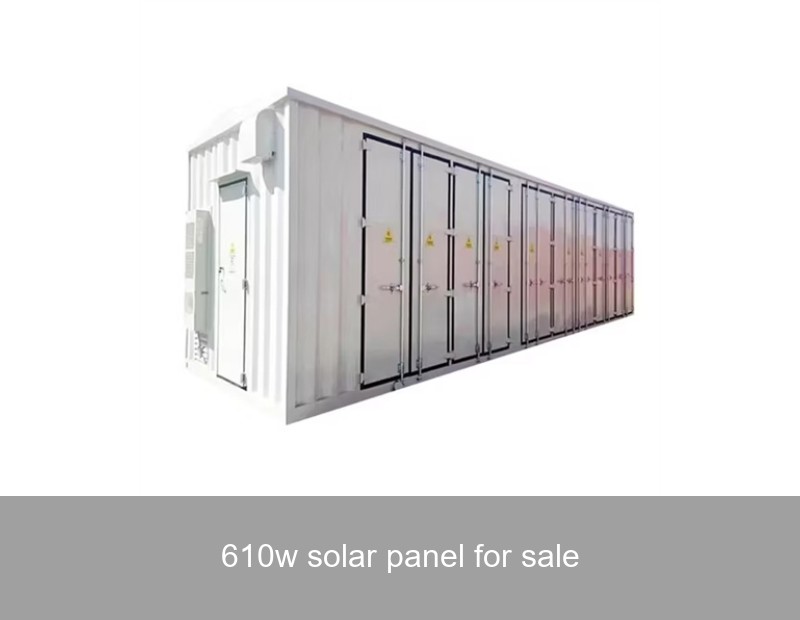
Image: A containerized battery system, similar to Highjoule's HPS Series, enabling energy resilience. (Source: Unsplash, Photographer: American Public Power Association)
Is a 610W Solar Panel System Right for You?
The decision goes beyond just wattage. These panels are an excellent fit if:
- You have limited roof or ground space and need to maximize power density.
- You are focused on minimizing installation and balance-of-system costs per watt.
- Your energy profile includes high daytime consumption or you have a robust storage solution to capture excess.
- You are planning a commercial or utility-scale project where economies of scale are vital.
However, it's crucial to consult with a professional. The physical size and weight require appropriate structural support. Furthermore, as the National Renewable Energy Laboratory (NREL) tracks, real-world performance can vary, and your local climate, shading, and orientation will ultimately determine the best panel technology for your site.
So, as you see a 610w solar panel for sale, ask yourself: Is my goal just to buy a panel, or is it to build a smarter, more resilient, and cost-effective energy system? What would it mean for your business or home to not just generate solar power, but to truly master its use, 24 hours a day?
 Inquiry
 Online Chat