


Finding the Right 800kVA Inverter for Sale: A Guide to Industrial & Commercial Energy Independence
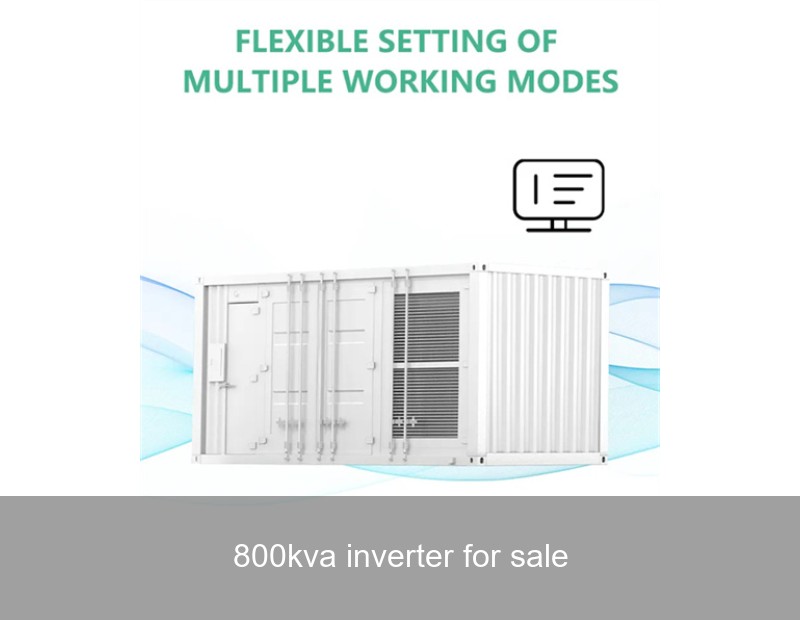
Are you managing a factory, a large commercial facility, or a community microgrid and feeling the pinch of rising energy costs and grid instability? You're not alone. Across Europe and the US, businesses are actively seeking robust solutions to take control of their power. This often leads to a critical search for a core component: an 800kVA inverter for sale. But purchasing such a powerful piece of equipment is about much more than just a transaction. It's about investing in a complete energy resilience strategy. This article will guide you through what an 800kVA inverter really does, why it's pivotal for large-scale applications, and how to choose a system that delivers lasting value and intelligence.
Table of Contents
- What is an 800kVA Inverter & Why Does Scale Matter?
- The Core Challenge: Beyond Just Converting Current
- The Data Behind the Demand: Why Large-Scale Storage is Booming
- Case Study: A German Manufacturing Plant's Journey to Resilience
- Key Features to Look For in an 800kVA Inverter System
- The Highjoule Approach: Integrated Intelligence for Megawatt-Scale Power
- Making the Informed Choice for Your Energy Future

Credit: Photo by American Public Power Association on Unsplash. Large-scale renewable integration requires robust power conversion.
What is an 800kVA Inverter & Why Does Scale Matter?
Let's break it down simply. An inverter's primary job is to convert Direct Current (DC) from sources like solar panels or batteries into the Alternating Current (AC) that powers our buildings and machinery. The "800kVA" rating speaks directly to scale and capacity. "kVA" (kilovolt-ampere) is a unit of apparent power. An 800kVA inverter is a heavy-duty system capable of handling a continuous load of around 800,000 volt-amperes. To put that in perspective, it can support the simultaneous power demands of a medium-sized factory, a large supermarket, a hospital wing, or a small community.
This isn't equipment for a residential rooftop. You're in the domain of industrial and utility-scale applications. When you search for an 800kVA inverter for sale, you're looking at the heart of a system designed for:
- Peak Shaving: Reducing demand charges from the utility by using stored energy during periods of highest consumption.
- Backup Power: Providing seamless transition to backup power during grid outages, ensuring operational continuity.
- Renewable Integration: Managing the variable output from large solar PV arrays, making it grid-friendly and usable on-site.
- Microgrid Formation: Enabling a facility to island itself from the main grid and run independently on solar + storage.
The Core Challenge: Beyond Just Converting Current
Here's a common misconception: buying a large inverter is like buying a large transformer—a straightforward hardware swap. The reality is more nuanced. The true challenge in deploying an 800kVA system lies in system integration, control intelligence, and long-term reliability. A standalone inverter without sophisticated energy management software (EMS) is like a powerful engine without a skilled driver. It won't optimize for cost savings, it may not communicate effectively with your solar arrays or multiple battery strings, and it could even create grid compatibility issues.
Furthermore, at this power level, efficiency isn't just a nice-to-have; it's a major financial factor. A difference of even 0.5% in conversion efficiency can translate to tens of thousands of euros or dollars in wasted energy over the system's lifetime. Thermal management, grid compliance (like UL 1741 SA in the US or VDE-AR-N 4105 in Germany), and serviceability are paramount.
The Data Behind the Demand: Why Large-Scale Storage is Booming
The market trend is clear. According to the International Energy Agency (IEA), global grid-scale battery storage capacity is set to multiply exponentially, with a significant portion of growth driven by commercial and industrial (C&I) applications seeking to manage costs and decarbonize. In the US, the Inflation Reduction Act (IRA) has created powerful investment tax credits (ITCs) for standalone storage, making projects more viable than ever. Similarly, Europe's push for energy security and the REPowerEU plan are accelerating adoption.
This isn't just about policy; it's about hard economics. For a facility with a peak demand of 1 MW, a well-designed 800kVA inverter paired with a suitable battery bank can shave off that expensive peak, potentially reducing demand charges by 20-30%. Over a year, these savings directly improve the bottom line.

Credit: Photo by Michael Fousert on Unsplash. Industrial battery storage requires robust, safe, and manageable systems.
Case Study: A German Manufacturing Plant's Journey to Resilience
Let's look at a real-world example. A mid-sized automotive parts manufacturer in Bavaria, Germany, faced volatile energy prices and needed to secure production against increasing grid instability. Their peak load was approximately 950 kVA.
Phenomenon: High electricity costs and fear of production downtime.
Action & Solution: They moved beyond simply looking for an 800kVA inverter for sale. Instead, they partnered with Highjoule to deploy an integrated solution:
- A Highjoule HJ-Commander 800 bi-directional inverter system, certified to VDE-AR-N 4105.
- A 1 MWh lithium-ion battery energy storage system (BESS).
- Highjoule's proprietary GridSynergy EMS, programmed to prioritize peak shaving, self-consumption of their existing rooftop solar, and automatic backup.
Data & Outcome: Within the first year of operation:
| Metric | Result |
|---|---|
| Demand Charge Reduction | 28% |
| Self-Consumption of Solar | Increased from 35% to over 80% |
| Backup Runtime for Critical Loads | Up to 4 hours |
| Estimated Payback Period | Under 5 years |
The plant manager noted, "The system pays for itself while acting as an insurance policy. The intelligence of the EMS was the differentiator—it makes decisions we wouldn't have time to make manually."
Key Features to Look For in an 800kVA Inverter System
When evaluating options for an 800kVA inverter for sale, use this checklist:
- Grid-Forming & Grid-Following Capability: Can it stabilize a microgrid (grid-forming) and also sync perfectly with the utility (grid-following)?
- High Efficiency Across Load Range: Look for >98.5% peak efficiency and strong performance at partial load.
- Advanced Battery Management System (BMS) Compatibility: It should seamlessly communicate with major lithium-ion battery technologies.
- Cybersecurity & Connectivity: Industrial-grade secure remote monitoring and control are non-negotiable.
- Modular & Scalable Design: Can you start at 800kVA and potentially scale up later by adding units in parallel?
- Comprehensive Warranty & Local Service: Ensure the provider has a strong technical support network in your region.
The Highjoule Approach: Integrated Intelligence for Megawatt-Scale Power
At Highjoule, we understand that your search for an 800kVA inverter for sale is actually a search for a reliable energy partner. Since 2005, we've evolved from a component provider to a full-system integrator. Our HJ-Commander Series of large-scale inverters (including the 800kVA model) is engineered not as a standalone box, but as the core of our IntelliBESS Platform.
What does this mean for you?
- Seamless Integration: Our inverters come pre-configured to work perfectly with our modular battery packs and our GridSynergy EMS, reducing engineering complexity and deployment time.
- Predictive Analytics: Our platform uses operational data to forecast energy usage, optimize charge/discharge cycles for maximum financial return, and even predict maintenance needs.
- Future-Proof Design: The modular architecture allows for technology updates and capacity expansion, protecting your investment as your needs and energy markets evolve.
We provide more than hardware; we deliver a Power Purchase Agreement (PPA) or long-term service model that guarantees performance, taking the operational risk off your shoulders and turning a capital expense into a predictable operational cost.
Is a Standard 800kVA Inverter Enough for a Microgrid?
This is a critical question. For a true, islandable microgrid, the inverter must have grid-forming "black start" capability. Many standard inverters are only grid-following. Highjoule's systems are designed with both modes, allowing a facility to smoothly disconnect from and reconnect to the main grid, all while maintaining stable voltage and frequency for critical loads—a must for hospitals, data centers, and campuses.

Credit: Photo by ThisisEngineering on Unsplash. Centralized energy management is key for optimizing large-scale systems.
Making the Informed Choice for Your Energy Future
Your journey toward energy resilience and cost control is significant. The decision to invest in an 800kVA-scale system is a major step. Remember, you are not just buying an inverter; you are architecting the future energy backbone of your operation.
The most successful projects are those where the technology provider acts as a true partner—understanding your specific load profiles, financial goals, and risk tolerance. They should offer clear data on projected savings, a roadmap for installation with minimal disruption, and a long-term service plan.
What specific energy challenge—be it demand charge spikes, renewable curtailment, or critical backup needs—is driving your search for a large-scale storage solution today, and how can we help you model its potential impact?
 Inquiry
 Online Chat