


Agricultural Photovoltaics: The Smart Fusion of Food and Clean Energy
Imagine a farm where the same plot of land yields a bountiful harvest and generates megawatts of clean electricity. This isn't a vision of the distant future; it's happening today through agricultural photovoltaics (Agri-PV). As farmers and landowners in Europe and the U.S. face increasing pressure from climate volatility and the need for diversified income, this innovative approach offers a compelling solution. It's about synergy—maximizing land use efficiency to create resilient, sustainable, and profitable operations. At Highjoule, we see Agri-PV as a cornerstone of the future energy landscape, and our advanced battery energy storage systems (BESS) are the key to unlocking its full, reliable potential.
Table of Contents
- What is Agricultural Photovoltaics?
- The Dual Challenge: Land Use and Energy Reliability
- Data Drives Growth: The Agri-PV Market
- Case Study: A Vineyard's Renaissance in France
- The Storage Imperative: Why Solar Alone Isn't Enough
- Highjoule's Role: Intelligent Storage for Agri-PV Systems
- Getting Started with Your Agri-PV Project
What is Agricultural Photovoltaics?
Agricultural photovoltaics goes beyond simply placing standard solar panels in a field. It involves the deliberate, integrated co-location of solar energy production and agricultural activities on the same land. The systems are often elevated, using taller mounting structures with wider spacing, or employ semi-transparent panels. This design allows for:
- Controlled Microclimates: Partial shading can reduce heat stress and water evaporation for certain crops.
- Continued Farming: Machinery can operate underneath or between the panel arrays.
- Protection: Panels can shield crops from extreme hail, frost, or intense sun.
- Dual Revenue Streams: Income from both energy sales (via Power Purchase Agreements or self-use) and crop production.

Image: A modern Agri-PV installation demonstrating dual land use. (Source: Fraunhofer)
The Dual Challenge: Land Use and Energy Reliability
For many, the initial appeal of Agri-PV is solving the "land use conflict." However, a more subtle challenge emerges: intermittency. Solar power is inherently variable—plentiful at noon, absent at night, and diminished on cloudy days. An agricultural operation, whether it's a dairy farm needing consistent cooling or irrigation pumps requiring scheduled power, needs reliability. This mismatch between solar generation and farm energy demand is the critical gap that must be bridged for Agri-PV to be truly transformative.
Data Drives Growth: The Agri-PV Market
The momentum behind Agri-PV is backed by solid research and market projections. A study by Nature Sustainability indicated that converting just 1% of global cropland to Agri-PV could meet the entire world's electricity demand. In the U.S., the National Renewable Energy Laboratory (NREL) has identified over 2 million hectares of "compatible" land. The European market is leading in implementation, with countries like Germany, France, and Italy offering targeted subsidy schemes. The global Agri-PV market is projected to grow from just over $3 billion in 2023 to nearly $10 billion by 2030, signaling a major shift in both agricultural and energy sectors.
Case Study: A Vineyard's Renaissance in France
Let's look at a real-world example. In the south of France, the Domaine de Nidolères vineyard partnered with a solar developer to install 7.5 hectares of elevated, semi-transparent PV panels over its vines. The data tells a powerful story:
| Metric | Result |
|---|---|
| Solar Capacity | 2.2 MWp |
| Annual Energy Production | 2,800 MWh |
| Water Savings for Irrigation | Estimated 20-30% reduction |
| Crop Protection | Panels mitigated hail damage in 2021 storm |
| Revenue Diversification | Stable long-term income from energy sold to the grid |
This project highlights the triple win: climate resilience for the grapes, significant clean energy generation, and financial stability for the winery. However, the vineyard still relies on the grid for power at night. The next step in optimization? Integrating on-site storage.
The Storage Imperative: Why Solar Alone Isn't Enough
This is where the conversation deepens. Agri-PV without storage is like a harvest without a silo—you must use the energy immediately or sell it, often at lower prices. To achieve true energy independence and maximize value, you need to store excess solar energy for use when you need it most. This allows for:
- Energy Arbitrage: Store cheap, self-produced solar energy and avoid buying expensive grid power during peak evening hours.
- Critical Load Backup: Keep essential farm operations (refrigeration, ventilation, water pumps) running during grid outages.
- Grid Services: In some markets, stored energy can be used to provide grid stability services, creating an additional revenue stream.
Highjoule's Role: Intelligent Storage for Agri-PV Systems
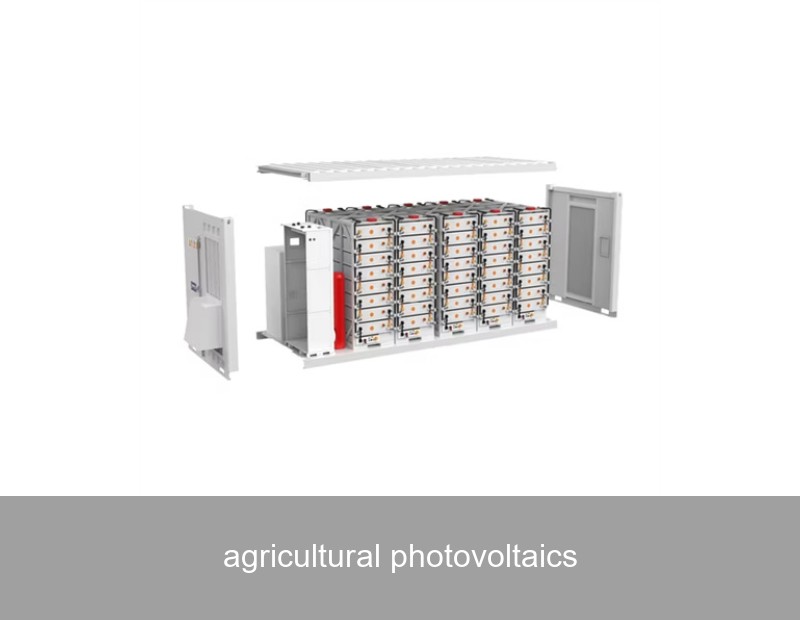
As a global leader in advanced energy storage since 2005, Highjoule specializes in making renewable energy systems like Agri-PV dispatchable, reliable, and intelligent. We don't just provide batteries; we provide integrated power solutions. For an agricultural operation, our H-Series Commercial & Industrial BESS is the ideal companion to a solar array.

Image: A containerized BESS unit, similar to Highjoule's H-Series, providing storage for a farm. (Source: Unsplash)
Our system's key features directly address Agri-PV needs:
- High Energy Density & Scalability: Compact footprint preserves land; systems scale from 100 kWh to multi-MWh to match any farm's size.
- Advanced Battery Management (BMS): Ensures safety, longevity, and optimal performance of lithium-ion phosphate (LFP) cells, the safest chemistry for agricultural environments.
- Smart Energy Management System (EMS): The true brain. Our EMS learns your farm's energy consumption patterns and automatically decides when to store solar energy, when to power the farm, and when to sell to the grid for maximum profitability.
- Robust Design: Built to withstand harsh outdoor, rural conditions with minimal maintenance.
By integrating a Highjoule BESS, the Domaine de Nidolères vineyard could use more of its own solar power to run evening operations or critical cooling systems, further insulating itself from energy price spikes and grid instability.
Getting Started with Your Agri-PV Project
Embarking on an Agri-PV journey requires careful planning. Here is a simplified roadmap:
- Site & Crop Suitability Analysis: Which crops are shade-resilient? What's the solar potential? Partner with Agri-PV specialists.
- Energy Audit: Understand your farm's precise load profile. When do you need power most? Highjoule's technical team can assist with this analysis.
- Financial Modeling: Model the CAPEX and OPEX, including solar panels, mounting structures, and the essential Highjoule storage system. Factor in incentives like the U.S. Investment Tax Credit (ITC) or European agricultural grants.
- Integrated System Design: Design the solar array and storage as one cohesive system from the start, not as an afterthought. This ensures optimal sizing and communication between components.
- Operation & Optimization: Leverage Highjoule's remote monitoring and analytics platform to track performance, savings, and ROI in real-time.
The fusion of agriculture and photovoltaics represents a profound leap forward in sustainable land management. It addresses food security, energy transition, and climate resilience in one unified system. But to truly harness its power, we must think beyond the panel. The question for forward-thinking landowners is no longer just "Could I host solar panels?" but rather, "How can I design an intelligent, self-sustaining energy ecosystem for my land that powers both my operations and my profitability?" What's the first energy challenge on your farm that an integrated Agri-PV and storage system could solve?
 Inquiry
 Online Chat