


All About All-Electric Power Solutions: Your Guide to a Smarter, Cleaner Energy Future
Imagine a world where your business, home, or community isn't just powered by electricity, but is intelligently powered. A world where every kilowatt-hour is managed for maximum efficiency, cost savings, and environmental benefit. This is the promise of all-electric power solutions—a comprehensive approach to energy that integrates generation, storage, and smart management. As grids worldwide face pressure and electricity costs remain volatile, these solutions are no longer a luxury; they're a strategic necessity for energy resilience and sustainability. In this article, we'll demystify what all-electric power solutions truly entail and how they are electrifying our future.
Table of Contents
- What Are All-Electric Power Solutions?
- The Challenge: Intermittency & The Grid Strain
- The Core Components: Beyond Just Solar Panels
- Real-World Impact: A Case Study from Bavaria
- Highjoule's Role in Advanced All-Electric Ecosystems
- Future Trends: Where Is This Technology Heading?
What Are All-Electric Power Solutions?
At its heart, an all-electric power solution is an integrated system designed to meet 100% of a site's energy needs using electricity as the sole energy carrier. This goes far beyond simply installing solar panels. It's a holistic ecosystem that typically combines:
- Renewable Generation: Like solar PV or wind turbines.
- Advanced Energy Storage: Primarily battery storage systems (BESS) to capture excess energy.
- Smart Energy Management: Software that orchestrates generation, storage, consumption, and even grid interaction.
- Electric End-Use Infrastructure: Such as EV charging stations, heat pumps, and electric industrial processes.
The goal isn't just to be "green." It's to achieve unprecedented levels of energy independence, cost predictability, and operational reliability. For businesses, this means protecting bottom lines from energy price spikes. For communities, it means building resilient microgrids that can operate independently during outages.

Image: A commercial site integrating solar generation and battery storage. Credit: Unsplash
The Challenge: Intermittency & The Grid Strain
Here's the central puzzle of the renewable revolution: the sun doesn't always shine, and the wind doesn't always blow. This intermittency creates a mismatch between when energy is produced and when it's needed most. According to the International Energy Agency (IEA), the global capacity of battery energy storage needs to expand dramatically—by over 40 times—by 2030 to align with net-zero goals. This isn't just about storing energy; it's about stabilizing the entire grid.
Furthermore, the push for electrification of transport and heating is set to increase electricity demand significantly. Without intelligent management, this could overwhelm aging grid infrastructure, leading to higher costs and reduced reliability. The all-electric power solution directly addresses this by creating self-balancing, localized energy networks.
The Core Components: Beyond Just Solar Panels
Let's break down the essential technology layers that make these systems work seamlessly.
1. Intelligent Battery Energy Storage Systems (BESS)
This is the linchpin. Modern BESS are not just "big batteries." They are sophisticated power electronics systems. Key considerations include:
- Chemistry: While lithium-ion dominates for its energy density and falling cost, new chemistries are emerging for longer-duration storage.
- Power vs. Energy: Systems must be sized correctly for both instantaneous power needs (like starting a large motor) and energy needs (runtime).
- Grid Services: Advanced systems can provide frequency regulation, voltage support, and other services that help stabilize the public grid.
2. The Brain: Energy Management Software (EMS)
If the BESS is the heart, the EMS is the brain. This software platform uses weather forecasts, energy price signals, and consumption patterns to make autonomous decisions in milliseconds. Should it store solar energy for the evening peak, sell it back to the grid now, or hold it in reserve for a potential outage? A smart EMS optimizes for your specific financial and resilience goals.
3. Seamless Integration & Scalability
A true solution is agnostic, able to integrate with existing solar arrays, new EV fleets, and various building management systems. It must also be modular, allowing capacity to be scaled up as needs grow—a critical feature for businesses and expanding communities.
Real-World Impact: A Case Study from Bavaria
Let's move from theory to practice. Consider a mid-sized dairy processing plant in Bavaria, Germany. Facing volatile energy prices and stringent sustainability targets, they implemented a comprehensive all-electric power solution.
- Problem: High, unpredictable energy costs for 24/7 cooling processes. Limited roof space for solar.
- Solution: A hybrid system featuring a 500 kW solar carport, a 1 MWh Highjoule H-Series battery storage system, and an AI-driven EMS.
- Results (12-month data):
Metric Result Energy Cost Savings 68% reduction in peak demand charges Self-Consumption of Solar Increased from 35% to over 90% Grid Independence During Outages Critical processes supported for 8+ hours CO2e Reduction Approximately 720 tonnes annually
This case, documented in part by the Fraunhofer Institute for Solar Energy Systems, highlights the multi-faceted ROI: direct financial savings, enhanced resilience, and measurable sustainability progress.
Highjoule's Role in Advanced All-Electric Ecosystems
As a global leader in advanced energy storage since 2005, Highjoule is at the forefront of enabling these transformative systems. We don't just supply components; we provide the foundational intelligence for all-electric power solutions.
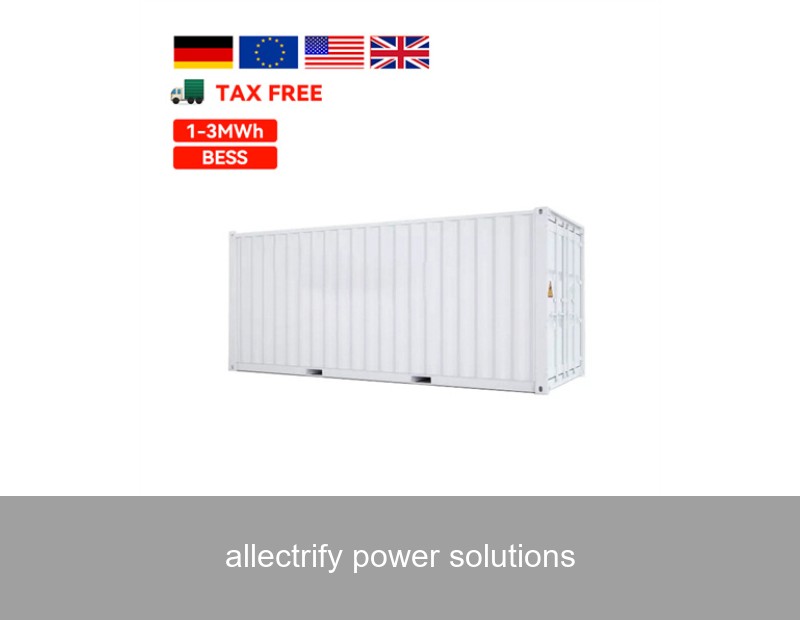
Our flagship product, the Highjoule Nexus Platform, is a fully integrated, containerized BESS that combines our proprietary battery modules, thermal management, and built-in EMS. It's designed for commercial and industrial applications where safety, scalability, and simplicity are paramount. For residential and smaller commercial clusters, our Highjoule Unity Series offers a modular, wall-mounted solution that can be easily expanded.
What sets Highjoule apart is our GridSynch AI software. This platform doesn't just manage the battery; it optimizes the entire site's energy flow, making real-time decisions based on economics and reliability. It can participate in grid service markets (where available), turning your energy storage into a potential revenue stream. Our solutions are deployed across Europe and North America, helping factories, hospitals, retail chains, and neighborhoods take full control of their energy destiny.

Image: Technician monitoring an advanced battery energy storage system. Credit: Unsplash
Future Trends: Where Is This Technology Heading?
The evolution of all-electric power solutions is accelerating. We're moving towards:
- Vehicle-to-Grid (V2G) Integration: Your future EV fleet won't just consume power; it will be a mobile storage asset for your facility.
- AI-Powered Predictive Optimization: Systems will forecast energy needs and market prices weeks in advance, not just hours.
- Standardized Grid Interactivity: As noted by the National Renewable Energy Laboratory (NREL), storage flexibility is key, leading to new standards for how distributed systems support the main grid.
The line between energy consumer and proactive energy manager is blurring. The question is no longer if one should adopt such a system, but how and when to start the journey.
Ready to Explore Your Potential?
What would energy independence look like for your operation? Could your organization benefit from turning a volatile cost center into a predictable, even revenue-generating, asset? The first step is understanding your unique energy profile and the possibilities that modern all-electric power solutions can unlock. What's the single biggest energy challenge you'd like to solve in the next three years?
 Inquiry
 Online Chat