


Understanding Amaron Battery 150Ah Price and the Value of Modern Energy Storage
If you're researching energy storage, whether for a solar setup, a backup power system, or an off-grid application, you've likely come across the "Amaron battery 150Ah price" as a benchmark. It's a common search because for years, reliable lead-acid batteries like those from Amaron have been the go-to solution. But here's a thought: when evaluating cost, are we looking at just the initial purchase price or the true value over the system's lifetime? The energy storage landscape is undergoing a radical shift. Today, we'll explore this shift, understand the total cost of ownership, and see how advanced solutions from providers like Highjoule are redefining what it means to invest in power resilience.
The Price Phenomenon: More Than a Number
It's natural. You need a battery, you search for "Amaron battery 150Ah price," and you get a figure—let's say, for argument's sake, in the range of $200-$300. It seems straightforward and affordable. This initial cost is what we call the CapEx (Capital Expenditure). However, for stationary energy storage, especially when integrated with renewable sources, the CapEx is just the tip of the iceberg.
Think about your car. You don't just pay the sticker price; you factor in fuel efficiency, maintenance costs, and how long it will last. The same rigorous analysis must be applied to batteries. A traditional 150Ah lead-acid battery, while having a lower upfront cost, comes with significant limitations: limited cycle life (typically 500-1200 cycles at 50% depth of discharge), slower charging, lower usable capacity (only about 50% to avoid damage), and regular maintenance needs. These factors contribute to a higher OpEx (Operational Expenditure) and a much shorter service life, often necessitating replacement every 3-5 years.
The Data Reality: Lead-Acid vs. Lithium-Ion
Let's put this into perspective with a simple comparison table. While we're using generic specifications for a 150Ah lead-acid battery versus a modern lithium iron phosphate (LFP) battery of similar capacity, the differences in performance and economics are stark.
| Parameter | Traditional 150Ah Lead-Acid (e.g., Amaron) | Modern 150Ah LFP Battery |
|---|---|---|
| Approximate Upfront Price (Example) | $250 - $350 | $600 - $900 |
| Usable Capacity (DoD*) | ~50% (75Ah) | ~90% (135Ah) |
| Typical Cycle Life (to 80% capacity) | 500 - 1200 cycles | 3000 - 6000+ cycles |
| Expected Lifespan (Years) | 3 - 5 years | 10 - 15 years |
| Efficiency | ~80% | ~95% | Maintenance | Periodic watering required | Maintenance-free |
*DoD: Depth of Discharge. A higher usable DoD means you can use more of the battery's stored energy without harming it.
The data tells a clear story. The lithium-ion battery, though double or triple the initial "Amaron battery 150Ah price," delivers over 2-4 times the usable energy per cycle and lasts 3-5 times longer. When you calculate the cost per kilowatt-hour delivered over the system's lifetime, the modern LFP solution often becomes the more economical choice. This is the core of the value proposition for advanced battery energy storage systems (BESS).

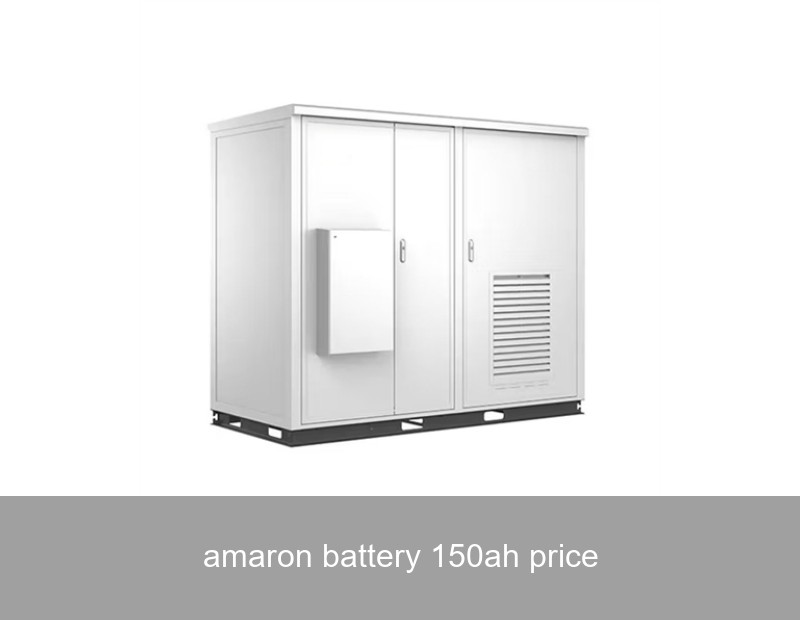
Image Source: Unsplash. A modern, scalable lithium-ion battery storage system.
Case Study: A German Bakery's Sweet Transition
Let's move from theory to a real-world example. Consider "Bäckerei Schmidt," a family-run bakery in Bavaria, Germany. They had a 20kW rooftop solar PV system paired with a bank of 24 lead-acid batteries (total ~30kWh). Their challenges were classic: the batteries needed replacement every 4 years, they could only use about 40% of their solar generation for nighttime operation due to battery limitations, and the maintenance was a hassle.
In 2021, they decided to upgrade. They replaced the entire bank with a Highjoule H-Cube 30 commercial energy storage system. Here are the results after two years:
- Solar Self-Consumption: Increased from 40% to over 85%, drastically reducing grid electricity purchases.
- Performance Guarantee: The Highjoule system came with a 10-year performance warranty, providing long-term cost certainty.
- Peak Shaving: The system's intelligent software now automatically discharges during peak tariff hours, saving an additional €1,200 annually on demand charges.
- Total Cost of Ownership (TCO): Projected over 10 years, the TCO of the new system is 35% lower than continually replacing lead-acid batteries, despite a higher initial investment.
For Bäckerei Schmidt, focusing solely on an "Amaron battery 150Ah price" equivalent would have locked them into an inefficient, high-maintenance cycle. By evaluating total value, they achieved greater energy independence and long-term savings. You can read more about the importance of lifecycle analysis for energy storage on the U.S. Department of Energy's website.
Beyond Price: The Highjoule Intelligent Storage Advantage
At Highjoule, we believe a battery is just one component of a smart energy ecosystem. Since 2005, we've evolved from providing robust battery units to delivering integrated, intelligent power solutions. When you choose a Highjoule system, you're not just buying battery cells; you're investing in a platform designed for efficiency, longevity, and grid interaction.
Our Core Technology Differentiators:
- Advanced LFP Chemistry: All our residential (H-Res) and commercial (H-Cube) series utilize Lithium Iron Phosphate batteries. They are inherently safer, more stable, and offer the exceptional cycle life we discussed.
- Intelligent Energy Management System (EMS): This is the brain of the operation. Our EMS doesn't just store and release energy. It learns your consumption patterns, integrates with weather forecasts for solar prediction, and can be configured for time-of-use optimization or backup power prioritization.
- Scalable & Modular Design: Need to start with 10 kWh and expand to 30 kWh later? Our modular design makes it as simple as adding more battery blocks. This future-proofs your investment against growing energy needs.
- Global Service & Monitoring: With our cloud-based platform, you and our certified technicians can monitor system health, performance, and efficiency in real-time from anywhere, enabling proactive maintenance.

Image Source: Unsplash. Real-time monitoring is key to maximizing storage value.
Where Highjoule Makes a Difference:
Our solutions are tailored for diverse applications:
- Residential: Maximize solar self-consumption, ensure backup power during outages, and reduce electricity bills.
- Commercial & Industrial: Peak shaving to cut demand charges, power quality management, and integrating renewable sources into operations.
- Microgrids: Providing the core storage component for community or remote microgrids, enabling energy independence and stability.
For a deeper dive into the safety and chemistry of LFP batteries, a great resource is the Battery University article on lithium-ion types.
Is Your Energy Storage Strategy Future-Ready?
The question around "Amaron battery 150Ah price" is a starting point, but it leads to a much more important conversation. As energy prices remain volatile and the push for decarbonization intensifies across Europe and North America, the criteria for a good investment are changing. Are you prepared for the next grid outage? How much of your own solar energy are you truly using? What will your electricity costs look like in 5 years?
Modern energy storage is an enabling technology that turns passive consumption into active management. It's about control, resilience, and long-term economics. So, we leave you with this: What specific energy challenge—be it unreliable power, high bills, or a desire to go greener—is motivating your search today, and how can a smarter storage solution transform that challenge into an opportunity?
 Inquiry
 Online Chat