


Navigating the Amaron Battery 200Ah Price: A Smart Buyer's Guide for Energy Independence
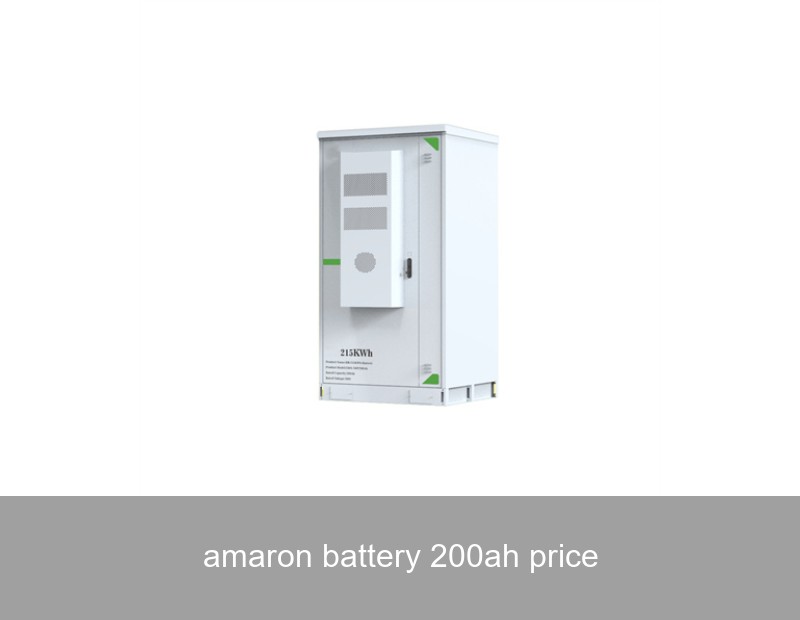
So, you're looking into an Amaron battery 200Ah price. That's a great starting point for anyone serious about reliable backup power or building a solar energy system. But here's a crucial insight we've gained from nearly two decades at Highjoule: focusing solely on the upfront cost of a battery can be a costly mistake. The true value lies in understanding total cost of ownership, system compatibility, and the long-term performance that directly impacts your energy security and savings. In this guide, we'll demystify the factors influencing that price tag and explore how modern, integrated solutions are redefining value in the European and American energy storage markets.
What Really Drives the Amaron 200Ah Battery Price?
The listed price for a lead-acid battery like the Amaron 200Ah is influenced by several tangible factors. Understanding these helps you decode the market.
- Technology (Flooded vs. AGM): Traditional flooded lead-acid batteries are often cheaper upfront but require regular maintenance. Absorbent Glass Mat (AGM) variants, a type of Valve-Regulated Lead-Acid (VRLA) battery, are typically priced higher due to their sealed, maintenance-free design and better performance in partial-state-of-charge conditions.
- Regional Market & Distribution: Costs fluctuate between Europe and the USA based on import duties, local distribution networks, and brand presence. A price in € might not directly translate to an equivalent $ figure after these layers are added.
- Cyclical Raw Material Costs: The price of lead and other commodities is volatile. According to the London Metal Exchange, lead prices can swing significantly, directly impacting manufacturing costs.
- Warranty and Lifespan: A battery with a longer performance warranty or a higher cycle life expectancy will command a premium. This is often where value becomes apparent over time.
However, this traditional component-based purchasing model has limitations. You're buying a single piece of a much larger puzzle—your complete energy system.
Beyond the Price Tag: Key Considerations for Modern Energy Needs
When evaluating an energy storage solution, shifting your mindset from "battery price" to "system value" is essential. Here’s why:
| Consideration | Standalone 200Ah Battery | Integrated Lithium/Ion System |
|---|---|---|
| Usable Capacity | ~80-100Ah (50% Depth of Discharge recommended for longevity) | ~95% of rated capacity (e.g., 190Ah from a 200Ah LiFePO4 battery) |
| Cycle Life | 300-500 cycles to 50% DoD | 6,000+ cycles to 90% DoD (for quality LiFePO4) |
| Efficiency | ~80-85% (energy lost as heat during charge/discharge) | >95% (more solar energy stored and available for use) |
| System Integration | Requires external charge controllers, inverters; complex wiring | Often all-in-one or seamlessly communicates with inverters & solar |
| Long-term TCO | Lower upfront cost, but likely replacement in 3-5 years | Higher upfront, but lower cost per cycle over 10-15+ years |
As you can see, the operational characteristics drastically affect the real-world value you receive. For applications demanding daily cycling—like pairing with solar—the long-term economics strongly favor advanced lithium-ion technologies.
Case Study: Why a German Farm Chose Integration Over a Standalone Battery
Let's look at a real-world example from Bavaria, Germany. The Müller family farm wanted to maximize self-consumption from their 30kW rooftop solar array and ensure resilience during grid outages for their refrigeration and milking systems.
Initial Plan: Expand their existing lead-acid bank with additional 200Ah batteries. The Amaron battery 200Ah price point was attractive, and they were familiar with the technology.
The Challenge: Their installer performed an energy audit and found the farm needed reliable, deep-cycle capability almost daily, especially in winter. The existing lead-acid batteries were degrading after just two years due to the demanding charge/discharge profile.
The Solution: They installed a Highjoule H-Ion 15 commercial energy storage system. This modular lithium iron phosphate (LiFePO4) system offered 15kWh of usable capacity, seamless integration with their existing solar inverters, and a guaranteed capacity retention of 80% after 10,000 cycles.
Data & Outcome (After 18 Months):
- Self-Consumption Rate: Increased from 35% to 88%.
- Energy Cost Savings: €2,300 annually, projecting a full system payback in under 7 years.
- Reliability: Successfully powered critical loads through three planned grid outages.
- Space & Maintenance: The system occupies 60% less space and requires zero maintenance compared to the old battery room.

Image Source: Unsplash (Representative image of a modern farm energy storage system)
This case highlights a critical pivot: instead of asking "what's the battery price?", the Müller's asked "what's the most reliable and cost-effective way to achieve our energy goals?" The answer was an intelligent, integrated system.
The Highjoule Approach: Intelligent Systems, Not Just Components
At Highjoule, our philosophy is built on this integrated mindset. Since 2005, we've evolved from providing robust battery components to delivering complete, smart storage solutions. We understand that the core of a great system isn't just a quality battery cell—it's the intelligence that manages it.
Our product lines, like the H-Ion Series for residential and commercial use and the GridMAX for microgrid applications, are built with this principle. They feature:
- Advanced Battery Management Systems (BMS): Our proprietary BMS doesn't just protect cells; it optimizes performance and lifespan in real-time based on usage patterns and environmental data.
- Grid-Interactive Capabilities: For markets with variable electricity tariffs or virtual power plant (VPP) programs, our systems can be configured to discharge or charge at optimal times, turning your storage into a revenue or savings asset. A study by the National Renewable Energy Lab (NREL) outlines the growing value of grid services from distributed storage.
- Scalable Architecture: Start with what you need and add modules as your energy needs grow, protecting your initial investment.
- Remote Monitoring & Diagnostics: Our Highjoule Energy Cloud platform gives you and your installer full visibility into system health and performance, enabling proactive maintenance.
This holistic approach ensures that every component, from the battery chemistry to the communication software, is designed to work in perfect harmony, delivering the lowest total cost of ownership and peace of mind.
Making Your Choice: The Right Questions to Ask
Whether you're a homeowner in California or a factory manager in Italy, moving beyond the initial price inquiry is key. Here are the questions we encourage you to discuss with your energy consultant:
- What is my usable energy storage capacity, and how does that meet my critical load profile during an outage?
- What is the expected cycle life under my specific usage pattern, and what warranty backs that up?
- How does this battery integrate with my existing or planned solar PV and inverter system?
- What are the installation, maintenance, and potential replacement costs over a 10-year horizon?
- Does this system have the intelligence to adapt to future energy tariffs or grid service programs?
By focusing on these questions, you transition from shopping for a commodity to investing in a tailored energy solution.
Ready to See the Full Picture?
The journey to energy independence is exciting. While the Amaron battery 200Ah price offers a data point, the real story is about achieving resilience, savings, and sustainability. We invite you to explore what a purpose-built system can do for your specific needs. What would you power first if you had a smarter, more resilient energy foundation in your home or business?
 Inquiry
 Online Chat