


Understanding BESS Battery Price: A Deep Dive into the 150Ah Segment
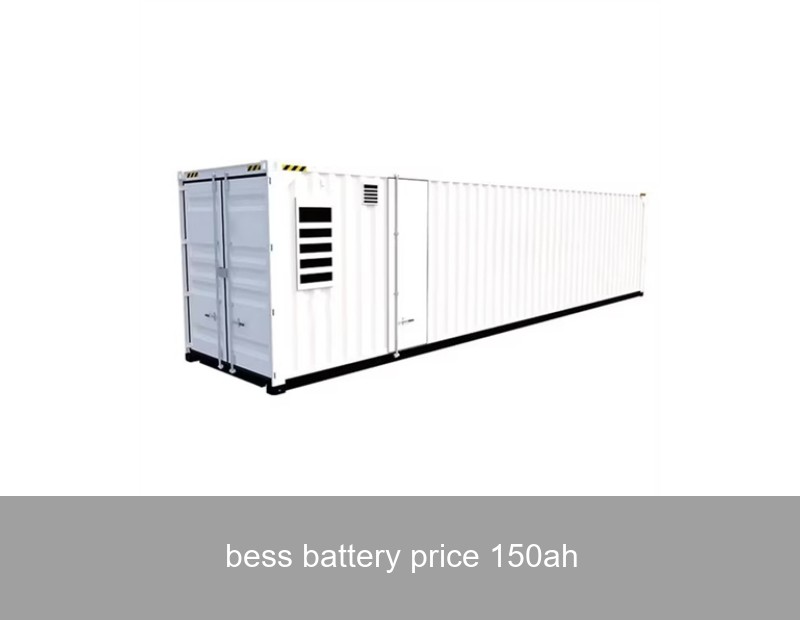
If you're researching Battery Energy Storage Systems (BESS), you've likely encountered the term "150Ah." It's a common capacity rating that pops up everywhere from residential solar kits to commercial backup power quotes. But what does "BESS battery price 150Ah" really tell you? As a product technology expert at Highjoule, I often explain that focusing solely on the amp-hour (Ah) rating and its sticker price is like buying a car based only on the size of its fuel tank. The real value lies in the complete system's intelligence, durability, and total cost of ownership. In this article, we'll unpack the factors influencing BESS pricing, explore the role of a 150Ah battery cell, and show you how to evaluate a storage solution for your true energy needs.
Table of Contents
- The Ah Myth: Why Price Per Cell Is Misleading
- The Real BESS Cost Breakdown: Beyond the 150Ah Battery
- Case Study & Data: A German Bakery's Recipe for Savings
- The Highjoule Approach: Engineering Value Beyond the Cell
- Future Price Trends: What Experts Predict
- Choosing Your System: The Right Questions to Ask
The Ah Myth: Why Price Per Cell Is Misleading
The "150Ah" refers to the capacity of an individual battery cell. Specifically, it means the cell can, in theory, deliver 150 amperes of current for one hour before being depleted. It's a useful metric for comparing cells, but here's the catch: a BESS is far more than a box of cells. The total system capacity (measured in kilowatt-hours, kWh) is determined by how many of these cells are connected together and at what voltage. A single 150Ah cell at 3.2V only stores about 0.48 kWh of energy—barely enough to run a microwave for half an hour. A functional home system typically needs 5-15 kWh, while commercial systems start at 30 kWh and scale up dramatically.
Therefore, asking for the "BESS battery price 150Ah" is a bit like asking for the price of a brick when you need to build a house. The brick's cost (the cell) matters, but the design, the foundation (BMS), the plumbing (inverter), and the skilled labor (system integration) determine the final home's value, safety, and longevity.
Key Components That Define True System Cost
- Battery Management System (BMS): The brain of the operation. A premium BMS ensures safety, maximizes cycle life, and manages cell balancing. A cheap BMS risks premature failure or even safety hazards.
- Inverter/Converter: The heart. This device converts stored DC power to usable AC power for your building. Its efficiency and power rating are critical to system performance.
- Thermal Management: The climate control. Batteries degrade quickly if too hot or too cold. Active liquid cooling or advanced air systems add cost but dramatically extend lifespan.
- System Integration & Software: The nervous system. Smart software enables energy arbitrage, grid services, and seamless integration with solar PV. This is where intelligence transforms stored energy into savings.
The Real BESS Cost Breakdown: Beyond the 150Ah Battery
Let's look at a simplified cost structure for a typical commercial-grade BESS. While cell costs have fallen significantly, their share of the total system cost is now often between 30-50%, down from over 70% a decade ago. The balance of system (BoS) costs now dominate.
| Cost Component | Approx. Share of Total System Cost | What It Enables |
|---|---|---|
| Battery Cells (e.g., 150Ah LFP) | 30-50% | Raw energy storage capacity. |
| Power Conversion (Inverter) | 15-25% | Making electricity usable for your facility. |
| BMS & System Integration | 15-20% | Safety, longevity, and smart controls. |
| Thermal Management & Enclosure | 10-15% | Reliability in diverse climates. |
| Engineering, Software, & Services | 10-15% | Custom design, commissioning, and ongoing optimization. |
This breakdown reveals why two systems built with similar 150Ah cells can have vastly different price tags and performance outcomes. The investment in high-quality BoS components pays dividends for 15-20 years.
Case Study & Data: A German Bakery's Recipe for Savings
Let's move from theory to practice. A family-owned bakery in Bavaria, Germany, faced steep demand charges from their utility and wanted to stabilize operations during grid fluctuations. Their primary goal wasn't just backup power; it was cost avoidance.
The Challenge: Morning energy peaks from ovens and refrigeration triggered high demand charges. A 3-hour power outage would spoil inventory and halt production.
The Solution: Highjoule designed and installed a bespoke 120 kWh BESS, integrated with their existing rooftop solar. The system uses high-cycle-life lithium iron phosphate (LFP) cells (including 150Ah-class cells) configured for maximum daily use. The intelligent energy management software was programmed to "peak shave," discharging the battery during the bakery's predictable morning and afternoon power peaks to flatten their grid draw.
The Data-Driven Outcome (First 12 Months):
- Demand Charge Reduction: 28% decrease in peak power draw from the grid.
- Energy Bill Savings: €5,200 saved annually from demand charge reduction and increased solar self-consumption.
- ROI Timeline: Projected full system payback in under 7 years, based on savings and a German federal subsidy (BAFA).
- Resilience: The system seamlessly provided backup power during two brief grid outages, preventing spoilage.

Image Source: Unsplash (Representative image of a professional BESS installation)
This case illustrates that the true "price" of a BESS must be measured against the lifetime value it creates. The bakery's system wasn't a cost center; it became a profit-protecting asset.
The Highjoule Approach: Engineering Value Beyond the Cell
At Highjoule, with nearly two decades of experience, we engineer systems where every component is optimized for the whole. Yes, we source top-tier 150Ah LFP cells known for their safety and long cycle life. But our core innovation lies in the Highjoule Harmony OS and our modular architecture.
Our H-Series Commercial & Industrial (C&I) systems are built around a "balance-of-system-first" philosophy. The integrated inverter is 98.5% efficient. The liquid-cooling thermal system maintains the ideal cell temperature year-round, extending life. Most importantly, the Harmony OS doesn't just store energy; it intelligently dispatches it based on real-time electricity prices, weather forecasts, and your facility's load patterns.
For residential and smaller commercial applications, our E-Series All-in-One units bring this integrated intelligence to a compact form factor. They simplify the "BESS battery price 150Ah" question by providing a complete, warrantied, and performance-guaranteed solution with a clear upfront cost and predictable long-term savings.
We view our role as long-term partners in energy resilience. Our services include detailed feasibility analysis, custom system design, professional installation, and remote performance monitoring to ensure your investment delivers its promised returns year after year.
Future Price Trends: What Experts Predict
According to analysis from BloombergNEF, the global volume-weighted average price for a battery pack fell to $139/kWh in 2023. They project prices to drop below $100/kWh by 2025, driven by scale, lower raw material costs, and manufacturing innovations (BloombergNEF, 2023). However, this refers primarily to pack prices. For complete, grid-connected BESS, the levelized cost of storage (LCOS)—which factors in installation, cycling, lifespan, and efficiency—is the more critical metric. LCOS is declining steadily, making storage competitive with peaker plants and a cornerstone of the clean energy transition (IRENA, 2023).

Image Source: Unsplash (Visual representation of declining cost trends)
This trend suggests that while the cost of the core battery block (including 150Ah cells) will continue to become more economical, the premium for intelligent, durable, and high-performance system integration will remain—and become even more valuable as grids become more dynamic.
Choosing Your System: The Right Questions to Ask
So, when you evaluate a BESS proposal, move beyond the "price per Ah." Instead, engage your provider with these questions:
- What is the system's warranted end-of-life capacity, and what is the expected cycle life under my specific usage profile?
- How does the BMS and thermal management system protect my investment in extreme temperatures?
- Can you provide a detailed financial model showing projected savings, including demand charge reduction and increased self-consumption, over 10+ years?
- What is the system's round-trip efficiency, and how does the software control strategy maximize my financial return?
- What does the service and support package include, and do you offer remote monitoring and performance guarantees?
As you ponder these questions, consider this: Is your primary goal the lowest upfront cost, or the highest and most reliable return over the system's lifetime? The energy landscape is shifting from a passive cost to an active asset class. How will you position your home or business to benefit?
 Inquiry
 Online Chat