


Navigating the Energy Transition: How to Identify the Best Lithium Battery Brands for Your Needs
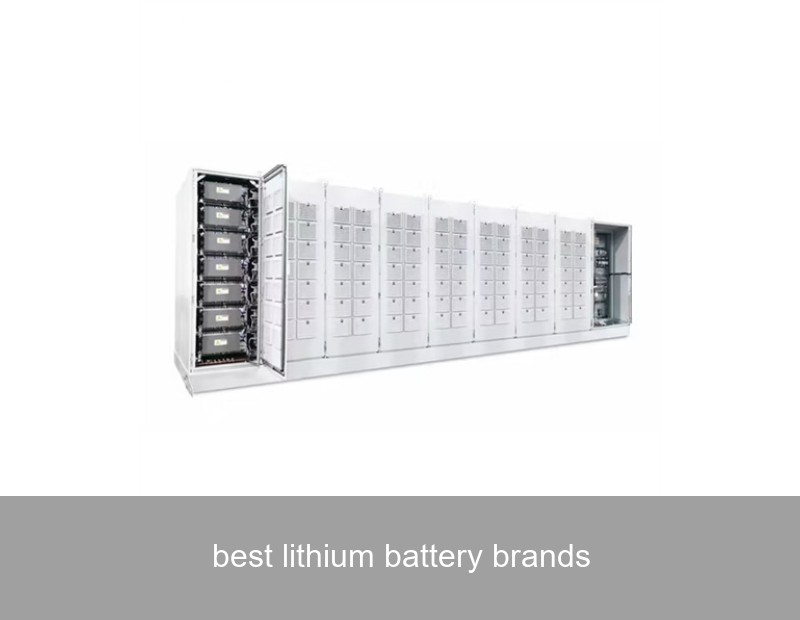
As the global push for renewable energy accelerates, a critical question emerges for homeowners and businesses alike: how do we store this clean power effectively? The answer increasingly lies in advanced lithium battery technology. But with a growing market, identifying the best lithium battery brands becomes paramount. It's not just about buying a battery; it's about investing in reliability, safety, and long-term performance for your solar panels or backup power system. This guide will cut through the noise, exploring the key criteria that separate industry leaders from the rest, and highlighting how companies like Highjoule are shaping the future of sustainable energy storage.
Table of Contents
- The Lithium-Ion Revolution: More Than Just a Trend
- Key Criteria for Evaluating the Best Lithium Battery Brands
- Beyond Specs: The Importance of System Intelligence and Software
- A Real-World Case: Stabilizing a European Microgrid
- The Highjoule Approach: Engineering for Real-World Demands
- Future Horizons: What's Next for Lithium Battery Technology?
The Lithium-Ion Revolution: More Than Just a Trend
Let's be honest, the shift to lithium-ion batteries from older technologies like lead-acid feels almost inevitable now. Why? The data speaks for itself. Lithium batteries offer significantly higher energy density (meaning more power in a smaller space), longer lifespans often exceeding 10 years with high cycle counts, and deeper daily discharge capabilities without damage. According to the U.S. Department of Energy, the price of lithium-ion battery packs has fallen by nearly 90% since 2010, fueling widespread adoption. This isn't just a minor upgrade; it's the foundational technology enabling modern energy independence.

Image Source: Unsplash - Professional installation of a modern lithium battery system.
Key Criteria for Evaluating the Best Lithium Battery Brands
So, what should you look for when comparing brands? It goes far beyond just the price tag per kilowatt-hour. Here are the non-negotiable pillars:
- Safety & Cell Chemistry: Not all lithium cells are created equal. Brands using premium, automotive-grade Lithium Iron Phosphate (LFP) chemistry, like many top-tier manufacturers, prioritize thermal and chemical stability. This drastically reduces fire risk compared to older NMC formulations, a critical factor for residential installation.
- Performance & Warranty: Look for transparent data on round-trip efficiency (typically above 94%), depth of discharge (DoD), and cycle life. A strong warranty (e.g., 10 years retaining 70% capacity) is a brand's vote of confidence in its own product's longevity.
- Scalability & Integration: Can the system start small and grow as your needs change? The best brands offer modular designs that allow seamless expansion. Furthermore, seamless integration with major solar inverter brands is essential for a hassle-free experience.
- Manufacturer's Proven Track Record: In an industry with many newcomers, a long history of deployment in diverse climates and applications is invaluable. It demonstrates resilience and real-world R&D investment.
| Feature | Entry-Level Brand | Premium Brand (e.g., Highjoule) |
|---|---|---|
| Core Chemistry | Varies, often standard NMC | Lithium Iron Phosphate (LFP) for enhanced safety |
| Typical Warranty | 5-7 years | 10+ years with guaranteed end-of-term capacity |
| System Intelligence | Basic monitoring | AI-driven energy management, grid services ready |
| Scalability | Limited or fixed capacity | Fully modular, expandable stackable units |
Beyond Specs: The Importance of System Intelligence and Software
Here's where the conversation gets interesting. Today's best lithium battery brands are not just hardware suppliers; they are energy software companies. The true value of a modern Battery Energy Storage System (BESS) lies in its brain. Advanced software can learn your energy consumption patterns, automatically optimize charging from solar or the grid (based on time-of-use rates), and even provide grid-support services in some regions. This intelligence turns a passive storage unit into an active financial asset, maximizing your return on investment. As a pioneer since 2005, Highjoule embeds this intelligence into its H-Series commercial systems and HomePower+ residential units, ensuring users don't just store energy, but manage it with precision.
A Real-World Case: Stabilizing a European Microgrid
Let's move from theory to practice. Consider a challenge faced by a rural community cooperative in Southern Europe. With an aging grid infrastructure and a high penetration of local wind and solar farms, they faced frequency instability and curtailment of renewable energy.
The Solution: The cooperative partnered with Highjoule to deploy a containerized, grid-scale Highjoule GridMax BESS with a capacity of 2.4 MWh. This system wasn't just a battery; it was a grid-forming asset programmed with Highjoule's proprietary grid-assist software.
The Data-Driven Outcome: Within the first year of operation:
- Renewable curtailment was reduced by over 95%, allowing clean energy to be stored and used locally.
- Grid frequency regulation improved by 40%, enhancing reliability for all connected users.
- The system's AI-based management predicted peak generation and automated dispatch, creating a new revenue stream for the cooperative through grid service contracts.
The Highjoule Approach: Engineering for Real-World Demands
Drawing from nearly two decades of experience, Highjoule's philosophy is built on adaptive engineering. We understand that a residential home in California, a brewery in Germany, and a hospital microgrid in Texas have vastly different needs. Our products reflect this. For instance, the Highjoule HomePower+ system features a modular design allowing homeowners to start with a 5kWh unit and expand to 20kWh, all managed via an intuitive app that suggests optimal savings strategies. For our commercial clients, the H-Series offers unparalleled flexibility, supporting complex peak shaving, demand charge reduction, and backup power protocols, all within a single, robust platform. This focus on versatility and durability, backed by a global support network, is what defines a true leader in the space.

Image Source: Unsplash - Residential home with solar and integrated battery storage for energy independence.
Future Horizons: What's Next for Lithium Battery Technology?
The innovation curve is steep. We're already seeing research into solid-state batteries, which promise even greater safety and energy density. However, for the foreseeable next decade, the evolution will be in system optimization, second-life applications for EV batteries, and advanced vehicle-to-grid (V2G) integration. The brands that will stay at the forefront are those investing not just in cell chemistry, but in the entire ecosystem—from manufacturing to recycling. Highjoule's R&D pipeline, for example, actively explores integrating second-life EV batteries into stationary storage applications, a move that supports a truly circular economy for energy.
As you evaluate your options for energy storage, remember that choosing among the best lithium battery brands is a decision that will impact your energy resilience and costs for the next decade or more. It requires looking beyond the brochure and understanding the company's expertise, software capabilities, and commitment to your long-term success. With the right partner, your energy storage system becomes more than a product; it becomes the intelligent heart of your personal or commercial energy ecosystem.
What specific energy challenge—be it unpredictable utility bills, frequent outages, or a desire to maximize your solar investment—is motivating you to explore lithium battery solutions today?
 Inquiry
 Online Chat