


Who Are the Biggest Solar Companies in the USA? Beyond Panels to Power Independence
When you think of the biggest solar companies in the USA, names like First Solar, SunPower, or Sunrun likely come to mind. These giants are rightfully celebrated for deploying millions of solar panels across American rooftops and fields. But here's a question we at Highjoule often ponder: is generating clean energy the end of the story, or just the beginning? True energy independence isn't just about producing power; it's about controlling it. This is where the narrative shifts from solar generation alone to intelligent, resilient energy storage—a domain where Highjoule has been a global leader since 2005.
Table of Contents
- The Solar Phenomenon: More Than Just Big Names
- The Storage Imperative: Why Solar Alone Isn't Enough
- Case Study: A U.S. Commercial Facility's Journey to Resilience
- Highjoule's Role: The Intelligent Bridge Between Solar and Stability
- The Future Landscape of American Solar & Storage
The Solar Phenomenon: More Than Just Big Names
The growth of solar in the U.S. is a testament to innovation and market demand. The Solar Energy Industries Association (SEIA) reports the U.S. solar market installed a staggering 32.4 gigawatts (GW) of new capacity in 2023, bringing the total installed capacity to over 179 GW—enough to power 33 million homes. The biggest solar companies in the USA have driven this expansion, focusing on manufacturing, project development, and residential leasing.
However, this massive influx of variable renewable energy creates a new challenge for the grid. Think of it like this: the sun doesn't always shine on schedule with our peak electricity demand, which often occurs in the early evening. The California "duck curve," a well-known phenomenon in energy circles, graphically shows the deepening dip in net load during sunny afternoons and the steep ramp-up as the sun sets. This imbalance underscores a critical gap.
The Limitation of Generation-Only Focus
Relying solely on solar generation, even at a massive scale, leaves two key issues unaddressed:
- Intermittency & Grid Stress: Solar production is weather-dependent. Surplus power at noon can strain the grid, while zero production at night forces reliance on fossil-fuel peaker plants.
- Vulnerability to Outages: During grid failures, most standard grid-tied solar systems shut off for safety. Without storage, your solar panels are idle when you need power the most.
This leads us to the next, crucial piece of the modern energy puzzle.

Image Source: Unsplash (Photographer: American Public Power Association)
The Storage Imperative: Why Solar Alone Isn't Enough
Data from the U.S. Energy Information Administration (EIA) reveals a telling trend: while solar and wind are the fastest-growing sources of electricity generation, their capacity factors (actual output vs. maximum possible) are around 25% and 35%, respectively. This variability is the fundamental reason energy storage systems (ESS) are transitioning from a luxury to a necessity. The smart pairing of solar with storage transforms a one-way generator into a 24/7 personal power plant.
The value proposition is clear:
- Energy Time-Shifting: Store excess solar energy produced at noon for use during expensive peak evening hours.
- Backup Power: Provide seamless, instantaneous power during grid outages, keeping critical loads operational.
- Grid Services: For larger commercial and industrial sites, storage can participate in demand response programs, generating revenue and supporting grid stability.
Case Study: A U.S. Commercial Facility's Journey to Resilience
Let's move from theory to a real-world example. A medium-sized food processing plant in Texas, operating with a 500 kW rooftop solar array, faced two major challenges: volatile energy prices and the constant threat of grid instability, which could spoil perishable inventory.
The Solution: In 2023, the facility partnered with Highjoule to integrate a 750 kWh Highjoule H-Cube Commercial Battery Energy Storage System (BESS) with their existing solar. The H-Cube's modular design allowed for seamless integration into their limited substation space.
The Data-Driven Outcome (12-month period):
| Metric | Before Highjoule BESS | After Highjoule BESS |
|---|---|---|
| Grid Electricity Cost | $18,500/month (avg.) | $11,200/month (avg.) |
| Solar Self-Consumption | ~65% | ~94% |
| Outage Protection | None (full shutdown) | Critical loads powered for 8+ hours |
| CO2e Reduction | ~42 tons/month | ~58 tons/month |
This case illustrates that the value of partnering with the biggest solar companies in the USA is maximized only when coupled with intelligent storage. The solar array generates the fuel, but the Highjoule BESS provides the control, ensuring every kilowatt-hour is used optimally for economics and resilience.
Highjoule's Role: The Intelligent Bridge Between Solar and Stability
While we may not install solar panels ourselves, Highjoule is a fundamental partner to solar integrators and developers. For nearly two decades, we've specialized in the "brain" and "bank" behind the solar array. Our expertise lies in advanced battery technology, power conversion, and, most importantly, intelligent energy management software.
Our product suite is designed to complement any major solar installation:
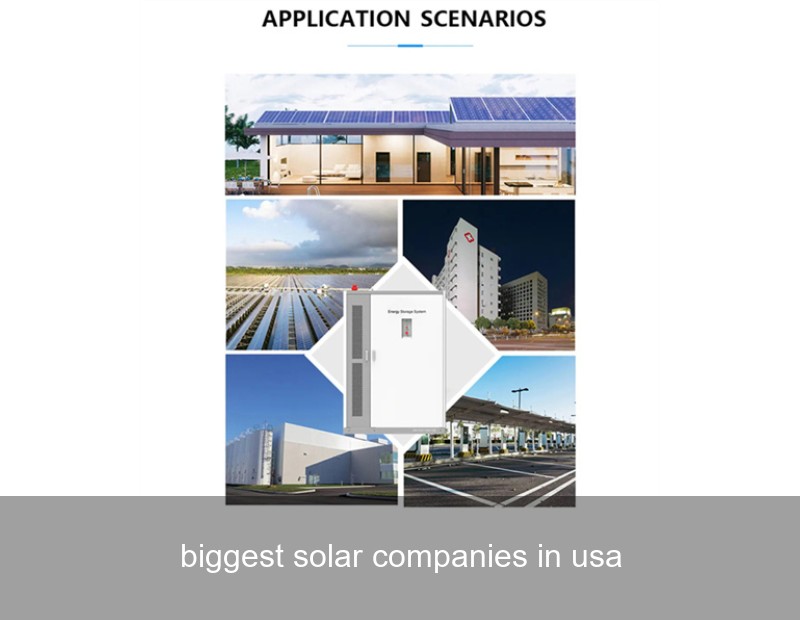
- H-Cube Commercial & Industrial BESS: A modular, containerized solution scalable from 250 kWh to multi-MWh projects. It features integrated safety systems, high-cycle life LiFePO4 batteries, and our proprietary JouleMind AI platform for predictive energy scheduling.
- H-Residence Home Energy System: A sleek, integrated unit for homeowners seeking to maximize their rooftop solar investment. It offers whole-home or critical load backup, time-of-use optimization, and simple monitoring via a mobile app.
- Microgrid Controllers: For campuses, communities, or industrial sites, our controller can seamlessly island a solar+storage+generation microgrid from the main grid, ensuring continuous operation.
Think of it this way: the biggest solar companies in the USA provide the excellent engine (solar panels). Highjoule provides the intelligent transmission, fuel tank, and navigation system (storage + software) that ensures you get where you need to go, regardless of road conditions.

Image Source: Unsplash (Photographer: Kindel Media)
The Future Landscape of American Solar & Storage
The U.S. energy landscape is evolving rapidly, fueled by the Inflation Reduction Act (IRA) which provides significant investment tax credits (ITC) for both solar and standalone storage. This policy is accelerating the adoption of storage as a critical infrastructure asset. The future belongs not to solar alone, but to integrated, intelligent solar-plus-storage ecosystems.
As you evaluate the biggest solar companies in the USA for your project, we encourage you to ask a deeper set of questions: How will this system perform when the grid is down? How can I maximize the financial return of every solar kilowatt-hour I produce? How do I future-proof my investment against volatile energy markets?
A Call for a Holistic Partnership
The most successful energy projects are built on collaboration. Leading solar developers frequently partner with specialized storage experts like Highjoule to deliver a complete, bankable solution. Our technical teams work in lockstep with solar designers to ensure perfect system harmony, from initial concept through commissioning and long-term operation.
So, as you embark on your journey toward energy independence, we leave you with this: What does true energy resilience look like for your home or business, and how can intelligent storage help you paint that picture?
For further reading on U.S. solar growth, you can explore reports from the Solar Energy Industries Association (SEIA) and grid data from the U.S. Energy Information Administration (EIA).
 Inquiry
 Online Chat