


Bloomberg Tier 1 Solar Panel: Your Ultimate Guide to Quality and Reliability
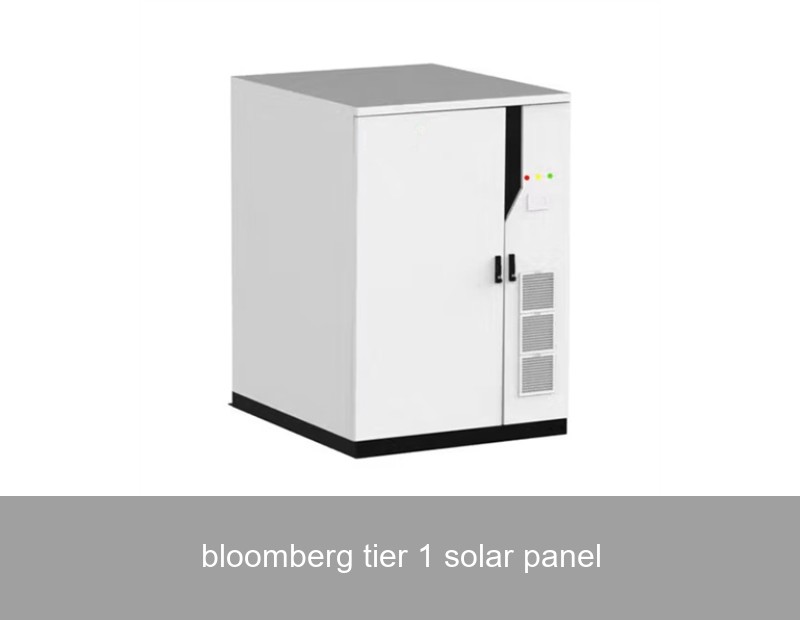
So, you're considering solar for your home or business. You've started your research and keep seeing the term "Bloomberg Tier 1" thrown around as a mark of quality. But what does it actually mean? Is it a guarantee of performance, or just a finance-friendly label? More importantly, how do these top-tier panels integrate into a complete energy system that works day and night? Let's demystify the term and explore how pairing high-quality solar generation with intelligent storage, like solutions from Highjoule, creates the ultimate path to energy independence.
Table of Contents
- What is a Bloomberg Tier 1 Solar Panel?
- The Phenomenon: Why "Tier 1" Became a Buzzword
- Data & Reality: Performance Beyond the Bankability List
- Case Study: A German Industrial Park's Tier 1 + Storage Success
- Expert Insights: Building a Holistic Energy System
- Where Highjoule Fits In: The Intelligent Storage Backbone
What is a Bloomberg Tier 1 Solar Panel?
First, let's clear up a common misconception. "Bloomberg Tier 1" is not a measure of panel efficiency, durability, or real-world performance. It is a financial rating created by BloombergNEF (BNEF). A manufacturer is classified as Tier 1 if its panels have been used in six different projects over the past two years, financed non-recourse by six different commercial banks. In simple terms, it signals that banks see the manufacturer as a low-risk investment. It's about the company's financial stability and the bankability of its products, not an engineering certification.

Image: High-quality solar installation requires both reliable panels and expert integration. (Source: Unsplash)
The Phenomenon: Why "Tier 1" Became a Buzzword
The solar industry is vast and competitive. For developers and homeowners, navigating hundreds of panel brands can be overwhelming. The Bloomberg Tier 1 list emerged as a handy, though imperfect, filter. It became a shorthand for "these manufacturers are established and reputable." For large-scale solar farm developers needing to secure multi-million dollar loans, using Tier 1 panels is often a non-negotiable requirement from their financiers. This trickled down to the residential and commercial market, where installers and consumers began using the term as a proxy for quality.
The Limitation of the Label
Relying solely on this financial tier can be misleading. A panel's true value is determined by its:
- Performance Warranty: How much power output is guaranteed over 25-30 years?
- Product Warranty: Coverage against defects and environmental wear.
- Degradation Rate: High-quality panels lose less than 0.5% of output per year.
- Temperature Coefficient: How well the panel performs on a hot day.
- Real-World Testing Data: From independent labs like PVEL, which publishes the PV Module Reliability Scorecard.
Data & Reality: Performance Beyond the Bankability List
Let's look at the numbers. A top-performing monocrystalline panel from a reputable Tier 1 manufacturer might have an efficiency rating of 21-22%. Its power output warranty typically guarantees 92% of original output after 10 years and around 85% after 25 years. However, these are lab-condition specs. Real-world energy yield depends on installation angle, shading, local climate, and crucially, how you use the generated power.
This is the critical link many miss. A Bloomberg Tier 1 solar panel captures electrons, but an intelligent system decides their fate. Without storage, excess solar energy produced at midday is often exported to the grid at low rates, while you buy back expensive power in the evening. The true economic and resilience benefit is unlocked only when you can store and manage that self-generated energy.
| Criteria | Bloomberg Tier 1 Status | Independent Quality Metrics |
|---|---|---|
| Primary Focus | Manufacturer's financial bankability | Panel's technical performance & reliability |
| Source | BloombergNEF (BNEF) | PVEL, KIWA, TÜV Rheinland, etc. |
| Best For | Assessing project finance risk | Assessing long-term energy yield & value |
| System Integration | Not considered | Critical: Compatibility with inverters & storage like Highjoule systems |
Case Study: A German Industrial Park's Tier 1 + Storage Success
Let's examine a real project in Bavaria, Germany. A medium-sized manufacturing company installed a 550 kW rooftop solar array using Tier 1 bifacial panels in 2022. While the solar generation was excellent, the facility's energy manager noticed a problem: 40% of the solar power was being fed into the grid during low-price hours, and the facility was still drawing significant grid power during peak evening hours for lighting and auxiliary systems.
The Solution: In 2023, they integrated a Highjoule HPS-300 commercial battery energy storage system (BESS) with a capacity of 300 kWh. The system's intelligent energy management software was programmed to:
- Store excess midday solar production.
- Discharge during the high-price evening peak (4 PM - 9 PM), reducing grid consumption.
- Provide backup power for critical loads during grid outages.
The Data-Driven Outcome (12 months post-installation):
- Grid Independence: Increased on-site consumption of solar power from 60% to 85%.
- Cost Savings: Reduced peak-demand charges and optimized time-of-use tariffs, leading to an additional €18,000 in annual energy cost savings on top of solar savings.
- ROI: The storage system's payback period was projected under 7 years, enhanced by Germany's dynamic energy market.

Image: A modern commercial battery storage system, similar to Highjoule's HPS series, enabling energy independence. (Source: Unsplash)
Expert Insights: Building a Holistic Energy System
As a product technology expert at Highjoule, I see the optimal energy system as a triad: Generation (Solar), Storage (Battery), and Intelligence (Software). A Bloomberg Tier 1 solar panel is an excellent choice for the first leg—it's a reliable, high-quality asset. But its potential is capped without the other two.
Think of it this way: The solar panels are your diligent workers, producing energy whenever the sun shines. The battery storage, like Highjoule's Residential HES series or Commercial HPS units, is your savings account, letting you store that hard-earned energy for when you truly need it. The energy management system is your financial advisor, making smart, split-second decisions on when to save, spend, or even sell back to the grid for maximum benefit.
Where Highjoule Fits In: The Intelligent Storage Backbone
Since 2005, Highjoule has focused on one mission: transforming how the world uses energy through advanced storage. We don't manufacture solar panels, and that's by design. We are agnostic experts who integrate seamlessly with top-tier solar arrays, including those using Bloomberg Tier 1 solar panels. Our role is to maximize the value of your solar investment.
For homeowners, our HES Series offers scalable, safe lithium iron phosphate (LFP) battery systems with an intuitive app for monitoring and control. For businesses and microgrids, our HPS Containerized BESS provides utility-scale power in a modular, plug-and-play format, complete with advanced grid-services capabilities. Our systems are designed with European and North American safety standards at their core, ensuring not just performance, but peace of mind for decades.
By pairing your high-quality solar with a Highjoule system, you move beyond just generating green energy. You build a resilient, self-optimizing power asset that manages costs, provides backup, and supports grid stability. You can explore more on the importance of storage for grid stability from the International Energy Agency.
The Future-Proof Choice
The energy landscape is shifting from simple net metering to more complex time-of-use rates and demand charges. A system designed today must be ready for tomorrow's electricity markets. Highjoule's software-upgradable platforms ensure your investment continues to adapt and optimize, protecting you against future rate changes and maximizing your return.

Image: A complete home energy ecosystem: solar generation, storage, and electric vehicle readiness. (Source: Unsplash)
So, as you finalize your plans for a solar installation and rightly consider the merits of a Bloomberg Tier 1 solar panel, we leave you with this question: What is your strategy for the energy your panels will produce when the sun sets, or when the grid goes down?
 Inquiry
 Online Chat