


Tier 1 Paneles Solares 2024: Your Guide to Quality and Long-Term Value
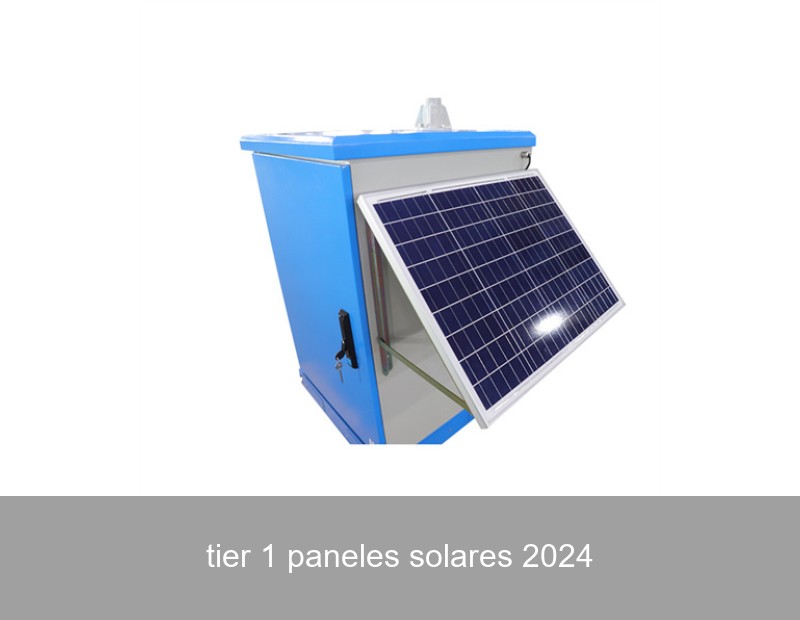
If you're planning a solar installation for your home or business in 2024, you've likely encountered the term "Tier 1 solar panels." It sounds like a mark of quality, a simple filter to separate the best from the rest. But here’s a reality check many discover too late: the label "Tier 1" isn't a government-certified standard or a guarantee of performance. It’s a financial classification, primarily used by banks and investors to assess a manufacturer's risk. So, how do you, as an informed buyer, cut through the jargon and make a decision that ensures reliability, efficiency, and a strong return on investment for the next 25+ years? This guide will demystify Tier 1 paneles solares 2024, highlight the real factors you should prioritize, and explain why the brain of your system—the energy storage solution—is just as critical as the panels on your roof.
The Trust Problem: Cutting Through the Marketing Noise
The solar industry is booming, and with growth comes complexity. A recent market analysis highlighted that while panel efficiency has plateaued slightly, the focus has shifted to durability, degradation rates, and real-world performance in diverse climates. The term "Tier 1" is often used as a powerful marketing tool, but it can create a false sense of security. It primarily indicates that the manufacturer has been financially stable enough to secure bank funding for large-scale projects, which does correlate with a lower likelihood of the company disappearing in a decade. However, it doesn't automatically mean their panels have the best temperature coefficient, the lowest degradation, or the most robust warranty backing. Your goal isn't just to buy a panel; it's to secure a dependable, high-yielding energy asset.
The Financial Backbone: What "Tier 1" Really Means
BloombergNEF's (BNEF) Tier 1 list is the most commonly referenced. Their quarterly ranking assesses manufacturers based on the bankability of their products—essentially, whether they have supplied panels for at least six different projects funded by six different commercial banks in the past two years. It's a useful first filter for risk-averse investors, but it's the starting line, not the finish line.
Key Criteria for Tier 1 Solar Panels in 2024: Look Beyond the Label
In 2024, discerning buyers should focus on tangible engineering and warranty metrics. Here’s what truly defines a top-tier panel today:
- Product Warranty: Look for a minimum of 15 years, with leading manufacturers now offering 20-25 years. This covers defects and workmanship.
- Performance Warranty: This is crucial. It guarantees the panel's power output over time. The best panels promise 92-93% output after 25 years, meaning an annual degradation rate of only about 0.3-0.4%.
- Efficiency Rating: Modern monocrystalline panels range from 20% to 23%+ efficiency. Higher efficiency means more power per square meter, a key factor for space-constrained roofs.
- Temperature Coefficient: Panels lose power as they heat up. A better (closer to zero) coefficient, like -0.26%/°C vs. -0.35%/°C, means better performance on hot summer days.
- Manufacturer's Longevity & Service: Does the company have a strong track record in your region? Will they be around to honor a 25-year warranty?
| Feature | Budget Panel | High-Performance "Tier 1" Panel |
|---|---|---|
| Efficiency | 19% - 20.5% | 21.5% - 23.2% |
| Annual Degradation | 0.5% - 0.7% | 0.3% - 0.4% |
| Temperature Coefficient | -0.35%/°C to -0.40%/°C | -0.26%/°C to -0.29%/°C |
| Product Warranty | 12-15 years | 20-25 years |
Beyond the Panel: Why Your Storage System Matters More
Here’s the insight that separates a good solar project from a great one: the true value of your Tier 1 paneles solares 2024 is unlocked not when the sun shines, but when it doesn't. Panels generate intermittent power. To maximize self-consumption, gain energy independence, and provide backup during outages, you need an intelligent storage system. This is where the expertise of a full-system provider like Highjoule becomes critical.
Highjoule doesn't just supply components; we engineer integrated energy ecosystems. Our HPS Series (Home Power Station) and C&I Energy Hub are designed to seamlessly pair with high-efficiency solar arrays. Think of it this way: your premium panels are prolific collectors, and our advanced battery storage system is a smart, high-capacity bank. It stores every excess kilowatt-hour, manages energy flow based on your usage patterns and utility rates, and ensures your home or business has clean, reliable power 24/7. Our systems use sophisticated Lithium Iron Phosphate (LFP) battery chemistry, renowned for its safety, longevity (typically over 6,000 cycles), and stable performance, making it the perfect partner for your long-life solar investment.

Image: A modern home energy system combining solar panels and wall-mounted storage. Source: Unsplash
Case Study: A German Industrial Park's Strategic Upgrade
Let's look at a real-world example from Bavaria, Germany. A mid-sized manufacturing park with a 500 kW rooftop solar array, installed in 2018 with well-regarded Tier 1 panels, was facing a challenge. Despite the quality panels, their grid dependency was still over 60%, and they were missing out on using a large portion of their solar yield during non-operational hours.
The Problem: High grid consumption during peak evening hours, leading to substantial energy costs and a lower carbon reduction than projected.
The Solution: In early 2023, they partnered with Highjoule to integrate a 750 kWh C&I Energy Hub with our proprietary energy management software (EMS).
The Data-Driven Outcome (12 Months Post-Installation):
- Grid Independence: Increased from 40% to 85% during summer months.
- Peak Shaving: Eliminated 95% of peak demand charges from the utility.
- ROI Acceleration: Projected payback period for the storage system reduced from 7 to 4.5 years due to optimized energy arbitrage and reduced grid fees.
This case illustrates the synergy effect: high-quality solar generation paired with intelligent storage creates a value far greater than the sum of its parts. The panels are the workhorse, but the storage system is the strategic brain that maximizes financial and operational returns. You can explore more about the importance of storage for grid stability in markets like California and Germany from the U.S. Department of Energy and the Fraunhofer Institute for Solar Energy Systems.
Making the Right Choice for Your Project
So, how do you proceed? Start by asking your installer or consultant deeper questions. Don't just ask, "Are they Tier 1?" Instead, ask:
- "Can you provide the specific performance warranty sheet for this panel model?"
- "How does your proposed battery system communicate with and optimize the power from these panels?"
- "What is the total system efficiency, including inverter and storage losses, not just the panel efficiency?"
As a global leader since 2005, Highjoule’s approach is to view the solar array and storage as one cohesive unit. Our design process ensures that the selected Tier 1 paneles solares 2024 are perfectly matched with the inverter and battery capacity of our storage systems, creating a resilient and efficient energy asset for your home or business.

Image: Advanced energy management control room monitoring renewable production. Source: Unsplash
The Highjoule Advantage: Integration is Everything
We provide end-to-end smart, sustainable power solutions. From initial consultancy to system design, installation support, and remote monitoring via our platform, we ensure your investment is sound. Our storage systems are future-proof, allowing for capacity expansion and software updates that adapt to new energy tariffs and regulations, protecting your investment for decades.
Given that the energy landscape and tariff structures are constantly evolving, what specific energy challenge—be it unpredictable bills, backup power needs, or sustainability targets—is driving you to explore solar and storage solutions today?
 Inquiry
 Online Chat