


Unlocking the Power Behind the Bosch 18V 2.0 Ah Li-Ion Battery: A Deep Dive into Modern Battery Technology
If you own a Bosch cordless tool, you're likely familiar with the compact power source that makes it tick: the Bosch 18V 2.0 Ah Li-Ion battery. This little green pack is a marvel of portable power, but have you ever wondered about the sophisticated technology inside it and how those same principles are scaling up to power our homes and businesses? The journey from a power tool battery to a whole-home energy storage system is a fascinating story of chemistry, engineering, and intelligent management.
Table of Contents
The Core Technology: More Than Just a Battery Cell
At its heart, the Bosch 18V 2.0 Ah battery uses Lithium-Ion (Li-Ion) chemistry, the same foundational technology that powers everything from your laptop to electric vehicles. The "18V" refers to its nominal voltage, and the "2.0 Ah" (Amp-hour) indicates its capacity—essentially, how much energy it can store. But here's the crucial part: it's not just a bundle of cells. It's an integrated Battery Management System (BMS).
Think of the BMS as the battery's brain. In your Bosch pack, it constantly monitors cell temperature, voltage, and current to prevent overcharging, deep discharge, and overheating. This is what ensures safety, maximizes the number of charge cycles, and delivers that consistent power until the charge is depleted. Now, imagine applying this same principle of intelligent monitoring and management to a battery system 1000 times larger. That's where the real revolution in energy begins.
The Data Reality: Why Capacity and Longevity Matter
Let's talk numbers. A 2.0 Ah battery at 18V stores about 36 Watt-hours (Wh) of energy. That's perfect for driving screws or drilling holes. But consider the energy needs of a typical household. According to the U.S. Energy Information Administration, the average U.S. home uses about 29 kWh (29,000 Wh) of electricity per day. That's equivalent to over 800 of those Bosch batteries!
This stark contrast highlights the scalability challenge. While the chemistry is similar, designing a system to safely and efficiently manage that much energy for 10-15 years requires a monumental leap in engineering. Cycle life—the number of full charge-discharge cycles a battery can handle before its capacity significantly degrades—becomes a critical economic factor. A quality power tool battery might be rated for 500-1000 cycles. A premium home or commercial storage system, like those from Highjoule, is engineered for 6,000 cycles or more, ensuring a decade-plus of reliable service.

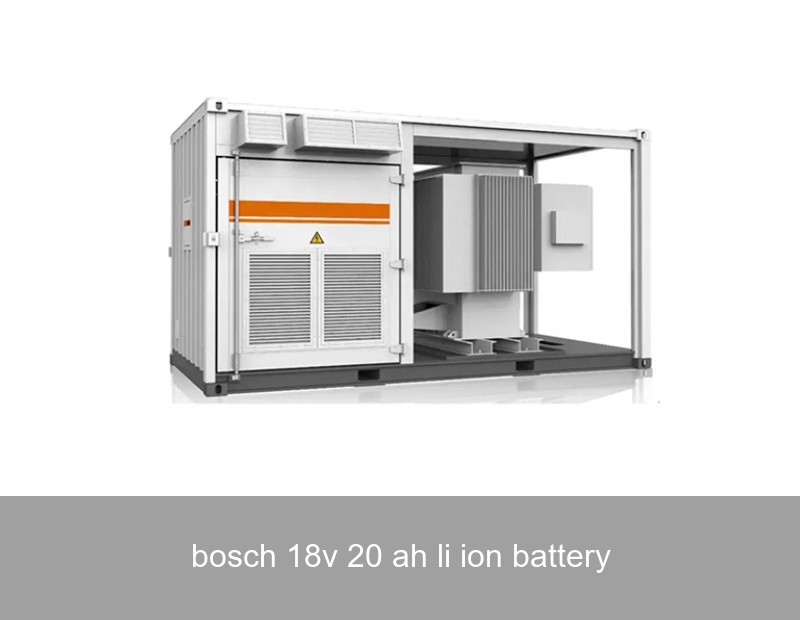
Image Source: Unsplash - A modern battery energy storage system showcasing modular Li-ion cells.
From Tool to Grid: A Case Study in Scalable Storage
The principles perfected in small battery packs are directly informing large-scale solutions. Let's look at a real-world example from the European market.
Case Study: Bavarian Dairy Farm, Germany
A medium-sized dairy farm in Bavaria faced two problems: volatile energy costs and an unreliable grid connection in their rural area. Their solution was to install a 120 kWh on-farm battery storage system, coupled with an existing 80 kW solar array. The system's intelligent BMS, much like the one in your Bosch battery but vastly more complex, does the following:
- Time-Shifting: Stores excess solar energy produced at midday for use in the high-demand evening milking and cooling processes.
- Backup Power: Provides seamless backup power for critical refrigeration during grid outages.
- Load Management: Smooths out power demand spikes from large equipment, avoiding costly peak demand charges from the utility.
The Data-Driven Outcome: Within the first year of operation, the farm reduced its grid electricity purchases by 68% and completely eliminated costs related to power interruptions. Their return on investment is projected within 7 years, thanks to energy savings and available government incentives for renewable integration. This is the scalable power of advanced battery technology in action.
Highjoule Solutions: Industrial-Grade Energy Storage
This is precisely where Highjoule's expertise comes into play. Since 2005, we've been translating the core virtues of reliability, intelligence, and safety—exemplified in premium tool batteries—into large-scale energy solutions. Our systems are built for the demands of commercial, industrial, and microgrid applications.
For instance, our H-Series Commercial Energy Storage platform incorporates a multi-layer BMS that goes far beyond basic functions. It features advanced thermal management for optimal cell life, state-of-health analytics for predictive maintenance, and seamless integration with solar inverters and building management systems. We don't just provide a battery; we provide a complete, intelligent power resilience and optimization platform. Whether it's for a factory looking to cap energy costs or a community microgrid seeking independence, Highjoule systems are engineered with the same philosophy of robust, user-centric design, just at a utility scale.

Image Source: Unsplash - An engineer performing checks on a large-scale battery storage installation.
Expert Insights: The Future of Battery Intelligence
The next frontier isn't just about storing more energy in a smaller space. It's about connectivity and intelligence. Researchers at institutions like The National Renewable Energy Laboratory (NREL) are working on "smart" batteries that can communicate directly with the grid (Grid-Interactive technology). Imagine a future where your home battery, or a fleet of industrial batteries like Highjoule's, automatically responds to grid signals—discharging during periods of high demand to support grid stability and earning revenue for the owner.
This level of integration requires a BMS with sophisticated software and cybersecurity protocols. It's a world away from a simple power tool battery, yet the fundamental goal remains identical: to deliver safe, reliable, and controllable power exactly when and where it's needed.
What Does Your Energy Future Look Like?
So, the next time you pick up your cordless drill powered by its dependable Bosch 18V 2.0 Ah Li-Ion battery, remember that you're holding a miniature version of a technology that is fundamentally reshaping our energy landscape. The question is no longer if battery storage is viable, but how it can be optimized for your specific needs.
Are you a business owner curious about how intelligent storage could shield you from rising energy prices? Or a homeowner with solar panels, wondering how to get the most out of your investment? The journey from understanding the battery in your hand to powering your world sustainably is closer than you think.
 Inquiry
 Online Chat