


Crafting a Winning Business Plan for a Solar Farm: The Indispensable Role of Energy Storage
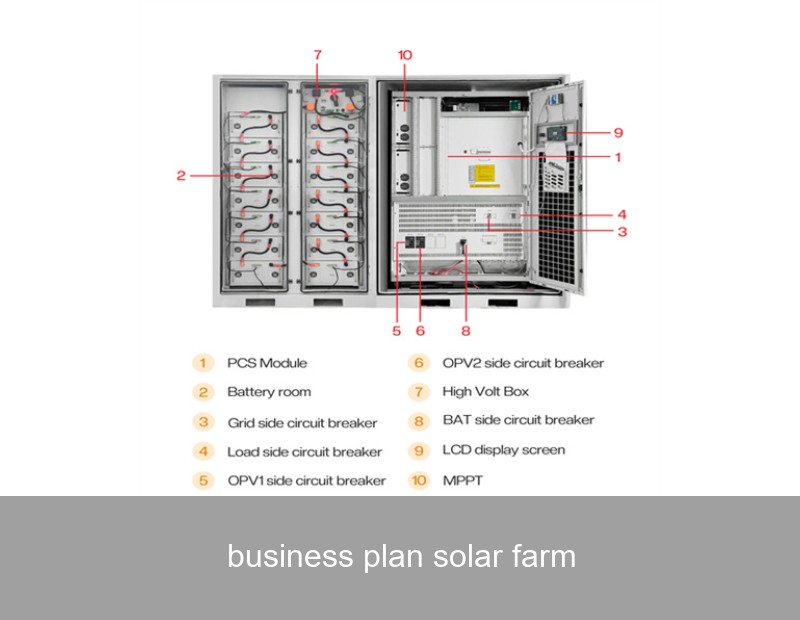
So, you're considering developing a solar farm. The vision is clear: vast arrays of panels harnessing the sun's power, a clean energy future, and a sound financial return. Your initial business plan for a solar farm likely covers land acquisition, panel technology, grid connection, and PPA (Power Purchase Agreement) negotiations. But if that plan stops at the inverter—where DC becomes AC and flows to the grid—you might be missing the most transformative component for profitability and resilience. Let's talk about the game-changer: integrating advanced battery energy storage systems (BESS) from the very blueprint stage.

A modern solar farm's potential is maximized when paired with intelligent storage. (Credit: Unsplash)
The Core Pillar: Why Your Business Plan for a Solar Farm Must Include Energy Storage
The old model of solar was simple: generate when the sun shines, sell it immediately. The modern energy landscape, especially in markets like Europe and the United States, demands more. Grid operators are grappling with volatility from renewable intermittency. This creates a phenomenon known as the "duck curve"—where net demand plummets during peak solar hours and then spikes rapidly as the sun sets. The result? Potential grid instability and, crucially for you, lower wholesale electricity prices during your peak generation hours.
This is where your business plan needs a strategic pivot. An integrated solar-plus-storage facility doesn't just produce energy; it manages and optimizes it. Think of storage as a time-machine for your electrons, allowing you to:
- Shift Energy: Store cheap, midday solar energy and dispatch it during high-price evening peaks.
- Provide Grid Services: Earn additional revenue by offering frequency regulation, voltage support, and capacity reserves to the grid operator.
- Enhance PPA Terms: Offer a firmer, more reliable power profile to offtakers, potentially securing a more attractive long-term contract.
- Future-Proof Your Asset: Mitigate the risk of future grid congestion or curtailment, which can directly impact revenue.
The Data Behind the Strategy
According to a report by the U.S. National Renewable Energy Laboratory (NREL), co-locating storage with solar can increase the project's value by up to 30% compared to standalone solar, depending on market structure and services offered. In the UK and parts of the EU, ancillary service markets for frequency response are creating lucrative, standalone revenue streams for battery assets.
Financial Modeling with Storage: The Real Numbers
Incorporating storage does increase capital expenditure (CapEx). A robust business plan for a solar farm must honestly address this. However, the focus should be on the Net Present Value (NPV) and Internal Rate of Return (IRR) over the project's 20-25 year lifespan. The added CapEx is an investment in revenue diversification and risk mitigation.
| Revenue Stream | Description | Market Example |
|---|---|---|
| Baseload PPA | Sale of smoothed, scheduled solar output. | Corporate offtakers in Germany. |
| Energy Arbitrage | Buy low (store midday solar), sell high (evening peak). | ERCOT (Texas), CAISO (California). |
| Frequency Regulation | Respond to grid frequency fluctuations in milliseconds. | National Grid (UK), PJM (Eastern US). |
| Capacity Market | Payment for guaranteed availability during future peak periods. | UK Capacity Market, ISO-NE (New England). |
Case Study: A 10MW Solar Farm in Texas - With and Without Storage
Let's ground this in a real-world scenario. Consider a 10MWac solar farm in the ERCOT market, Texas.
- Scenario A (Solar-Only): The farm generates ~18,000 MWh/year. It sells power via a PPA at a fixed $35/MWh. Annual revenue: ~$630,000. It faces significant price cannibalization—its own peak output depresses midday prices.
- Scenario B (Solar + 5MW/20MWh BESS): The farm integrates a battery system like Highjoule's GridMax Commercial. It now uses 30% of its generation to charge the battery. It sells 70% under a PPA at $35/MWh ($441,000). The stored energy is dispatched during the 4-hour evening peak, where prices average $75/MWh. Additional arbitrage revenue: ~$328,000/year. Furthermore, it dedicates 1MW of the battery's power to ERCOT's Fast Frequency Response market, earning an estimated $60,000/year. Total estimated annual revenue increase: over 25%.
The storage system, while a CapEx addition, transforms the project's economics and resilience, making it far more attractive to investors seeking durable assets in the energy transition.

Advanced BESS units, like Highjoule's GridMax, are the operational heart of a modern solar farm's profitability. (Credit: Pexels)
Highjoule's Role: Intelligent Storage for Your Solar Business Plan
This is where Highjoule transitions from a component supplier to a strategic partner. Since 2005, we've evolved from providing battery units to delivering integrated, intelligent energy management platforms. For your business plan for a solar farm, our technology provides the critical link between generation and optimized monetization.
Our flagship product for such applications, the GridMax Industrial Series, is more than just a battery container. It's a grid-edge intelligence hub. Its AI-driven energy management system (EMS) doesn't just store and release energy; it continuously analyzes dozens of data points—wholesale electricity prices, grid frequency, weather forecasts, PPA obligations—to make real-time decisions on the most profitable use of every stored kilowatt-hour. This maximizes the multiple revenue streams we discussed earlier.
For developers, this means we help de-risk the storage component. Our services include:
- Feasibility & Sizing Analysis: We work with your team to model the optimal storage size (power and energy) for your specific location and market rules, ensuring your financial projections are built on solid technical ground.
- Technology-Agnostic Advisory: While we offer best-in-class lithium-ion phosphate (LFP) systems for safety and longevity, our expertise helps you evaluate the right technology for your duty cycle and financial model.
- Long-Term Performance Assurance: Our comprehensive O&M (Operations & Maintenance) packages and performance guarantees ensure your storage asset delivers on its financial promise for decades, protecting your IRR.
Key Components of a Modern Solar Farm Business Plan
Let's structure your document. Beyond the standard executive summary and company description, ensure these sections reflect the integrated approach:
1. Market & Regulatory Analysis
Detail the specific opportunities in your target region (e.g., FERC Order 2222 in the US enabling distributed resource aggregation, or the EU's "Fit for 55" package). Cite specific grid service markets. The U.S. Department of Energy publishes excellent regional storage market assessments.
2. Technology & Operational Plan
This section should have two integrated subsections: Solar Generation and Energy Storage & Management. Describe the chosen PV technology, but give equal weight to the BESS specification, its control philosophy, and how the EMS will operate across multiple value streams.
3. Financial Projections
This is the core. Provide a detailed 20-year pro forma with:
- CapEx Breakdown: Clearly itemize solar, storage, balance-of-system, and soft costs.
- Revenue Stack Model: A dynamic model showing contributions from PPA, arbitrage, and grid services. Be conservative with degradation and market saturation.
- Sensitivity Analysis: Show how your NPV/IRR is impacted by changes in key assumptions (e.g., 10% drop in frequency regulation prices, or a 15% increase in battery system cost).
4. Risk Mitigation
Address technology risk (mitigated by partnering with established providers like Highjoule), market price risk (mitigated by revenue stacking), and regulatory risk. Show that storage itself is a primary risk mitigation tool against curtailment and price cannibalization.

Strategic planning and layout, including storage siting, are crucial in the initial design phase. (Credit: Unsplash)
Your Next Step: From Plan to Power
Crafting a compelling business plan for a solar farm is the first critical step in securing land, permits, financing, and offtakers. In today's market, the most compelling plans are those that present solar not as a simple generator, but as a smart, dispatchable, and multifunctional grid asset. The integration of sophisticated energy storage is no longer a "nice-to-have" but a fundamental driver of economic viability and long-term competitiveness.
As you refine your financial models and technological assumptions, consider this: What specific revenue stack combination in your target market would make your solar-plus-storage project not just viable, but irresistibly attractive to the most discerning infrastructure investors?
 Inquiry
 Online Chat