


Understanding the Cell Block: The Core Building Unit of Your Lithium Ion Battery
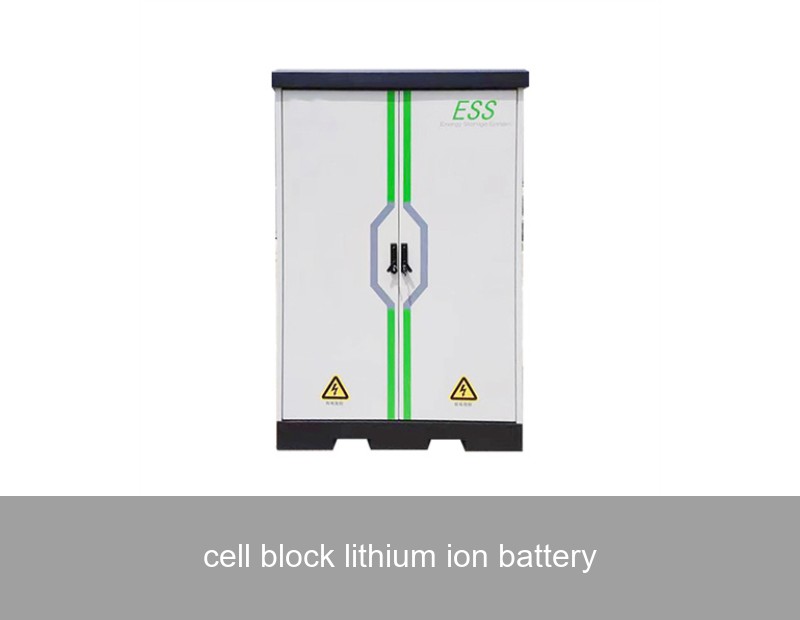
When discussing energy storage, we often hear about the battery as a whole—its capacity in kilowatt-hours (kWh) or its power rating in kilowatts (kW). But for engineers and performance-driven users, the real magic—and the key to safety, longevity, and efficiency—lies one level deeper. Let's talk about the fundamental building block: the cell block lithium ion battery unit. Think of it not just as a cluster of cells, but as the heart's ventricle, a precisely engineered subsystem that determines the overall health of the entire energy storage system.
You see, a single lithium-ion cell, like the common 18650 or prismatic cell, is a power-packed but vulnerable unit. By itself, it's not particularly useful for large-scale storage. That's where the cell block comes in. It's the critical intermediate assembly where individual cells are connected in series and parallel configurations, housed with monitoring and management electronics, and physically secured to form a manageable, scalable, and safe power module. The design philosophy behind this block is what separates a basic battery from a high-performance, reliable asset.
Why Cell Block Architecture Matters: From Phenomenon to Performance
Let's break down the "why" using a logical step-by-step approach.
The Phenomenon: The Challenge of Scaling Up Single Cells
Imagine trying to power a factory or a commercial building with thousands of loose AA batteries. It's chaotic, inefficient, and a thermal nightmare. The same principle applies to lithium-ion cells. Simply connecting hundreds of them together without a thoughtful, modular architecture leads to several observable problems:
- Thermal Runaway Risk: Heat from one failing cell can propagate unchecked to its neighbors.
- Performance Imbalance: Small variations in individual cells lead to reduced overall capacity and lifespan (the "weakest link" effect).
- Maintenance Headache: Identifying and replacing a single faulty cell in a massive, tangled array is costly and disruptive.
The Data: How Design Dictates Longevity
Research and industry data consistently highlight the impact. A study highlighted by the National Renewable Energy Laboratory (NREL) emphasizes that battery degradation is heavily influenced by temperature gradients and state-of-charge imbalances within the pack—factors directly managed at the cell block level. For instance, a temperature differential of just 5°C across a block can accelerate capacity fade by up to 20% over time compared to a thermally uniform block.
| Design Factor | Poorly Managed Block | Well-Engineered Block |
|---|---|---|
| Thermal Gradient | > 5°C | < 2°C |
| Capacity Utilisation | ~70-80% (due to imbalance) | > 95% |
| Projected Cycle Life (to 80% capacity) | 3,000 - 4,000 cycles | 6,000+ cycles |
A Real-World Case Study: The Power of Intelligent Cell Block Design
Let's look at a concrete example from our target market. A mid-sized dairy processing plant in Bavaria, Germany, faced unpredictable demand charges and sought to increase its energy resilience with solar-plus-storage. Their primary concern was not just upfront cost, but total cost of ownership over a 15-year period. They needed a system that could handle two charge/discharge cycles daily without significant degradation.
The solution deployed utilized a commercial battery energy storage system (BESS) built on advanced cell block lithium ion battery architecture. Each cell block was an independent, sealed unit featuring:
- Integrated, cell-level voltage and temperature monitoring.
- Active liquid cooling channels running between cells to maintain the optimal 25°C ±2°C.
- A dedicated block-level controller that communicated with the main BMS.
Image: Example of modern battery module assembly with thermal management. Credit: Unsplash (Representative image)

The result? After 18 months of operation, data logging showed a capacity fade of less than 1.5%, putting it on track to exceed its 10-year warranty with significant margin. The plant manager noted, "The predictability is as valuable as the savings. We know exactly what the system can deliver, shift after shift." This case underscores that intelligent cell block design isn't an engineering luxury; it's a financial imperative for commercial and industrial applications.
The Highjoule Approach: Intelligent Cell Blocks for Demanding Applications
At Highjoule, with nearly two decades of experience since 2005, we've built our reputation on this foundational understanding. We don't just source cells and pack them together; we engineer the cell block as the core determinant of system performance.
Our H-Series commercial and industrial storage systems are built around our proprietary IntelliBlock™ architecture. What does this mean for you?
- Modular Safety: Each IntelliBlock is a fire-rated enclosure with internal fire-retardant materials and thermal isolation barriers. This design inherently contains any single-cell event, preventing cascade failure.
- Granular Health Insights: Our block-level monitoring goes beyond standard BMS, providing actionable data on individual cell impedance trends. This allows for predictive maintenance, not just fault detection.
- Seamless Scalability: Need to expand your storage capacity? Our systems are designed for plug-and-play addition of pre-configured, pre-tested cell blocks, dramatically reducing installation complexity and cost.
This philosophy extends to our residential EchoHome and microgrid solutions, ensuring that whether you're powering a home or stabilizing a community grid, the fundamental power unit is robust, efficient, and smart. For us, the cell block lithium ion battery is the canvas on which we paint reliability.
Future Trends: Where is Cell Block Technology Headed?
The evolution is towards even greater integration and intelligence. We're moving from "dumb" blocks that simply hold cells to "smart power nodes." The next generation of cell block designs will likely incorporate:
- DC-DC Conversion at the Block Level: Allowing for optimal charging of each block independently, maximizing energy harvest from solar arrays even under partial shading.
- Cell Chemistry Agnostic Design: Modular blocks that can accommodate future advancements, like solid-state or silicon-anode cells, without redesigning the entire system.
- Enhanced Second-Life Readiness: Blocks designed with embedded health passports (digital twins) to streamline their validation and reuse in less demanding applications after their first life, a concept supported by circular economy research from entities like the Ellen MacArthur Foundation.
Image: Technician working on advanced battery module assembly. Credit: Unsplash (Representative image)

So, as you evaluate storage solutions for your business or community, look beyond the brochure's top-level specs. Ask your provider: "How is your cell block lithium ion battery unit designed to manage heat, ensure balance, and protect my investment over the next decade?" The depth of their answer will reveal everything you need to know about the system's true quality.
What specific operational challenge in your energy profile—be it demand charge spikes, renewable intermittency, or backup power needs—could be most directly solved by rethinking the foundation of your storage, one cell block at a time?
 Inquiry
 Online Chat