


Unlocking Solar Longevity: The Critical Role of the Cell Chronic Solar Inverter
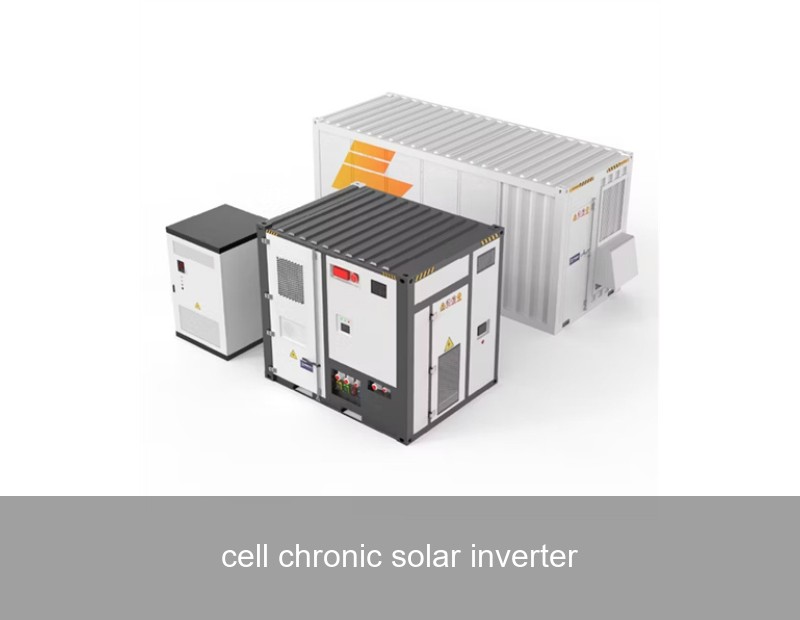
Have you ever wondered why two seemingly identical solar installations, after a decade, can have wildly different performances? One might still be humming along at 95% capacity, while the other is struggling to hit 80%. The secret often lies not just in the panels themselves, but in the brain of the system: the inverter. More specifically, its ability to manage the long-term, chronic health of each individual solar cell. This is where the concept of a cell chronic solar inverter becomes paramount. It's not just about converting DC to AC; it's about intelligent, ongoing care for the very heart of your photovoltaic array.
Table of Contents
The Silent Issue: Cell-Level Degradation
Picture a chain of holiday lights. When one bulb goes out, the entire string can fail. Traditional string inverters treat a solar panel array similarly. They optimize the power for the whole string, but if one panel—or worse, one cell within a panel—is underperforming due to shading, soiling, micro-cracks, or early degradation, the output of every other panel in that string is dragged down to the lowest level. This is a chronic condition, a slow bleed of energy and revenue over the 25+ year lifespan of your system.
A cell chronic solar inverter philosophy addresses this by focusing on the health of the smallest unit: the photovoltaic cell. Chronic issues like Potential-Induced Degradation (PID), snail trails, and cell mismatch start small but compound over time. An inverter system designed with this in mind doesn't just passively convert power; it actively diagnoses and mitigates these issues at their root.
The Data Reality: Why Module-Level Monitoring Isn't Enough
Many modern systems use power optimizers or microinverters to tackle module-level problems. This is a great step forward. But consider this data point: a study by the National Renewable Energy Laboratory (NREL) indicates that cell-level mismatch within a single module can cause losses of up to 10% even when the module-level output appears normal. That's energy literally disappearing in the internal circuitry of the panel, invisible to module-level monitoring.
| Problem Type | Traditional String Inverter Impact | Advanced Cell-Aware Inverter Impact |
|---|---|---|
| Partial Shading (on 2-3 cells) | Whole string performance reduced | Isolated impact; system re-optimizes around it |
| Cell Micro-Crack (Chronic) | Gradual, undetected string-level loss | Identified, localized, and power output adjusted to prevent hotspotting |
| Potential-Induced Degradation (PID) | Can affect multiple modules severely, often requiring costly fixes | Proactive PID reversal algorithms applied at the inverter level to protect cells |
The Inverter Evolution: From String to Chronic Care Specialist
The journey of solar inverter technology is one of increasing granularity and intelligence:
- String Inverters: The "general practitioner" for the whole array. Effective for uniform, unshaded sites but blind to individual component health.
- Microinverters & Power Optimizers: The "module specialists." They solve module-level mismatch and shading superbly, providing excellent visibility.
- Cell Chronic Solar Inverter Systems: The "preventive care physicians." This represents the next logical step—a system that uses advanced power electronics and AI-driven analytics to understand the *chronic* state of the solar array's fundamental building blocks. It goes beyond harvesting today's maximum power to ensuring tomorrow's reliability.

Image Source: Unsplash (Representative image of advanced inverter technology)
The Highjoule Approach: Prolonging Solar Vitality
At Highjoule, we engineer this philosophy into our core. Our Helios 360 advanced hybrid inverter system is built with the long-term chronic health of your solar investment in mind. It integrates several key features:
- Sub-Module MPPT Tracking: Our technology can identify and compensate for performance discrepancies not just between panels, but within panels, neutralizing the effects of cell-level chronic issues.
- Chronic Analytics Engine: The inverter continuously learns your system's "health baseline." It doesn't just alert you to a sudden drop in output; it flags gradual, chronic declines in specific zones of your array that could indicate early-stage PID, soiling buildup, or connection wear.
- Proactive PID Management: The Helios 360 can automatically apply corrective voltage at night to reverse the effects of Potential-Induced Degradation, a chronic issue that silently saps cell efficiency, particularly in humid climates or with certain panel types.
When paired with Highjoule's integrated battery storage, the system becomes even more potent. It allows for intelligent energy routing, ensuring that every kilowatt-hour generated by your carefully maintained cells is stored or used with maximum efficiency, creating a truly resilient and sustainable energy ecosystem for your home or business.
Case Study: A European Commercial Rooftop's Recovery
Let's look at a real-world application. A 250 kW rooftop solar installation on a logistics warehouse in Northern Germany, operational since 2018, was showing a 15% underperformance against initial projections by 2023. Standard monitoring pointed to "normal degradation."
A retrofit with a Highjoule Helios 360 system, replacing the old central inverter, changed the narrative. Within a week, the system's analytics pinpointed not one, but three chronic issues:
- Severe PID in the southern-facing string arrays.
- Multiple modules with significant cell-level mismatch (likely from minor transport damage years prior).
- A growing resistance in a central junction box.
The Helios 360's PID reversal function was activated. The system then re-optimized the entire array, bypassing the worst-performing cells within modules virtually. The junction box issue was flagged for physical repair. The result: Within two months, the system recovered 11.5% of its lost output, bringing it to within 96% of its original projected yield. This translated to an additional 8,200 kWh of clean energy generated in the first quarter post-upgrade, securing thousands of euros in regained revenue and proving the value of a chronic-care approach.

Image Source: Unsplash (Representative image of a commercial solar installation)
Future-Proofing Your Investment
Choosing a solar inverter today is a decision that will resonate for decades. As the International Energy Agency (IEA) consistently highlights, the reliability and longevity of renewable assets are critical to meeting global net-zero targets. Opting for a system with a cell chronic solar inverter mindset is an investment in durability and sustained yield.
It's about asking a deeper question: Do you want a system that simply converts sunlight, or one that actively nurtures and protects its ability to do so for its entire lifespan? With climate patterns becoming more extreme, ensuring every cell in your array is operating optimally is no longer a luxury—it's a necessity for maximizing ROI and environmental impact.
Ready to Diagnose the Health of Your Solar Investment?
Could your solar array be suffering from silent, chronic cell-level issues that are eroding your expected returns? What would recovering even 5-10% of your system's lost performance mean for your energy bills or sustainability goals this year, and over the next fifteen?
 Inquiry
 Online Chat