


Commercial ESS: How Much Does It Really Cost? A Real-World Breakdown
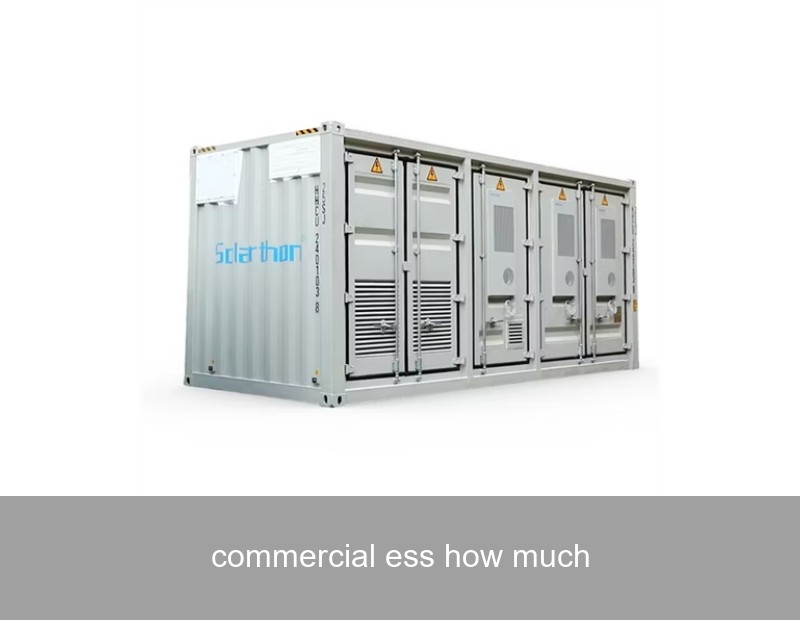
If you're a business owner, facility manager, or energy consultant looking into energy storage, the first question is almost always: "A commercial ESS, how much?" It's the right question to ask, but the answer is rarely a simple number on a price tag. The cost of a Commercial Energy Storage System (ESS) is an equation, balancing upfront investment against decades of operational savings, resilience, and sustainability benefits. In this guide, we'll move beyond the sticker shock and break down the true cost components, showcase real data, and help you understand the value proposition of modern storage solutions from providers like Highjoule.
Table of Contents
The Real Cost Components of a Commercial ESS
Think of a commercial ESS not just as a battery box, but as an intelligent energy asset. The total installed cost encompasses several layers:
- Core Hardware: This includes the battery modules (typically lithium-ion, with LFP chemistry now dominating for safety and longevity), the battery management system (BMS), power conversion system (PCS/inverters), and the thermal management system. This bundle often represents 40-60% of the upfront cost.
- Balance of System (BOS): This is the "everything else" – wiring, conduits, safety disconnects, switchgear, and the physical enclosure or containerization.
- Software & Intelligence: The brain of the operation. Advanced energy management software (EMS) is what transforms stored energy into savings by automating when to charge (from the grid or solar) and when to discharge based on utility rates, demand charges, and on-site needs.
- Installation & Labor: Costs vary significantly by region, site complexity, electrical infrastructure, and permitting requirements. A retrofit into an existing facility may be more involved than integrating into a new build.
- Ongoing Costs & Value: Don't forget operations and maintenance (O&M), potential warranty extensions, and software subscription fees for advanced features. Crucially, this is where value streams like demand charge reduction, energy arbitrage, and grid services revenue offset costs.

Image: A modern commercial battery storage installation requires careful planning and integration. Source: Unsplash (Representative image)
Key Factors That Determine "How Much?"
To get a meaningful estimate, you need to assess your specific context. Here are the primary levers:
| Factor | Impact on Cost | Questions to Ask |
|---|---|---|
| System Size (kWh & kW) | The primary cost driver. Larger capacity (kWh) and power output (kW) mean higher hardware costs. | What are my peak demand (kW) shaving needs and desired backup duration (hours)? |
| Site-Specifics & Interconnection | Complex electrical upgrades or long-distance cable runs can add 20-30%+ to installation costs. | Is my main service panel ready? How far is the proposed ESS location from the point of interconnection? |
| Technology & Vendor | Established, high-quality providers like Highjoule may have a higher initial cost but offer superior longevity, safety, and software intelligence, leading to better lifetime value. | Does the system use proven, cycle-stable LFP chemistry? Is the software platform future-proof and grid-responsive? |
| Local Incentives & Regulations | Can drastically reduce net cost. In the US, the Investment Tax Credit (ITC) now covers standalone storage. EU nations have various grants and subsidies. | What national or utility-specific incentives are available in my region (e.g., Germany's BAFA, or California's SGIP)? |
Case Study: A European Logistics Center Saves Big
Let's move from theory to practice. A major logistics company operating a 100,000 sq. ft. distribution center in Germany faced volatile energy costs and high "peak demand charges" – fees based on their highest 15-minute power draw each month. Their goal: reduce operational costs and increase on-site renewable consumption.
The Solution & Data: They partnered with Highjoule to deploy a 500 kWh / 250 kW containerized ESS, integrated with their existing rooftop solar PV. The Highjoule system's AI-driven EMS was programmed to strategically discharge the batteries during short periods of peak facility demand and to store excess solar energy for use in the evening.
- Upfront Installed Cost: ~€280,000 (pre-incentive).
- German Federal Incentive (BAFA): ~€75,000 grant.
- Net Project Cost: ~€205,000.
- Annual Savings: The system delivers €68,000 in annual savings through a combination of demand charge reduction and optimized solar self-consumption.
- Simple Payback Period: Just over 3 years. For a system with a 15-year design life, this represents over a decade of nearly pure financial gain and enhanced energy security.
This case highlights that the critical metric isn't just "commercial ESS how much?" but "what is my net cost after incentives, and what is my annual return?"
The Highjoule Approach: Maximizing Your Investment
Since 2005, Highjoule has focused on delivering intelligent storage that prioritizes lifetime value over just low initial cost. Our systems are engineered for the commercial and industrial sector's rigorous demands.
Our H-Series C&I ESS is a modular, containerized solution that simplifies deployment. It features:
- Ultra-Safe LFP Battery Chemistry: Non-flammable, with a lifespan exceeding 6,000 cycles, ensuring your asset pays back for decades.
- Highjoule Apex EMS™: This is where the magic happens. Our proprietary software continuously analyzes utility rate structures (like time-of-use and demand rates), weather forecasts, and on-site load patterns to make real-time, revenue-optimizing decisions. It can even participate in grid flexibility programs where available.
- Seamless Integration: Designed to work with both new and existing solar PV installations, and easily interfaces with building management systems.
We provide end-to-end support from initial feasibility and financial modeling to commissioning and long-term performance monitoring, ensuring your system delivers on its promised financial and operational goals.

Image: Advanced energy management software is key to unlocking savings. Source: Unsplash (Representative image)
Understanding Your ROI Timeline
The payback period for a commercial ESS can range from 3 to 7 years, heavily influenced by your local electricity rates and incentive landscape. In regions with high demand charges or volatile pricing, like California or parts of the UK, ROI accelerates.
Consider this: The International Energy Agency (IEA) notes that battery costs have fallen by over 90% in the last decade, while grid volatility is increasing. This convergence makes storage more attractive than ever. The true cost of not having storage includes continued exposure to peak demand penalties, grid outage downtime, and missed sustainability targets.
Your Next Step: From Cost Question to Value Answer
So, "commercial ESS, how much?" The most honest answer is: "It depends, but let's calculate it for your facility." The journey starts with a detailed analysis of your last 12-24 months of utility bills to identify your unique load profile and cost-saving opportunities.
What specific pain point is driving your interest in energy storage – is it reducing a particular line item on your utility bill, ensuring backup power for critical operations, or achieving a corporate carbon reduction goal? Sharing this goal is the first step toward a solution that makes financial sense.
 Inquiry
 Online Chat