


How Much Solar Power Can Your Stockholm Home Really Generate?
As a Stockholm homeowner, you've likely noticed more solar panels appearing on rooftops across the city, from Södermalm to Bromma. The question isn't just about joining the green trend—it's a practical one: how much solar energy can you realistically produce in Stockholm's unique climate? The answer might surprise you. While the "Land of the Midnight Sun" imagery belongs to the far north, Stockholm, with its long summer days and increasing solar hours, presents a compelling case for photovoltaic (PV) investment. Let's move beyond guesswork and dive into the data, real-world examples, and modern technology that make solar in Stockholm not just viable, but highly intelligent.
Table of Contents
- Stockholm's Solar Potential: Beyond the Latitude
- Key Factors Determining Your Solar Yield
- A Real Stockholm Case Study: The Västerort Home
- Maximizing Return: The Critical Role of Energy Storage
- The Highjoule Solution: Smart, Integrated Storage for Nordic Climates
- Your Solar Journey: What's the Next Step?
Stockholm's Solar Potential: Beyond the Latitude
Yes, Stockholm lies at approximately 59°N, a latitude that suggests limited sun. However, solar potential is measured in kilowatt-hours (kWh), not just sunshine. Thanks to long, bright summer days compensating for dark winters, and remarkably clean air, Stockholm's solar irradiance is effective. According to the European Commission's PVGIS tool, a typical south-facing, optimally tilted rooftop solar installation in Stockholm can generate around 850-950 kWh per kilowatt-peak (kWp) of installed capacity annually. For a standard 10 kWp system, that's roughly 9,000 kWh per year—a significant portion of the average Swedish household's electricity consumption, which Statistics Sweden (SCB) places at about 8,000-10,000 kWh annually.

Image: Rooftop solar installations are increasingly common in Stockholm's neighborhoods. Source: Wikimedia Commons.
Key Factors Determining Your Solar Yield
Understanding your specific potential requires looking at a few critical variables:
- Roof Orientation & Tilt: A south-facing roof with a 30-45 degree tilt is ideal. East/West orientations can still achieve 80-85% of optimal yield, offering flexibility.
- Shading: This is a major yield killer. Trees, chimneys, or neighboring buildings that cast shadows, especially during the low winter sun, can dramatically reduce output.
- System Size & Panel Efficiency: Modern monocrystalline panels convert more than 22% of sunlight into electricity, making excellent use of available light. The size of your system should match your electricity consumption profile.
- Technology Choice: This is where the real magic happens. The panels themselves are only part of the equation. To truly capitalize on every kilowatt-hour you produce, integrating a smart battery storage system is the game-changer for Nordic climates.
A Real Stockholm Case Study: The Västerort Home
Let's look at concrete data from a 2023 installation in a detached house in Västerort. The homeowners installed a 12.8 kWp solar array on their south-east/west hybrid roof. They paired it with a 13.5 kWh capacity battery storage system from the outset.
| Metric | Result (First Full Year) | Impact |
|---|---|---|
| Total Solar Generation | 11,200 kWh | Exceeded annual household consumption (~10,500 kWh). |
| Self-Consumption Rate (without storage) | ~35% | 65% of generated power would have been exported to the grid at a lower price. |
| Self-Consumption Rate (with storage) | ~85% | The home used the vast majority of its own clean energy on-site. |
| Grid Independence During Peak Hours | Nearly 100% | The battery covered evening loads after sunset, avoiding expensive peak tariffs. |
"The battery wasn't an extra; it was the brain of the system," the homeowner noted. "Our goal wasn't just to produce energy, but to control it. On a bright July day, we fill the battery by midday and run the house, charge the EV, and even pre-heat the sauna on pure solar. In December, the battery intelligently stores cheap overnight wind power to offset daytime use." This case highlights that the question isn't just 'how much solar,' but 'how well can you use what you generate?'
Maximizing Return: The Critical Role of Energy Storage
As the case study shows, a solar system without storage in Stockholm often leads to a surplus exported to the grid in summer and a deficit requiring imports in winter. With dynamic electricity prices and varying buy-back (överföringspris) rates, this can erode your financial and energy independence goals. A battery storage system flips this model:
- Increase Self-Consumption: Store daytime excess for use in the evening, dramatically boosting the value of each kWh you produce.
- Provide Backup Power: A critical benefit during grid outages, ensuring your home remains powered.
- Enable Smart Energy Management: Advanced systems can integrate with heat pumps and EV chargers, and even participate in grid-balancing services in the future.
The Highjoule Solution: Smart, Integrated Storage for Nordic Climates
This is where Highjoule's expertise becomes pivotal. Since 2005, we have specialized in designing battery energy storage systems (BESS) that are not just hardware, but intelligent energy platforms. For Stockholm homeowners, our ResiCore ESS is engineered to thrive in your specific context.
The ResiCore isn't just a battery box. It's an integrated system featuring our proprietary Adaptive Charge OS, which uses predictive weather data and electricity price forecasts to autonomously optimize your energy flow. Should it store solar excess, charge from the grid during low-cost overnight hours, or hold capacity for an expected peak demand period? It makes these decisions seamlessly.

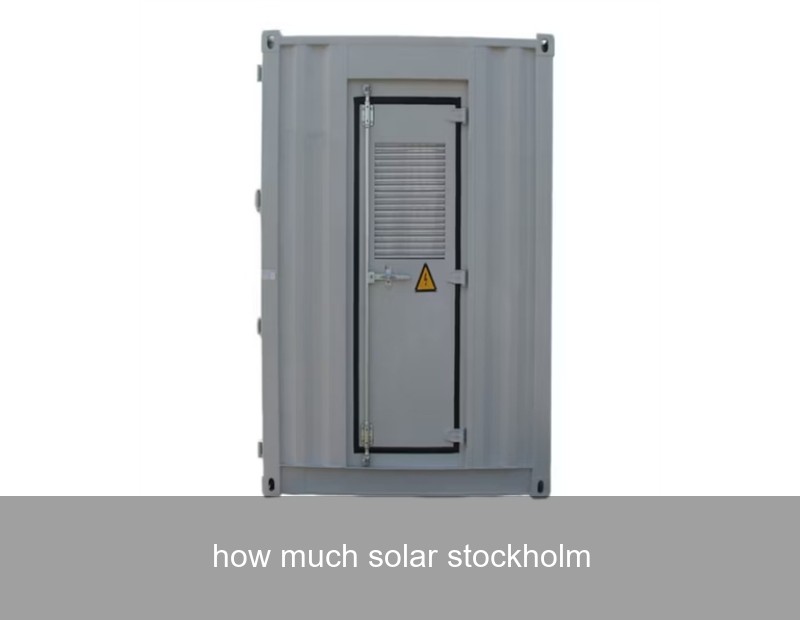
Image: A modern, compact home battery storage system like Highjoule's ResiCore, typically installed in a garage or utility room.
Our systems are built with lithium iron phosphate (LFP) battery chemistry, renowned for its safety, long cycle life (10,000+ cycles), and stable performance across the temperature range of a Swedish year—from humid summers to freezing winters. We provide a complete solution: expert site assessment, seamless integration with your chosen solar panels, professional installation, and remote monitoring via our user-friendly Highjoule Hub app.
For larger properties, commercial operations, or even community microgrids in the Stockholm archipelago, our scalable GridMax Industrial BESS solutions provide the same intelligence at a greater scale, ensuring reliability and sustainability.
Your Solar Journey: What's the Next Step?
So, back to your original question: how much solar can you generate in Stockholm? The technical potential is solid, but your personal potential is defined by your roof, your consumption, and most importantly, your ability to store and manage the energy you produce. The modern solar investment in Sweden is inherently a solar-plus-storage investment.
Instead of just getting a quote for panels, we encourage you to ask installers: "What is the estimated self-consumption rate for my proposed system, and how can a storage system like Highjoule's ResiCore improve it to maximize my independence and return?"
What specific energy goal is driving your interest in solar—is it reducing your electricity bill, achieving energy security, or minimizing your carbon footprint—and how might a smart storage system help you achieve that goal faster?
 Inquiry
 Online Chat